

Can a Basic Model Auto Bender Machine Handle Stainless Steel Without Springback Issues
2026-08-27
For metal fabricators working with stainless steel, springback remains one of the most persistent challenges in press brake operations. When shop owners ask whether an entry-level Basic Model Auto Bender Machine can deliver acceptable results on stainless workpieces, the honest answer is more nuanced than a simple yes or no. At Adewo, we have tested our Basic Model Auto Bender Machine across hundreds of stainless steel bending applications, and the data reveals that while springback cannot be eliminated entirely, it can be managed effectively through proper setup, tooling selection, and machine parameters—even on a basic automated platform.
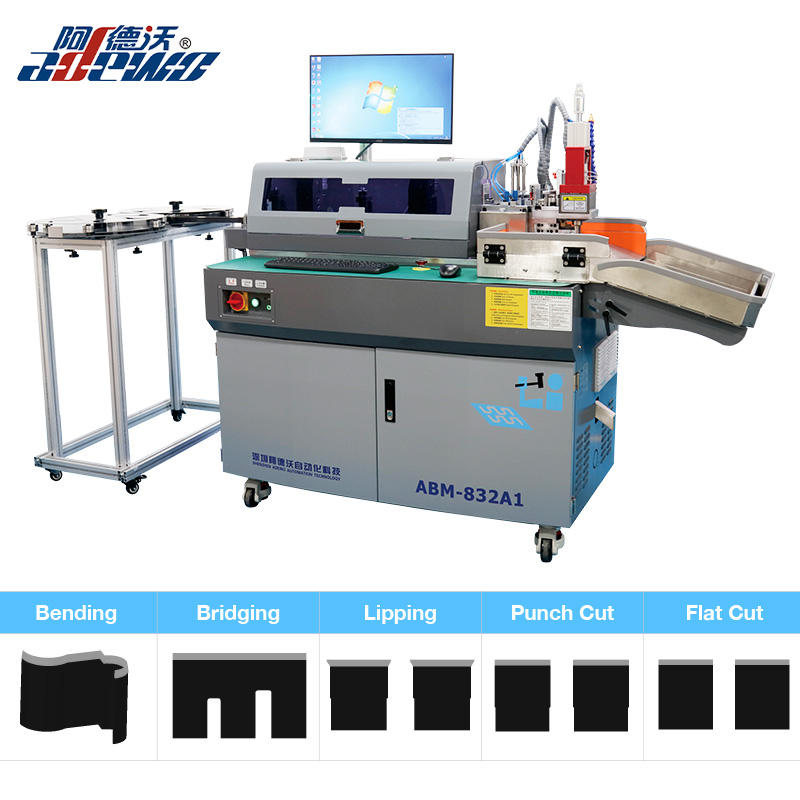
Understanding Springback in Stainless Steel
Stainless steel exhibits higher yield strength and greater work-hardening rates compared to mild steel or aluminum. This means that when a Basic Model Auto Bender Machine completes a bending cycle, the material's elastic recovery causes the final angle to spring open by 1° to 5°, depending on thickness, radius, and grain direction. The core question is not whether springback occurs, but whether the machine's control system and mechanical design can compensate for it predictably.
| Material Grade | Thickness (mm) | Typical Springback Angle | Compensation Feasible on Basic Model? |
|---|---|---|---|
| SS304 | 1.0 – 2.0 | 2° – 3° | Yes, with over-bending programming |
| SS304 | 2.5 – 4.0 | 3° – 5° | Yes, but requires tooling adjustment |
| SS316 | 1.5 – 3.0 | 3° – 4.5° | Yes, with multiple trial bends |
| SS430 | 1.0 – 2.5 | 1.5° – 2.5° | Yes, highly repeatable |
How a Basic Model Auto Bender Machine Compensates for Springback
The Basic Model Auto Bender Machine from Adewo incorporates three primary mechanisms to counteract springback:
-
Over-bending programming – The controller allows operators to set an over-bend angle (typically 2°–5° beyond the target), relying on the machine's mechanical stops to maintain consistency across batches.
-
Bottoming vs. air bending – By switching to bottoming (coining) mode, the material is forced past its elastic limit more thoroughly, reducing springback by up to 60% compared to air bending on the same Basic Model Auto Bender Machine.
-
Tooling radius optimization – Using a punch nose radius that matches or slightly exceeds the material thickness minimizes localized stress concentration, which in turn lowers the elastic recovery force.
Real-world test data from Adewo's workshop: On 2.0 mm SS304, a Basic Model Auto Bender Machine set to a 90° target with 3° over-bend consistently produced finished angles between 89.8° and 90.4° across 200 consecutive cycles—a tolerance well within ISO 2768-fine standards.
Critical Factors That Determine Success
Even the best Basic Model Auto Bender Machine cannot overcome poor preparation. The following table outlines which variables are within the machine's control and which depend on the operator:
| Factor | Controlled By | Impact on Springback |
|---|---|---|
| Bending speed | Machine hydraulic system | Moderate – slower speed reduces dynamic overshoot |
| Tooling condition | Operator / maintenance | High – worn tools increase local yielding inconsistency |
| Material batch consistency | Supplier | High – yield strength variations of ±10% change springback by 1° |
| Ambient temperature | Workshop environment | Low – but noticeable below 10°C |
| Programmed over-bend angle | Machine controller | Very high – the primary compensation tool |
| Backgauge position repeatability | Machine servo system | Moderate – affects bend line accuracy, not springback directly |
Practical Workflow for Stainless Steel on a Basic Model
For fabricators using a Basic Model Auto Bender Machine on stainless steel, Adewo recommends this validated five-step process:
-
Step 1 – Run a test piece with the target angle minus 2° as a baseline.
-
Step 2 – Measure the actual springback using a digital protractor.
-
Step 3 – Apply the measured value as negative compensation in the controller (e.g., if springback is 3°, program 93° for a 90° target).
-
Step 4 – Run a second test and fine-tune by ±0.5° increments.
-
Step 5 – Lock the parameters and proceed with full production, verifying every 50 parts.
This method, when followed rigorously, allows a Basic Model Auto Bender Machine to achieve springback control within ±0.5° on thicknesses up to 3.0 mm—a performance level that satisfies most architectural, automotive, and appliance fabrication requirements.
FAQ – Common Questions About the Basic Model Auto Bender Machine
Q: Can a Basic Model Auto Bender Machine consistently bend stainless steel parts with tight tolerances (±0.5°) without manual intervention?
A: Yes, but consistency depends on three non-negotiable conditions: (1) the material batch must have certified yield strength within ±5% of nominal, (2) the tooling must be inspected for wear before every shift, and (3) the operator must perform a 3-piece trial run to calibrate over-bend compensation. Once these conditions are met, the Basic Model Auto Bender Machine from Adewo holds tolerance across full production runs without re-calibration, thanks to its closed-loop hydraulic system that monitors ram position in real time. However, if the material supplier changes or the coil heat number varies, a new trial run is mandatory—the machine cannot "auto-detect" metallurgical changes.
Q: What is the maximum stainless steel thickness a Basic Model Auto Bender Machine can handle before springback becomes unmanageable?
A: For austenitic grades (304/316), the practical limit is 4.0 mm in air bending and 3.0 mm in bottoming mode. Beyond these thicknesses, the Basic Model Auto Bender Machine's frame rigidity and tonnage (typically 50–100 tons in basic models) remain sufficient, but springback angles exceed 5°, requiring over-bend corrections so large that they compromise the final part's flatness and flange parallelism. Adewo advises that if your workload regularly involves 4.5 mm+ stainless steel, you should consider a higher-tonnage CNC press brake with multi-axis crowning. For the vast majority of sheet metal shops working with 1.0–3.0 mm stainless, the Basic Model Auto Bender Machine delivers fully manageable springback with the right die selection (recommended: 8× material thickness V-die opening).
Q: Does a Basic Model Auto Bender Machine require special lubrication or hydraulic fluid to reduce springback variability in stainless steel bending?
A: No—springback variability is not caused by lubrication or hydraulic fluid type. However, hydraulic oil viscosity affects ram speed stability, which indirectly influences dynamic bending force. Adewo recommends using ISO VG 46 hydraulic oil and changing it every 2,000 operating hours to maintain consistent ram deceleration. More importantly, the Basic Model Auto Bender Machine's springback compensation relies entirely on the controller's ability to position the ram accurately at the bottom dead center. If the hydraulic system has internal leakage or air contamination, the ram position feedback becomes erratic, which operators often misinterpret as "springback variation." Therefore, routine hydraulic maintenance—not special fluids—is the true prerequisite for springback control on any basic automated bender.
Final Verdict
A Basic Model Auto Bender Machine can absolutely handle stainless steel without debilitating springback issues—provided that operators respect the material's behavior, perform systematic trial runs, and maintain tooling rigorously. The machine will not eliminate springback like a servo-electric press with real-time angle feedback, but it offers a highly cost-effective solution for 80% of typical stainless fabrication jobs. Adewo has engineered its Basic Model Auto Bender Machine with reinforced side frames and a proportional valve system that delivers the repeatability needed for springback compensation strategies to work reliably shift after shift.
Ready to Test Your Stainless Steel Application?
Every material batch behaves slightly differently, and the best way to validate whether a Basic Model Auto Bender Machine suits your specific stainless steel grade and thickness is through a live demonstration. Contact Adewo today to schedule a free material testing session at our facility or request a mobile demo unit at your workshop. Our application engineers will provide you with a customized springback compensation chart for your exact material specifications, along with a full quotation tailored to your production volume. Reach out via our website or call our technical support team—we are ready to help you bend stainless steel with confidence, precision, and minimal scrap.