

Can a Belt Turnover Machine Handle Both Fabric and Steel-Cord Conveyor Belts
2026-07-01
When bulk material handling systems require a 180° belt flip to keep the carrying side clean and prevent spillage, the Belt Turnover Machine becomes an indispensable component. But a critical question haunts many plant engineers and maintenance managers: Can a single Belt Turnover Machine reliably handle both fabric‑ply belts and heavy steel‑cord belts? At Fortran, we have engineered turnover solutions for over two decades, and the short answer is yes—but with crucial design distinctions. This blog breaks down the technical realities, compatibility factors, and best practices to help you select the right Belt Turnover Machine for your mixed‑belt environment.
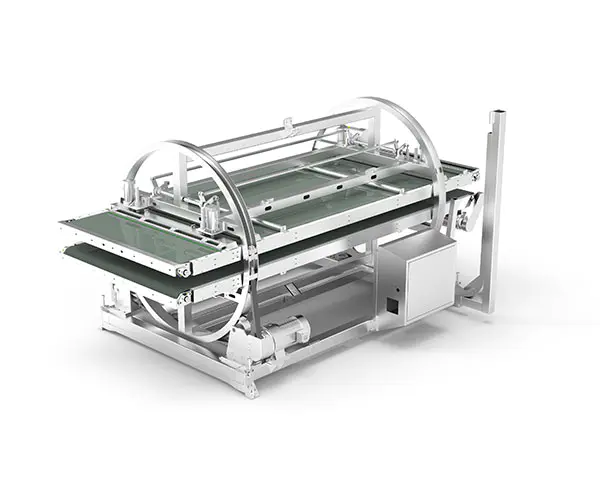
Understanding the Core Difference: Fabric vs. Steel‑Cord Belts
Before evaluating whether a Belt Turnover Machine can serve both belt types, we must understand their mechanical personalities.
| Belt Characteristic | Fabric‑Ply Belt | Steel‑Cord Belt |
|---|---|---|
| Tensile modulus | Low to medium (elastic) | Very high (stiff, low elongation) |
| Minimum pulley diameter | Smaller (300–600 mm) | Larger (800–1,200+ mm) |
| Flexural rigidity | Flexible, easy to twist | Rigid, resists twisting |
| Tracking sensitivity | Moderate | Highly sensitive to misalignment |
| Splice type | Mechanical or vulcanized | Only vulcanized, with steel cords |
| Typical tension range | 100–500 kN/m | 1,000–6,000+ kN/m |
A Belt Turnover Machine designed for fabric belts relies on gentle roller pressure and short turnover lengths. For steel‑cord belts, however, the same Belt Turnover Machine must provide longer turnover distances, larger‑diameter guide pulleys, and robust frame structures to avoid cord fatigue or separation.
Can One Machine Do Both? – The Fortran Engineering Approach
The truthful answer is: A standard off‑the‑shelf Belt Turnover Machine cannot optimally serve both types. But a **modular Belt Turnover Machine from Fortran—with adjustable roller positions, interchangeable pulley sets, and variable turnover length—can be reconfigured to handle fabric and steel‑cord belts on different production lines.
Fortran offers a hybrid Belt Turnover Machine series (Model FT‑HT) that includes:
-
Quick‑change roller cassettes with two roller diameter options (400 mm for fabric, 900 mm for steel‑cord).
-
Telescopic frame arms to adjust turnover length from 3 m to 8 m.
-
Load‑cell monitoring to detect abnormal twist resistance, alerting operators before belt damage occurs.
In practice, we recommend dedicated turnover units for each belt type if your plant runs both continuously. However, for seasonal or batch production, the Fortran adaptable Belt Turnover Machine delivers outstanding ROI.
Critical Design Factors for Mixed‑Belt Operation
If you plan to use a single Belt Turnover Machine for both belt constructions, these four factors are non‑negotiable:
-
Turnover Length – Steel‑cord needs at least 2.5× the length required for fabric to distribute torsion evenly.
-
Roller Hardness – Fabric belts tolerate polyurethane rollers; steel‑cord belts demand steel‑cored, rubber‑lined rollers to absorb impact.
-
Frame Rigidity – The Belt Turnover Machine frame must withstand 3–5× higher reaction forces from steel‑cord belts.
-
Tracking Control – An active edge‑tracking system (optional on Fortran models) is essential for steel‑cord, optional for fabric.
Performance Comparison – Single Machine vs. Dedicated Units
| Evaluation Criteria | One Belt Turnover Machine (adjustable) | Two Dedicated Belt Turnover Machines |
|---|---|---|
| Capital cost | Lower (one unit) | Higher (two units) |
| Changeover time | 45–90 minutes (with Fortran quick‑change) | Zero (parallel lines) |
| Belt wear risk | Moderate (if settings are miscalculated) | Minimal (optimized permanently) |
| Maintenance complexity | Higher (dual‑role components) | Lower (specialized spares) |
| Space requirement | Compact | Double the footprint |
| Recommended by Fortran | For batch plants < 5 changeovers/month | For continuous 24/7 operations |
Frequently Asked Questions About the Belt Turnover Machine
Q1: Can a Belt Turnover Machine automatically adjust its turnover angle when switching from fabric to steel‑cord belts?
A: Yes—but only if the Belt Turnover Machine is equipped with motorized roller‑positioning actuators and a programmable logic controller (PLC). Fortran offers this as an optional “Auto‑Twist” package. The system stores preset roller angles and turnover lengths for up to 10 belt recipes. Upon belt changeover, the operator selects the new belt type on the HMI, and the Belt Turnover Machine re‑positions its guide rollers within 3 minutes. However, manual verification of belt tracking remains mandatory for the first 5 minutes after changeover. Without this automation, the turnover angle is fixed mechanically and cannot adapt—making it unsafe for steel‑cord belts that require a gentler twist gradient.
Q2: What happens if I run a steel‑cord belt through a Belt Turnover Machine originally sized for fabric belts?
A: This is a high‑risk scenario. A fabric‑sized Belt Turnover Machine typically has a turnover length of 2–3× belt width. For a 1,600‑mm steel‑cord belt, that length would be ~4.8 m—far too short. The steel cords would experience concentrated torsional strain at the entry and exit points, leading to cord‑to‑rubber separation (known as “blistering”) within 200–300 operating hours. Additionally, the undersized rollers would develop flat spots and bearing failures. Fortran strongly advises against this cross‑use unless the Belt Turnover Machine is explicitly rated for both belt classes. If you have already done so, stop the conveyor immediately and inspect the belt splice with an X‑ray scanner—internal cord damage is often invisible to the naked eye.
Q3: How do I maintain a Belt Turnover Machine that handles both belt types to ensure consistent performance?
A: Maintenance becomes more critical with dual‑role operation. Fortran recommends a three‑tier schedule:
-
Daily: Check roller surface temperature (infrared gun) — fabric belts run cooler (<50°C), steel‑cord runs warmer (up to 70°C). A sudden 15°C rise indicates excessive friction.
-
Weekly: Measure the turnover length accuracy—the entry and exit twist angles must remain within ±1.5° of the setpoint. Use a digital inclinometer.
-
Monthly: Inspect all frame bolted connections for torque loss, as steel‑cord belts impose higher vibration loads. Retorque to Fortran‑specified values (printed on the frame plate). Also, lubricate the roller bearings with high‑temperature grease (NLGI #2) because mixed‑belt operation doubles the cumulative running hours per component. Keep a dedicated logbook for each belt type to correlate wear patterns—this data helps you predict roller replacement intervals accurately.
Final Recommendation from Fortran
If your operation runs fabric belts 80% of the time and steel‑cord belts occasionally, a single Fortran modular Belt Turnover Machine with the Auto‑Twist package is a cost‑effective solution. If your mix is closer to 50‑50, we strongly advise two dedicated Belt Turnover Machine units—the reduced downtime and belt‑life extension will pay back the extra investment in under 18 months.
Remember: Belt Turnover Machine selection is not a “one‑size‑fits‑all” decision. The wrong choice can shorten belt life by 40% and increase unplanned stops by 25%. Fortran engineers use dynamic simulation software to model torsional stress for your specific belt construction, ensuring you get the correct turnover geometry from day one.
Ready to Find Your Ideal Belt Turnover Machine?
Every conveyor system is unique, and so is every Belt Turnover Machine we build at Fortran. Whether you need a single adaptable unit or a fleet of dedicated turnover stations, our team provides site‑specific calculations, 3D layout drawings, and full commissioning support.
Contact us today for a no‑obligation technical consultation. Share your belt specifications (width, type, tension, speed), and we will deliver a tailored proposal within 48 hours.