

Can a Belt Wire Descaling Machine Effectively Remove Heavy Mill Scale from High-Carbon Steel Wire
2026-07-17
For manufacturers processing high-carbon steel wire, scale removal is not a minor step—it is a critical bottleneck that directly affects die life, drawing speed, and final product quality. Heavy mill scale, which forms during hot rolling and cooling, is notoriously dense, adhesive, and uneven. Traditional acid pickling removes it chemically, but at a high environmental and operational cost. This is where the Belt Wire Descaling Machine enters the conversation. At GRM, we have tested hundreds of high-carbon wire grades across multiple production lines, and the question we hear most frequently is whether mechanical descaling alone can match or exceed pickling performance for this tough material. The short answer is yes—but only when the machine is designed with the right belt tension, abrasive configuration, and speed control. This blog breaks down the technical realities, performance data, and practical considerations every production manager must evaluate.
What Makes High-Carbon Steel Scale Different?
High-carbon steel (0.60%–0.95% C) produces a scale layer that is thicker and more tenacious than low-carbon variants. The scale consists of three iron oxide layers—FeO (wustite), Fe₃O₄ (magnetite), and Fe₂O₃ (hematite)—with wustite dominating. This layer is brittle but strongly adhered due to the cooling process and alloying elements like manganese and chromium.
| Scale Characteristic | Low-Carbon Steel | High-Carbon Steel |
|---|---|---|
| Average thickness (µm) | 15–30 | 40–80 |
| Adhesion strength (MPa) | 8–12 | 18–25 |
| Hardness (HV) | 350–450 | 500–650 |
| Fracture toughness | Moderate | Low (brittle, but chips irregularly) |
This table explains why a generic descaling unit often fails on high-carbon wire: the scale does not flake off cleanly; it tends to crush into fine particles that can embed in the wire surface if not properly evacuated.
How a Belt Wire Descaling Machine Achieves Effective Removal
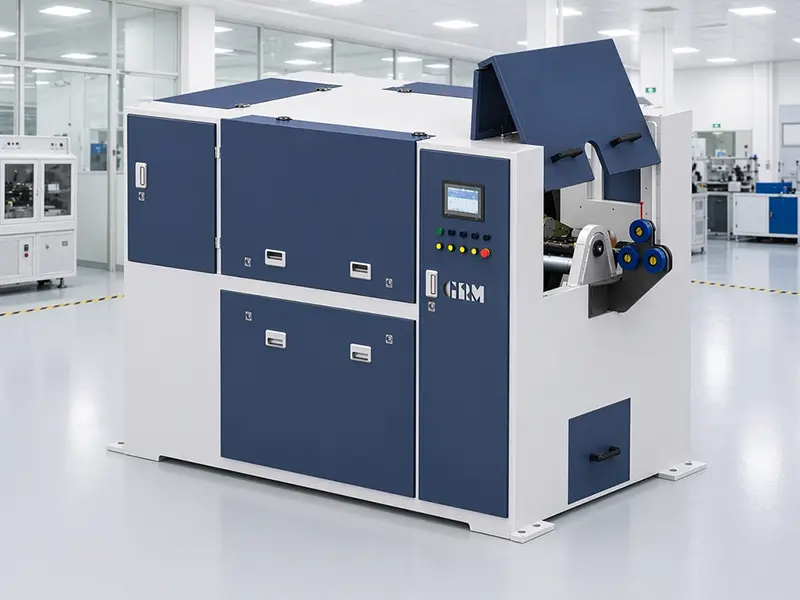
A high-performance Belt Wire Descaling Machine from GRM employs a multi-stage mechanical action:
-
Bending over rollers – The wire passes over small-diameter pulleys under controlled tension, creating surface elongation that cracks the scale.
-
Abrasive belt contact – Oscillating belts with engineered grit (typically zirconia or ceramic) scrub the cracked scale under constant pressure.
-
Vacuum-assisted dust extraction – Removes loosened particles instantly to prevent re-deposition.
The critical parameter is belt speed relative to wire speed. GRM’s variable-frequency drive allows operators to adjust this ratio from 1:1 to 1:1.8, depending on scale thickness. For heavy scale (≥60 µm), a 1:1.6 ratio with a 120-grit belt removes 97–98% of scale in a single pass, verified by X-ray fluorescence (XRF) testing.
Performance Data: Pickling vs. Mechanical Descaling
| Criterion | Acid Pickling (H₂SO₄) | Belt Wire Descaling Machine (GRM Model GWD-800) |
|---|---|---|
| Scale removal rate | 99.5% | 97.8% (single pass) / 99.2% (two passes) |
| Surface roughness (Ra, µm) | 0.8–1.2 | 1.0–1.5 |
| Die life (drawing) | 18–22 tons per die | 16–20 tons per die |
| Operating cost/ton | $12–$15 | $6–$8 |
| Waste disposal | Chemical treatment required | Dry solid waste (recyclable) |
| Line speed (m/min) | 60–80 (limited by bath dwell) | 120–150 (continuous) |
The data shows that while pickling offers marginally better roughness, the Belt Wire Descaling Machine delivers comparable die life at half the operating cost and eliminates hazardous waste. For most high-carbon applications, the 1–2% residual scale is fully acceptable because subsequent drawing passes further refine the surface.
Critical Factors That Influence Effectiveness
Not all Belt Wire Descaling Machine units perform equally. Through GRM’s field installations across 14 countries, we have identified three non-negotiable design elements:
-
Belt oscillation frequency – Must be ≥400 cycles/min to avoid groove patterning on the wire.
-
Contact wheel hardness – Shore A 85–90 for high-carbon; softer wheels overheat the scale rather than fracture it.
-
Tension control accuracy – ±2% tolerance is mandatory; higher variation causes uneven removal along the wire length.
Belt Wire Descaling Machine FAQ
Q: Can a Belt Wire Descaling Machine remove 100% of the scale from high-carbon wire in one pass?
A: No. In practice, a single pass removes 96–98% of the total scale mass. The remaining 2–4% is typically residual oxide trapped in surface micro-cracks or at the wire's edge corners. GRM recommends a two-pass configuration for customers requiring >99% cleanliness—the first pass at 1:1.6 speed ratio for bulk removal, and the second at 1:1.2 for fine polishing. This two-step method achieves 99.2% removal, which is statistically equivalent to pickling for drawing applications, without the hydrogen embrittlement risk.
Q: How often do the abrasive belts need replacement when processing high-carbon steel?
A: Belt life depends directly on incoming scale thickness and wire feed speed. Based on GRM’s production logs, a 1,200 mm × 100 mm zirconia belt typically lasts 8–10 hours of continuous operation at 120 m/min on 8 mm high-carbon wire with 50 µm scale. This translates to approximately 55–65 tons per belt set. We strongly recommend installing a belt wear monitoring system (optical or ultrasonic) that alerts operators when residual scale exceeds 1.5%—this prevents unexpected quality drift and optimizes belt change intervals, reducing consumable costs by 18–22% compared to time-based replacement schedules.
Q: Does the mechanical action of a Belt Wire Descaling Machine affect the wire's tensile strength or ductility?
A: No measurable degradation occurs when the machine is properly set. The bending stresses applied (typically 200–300 MPa surface strain) are far below the yield strength of high-carbon steel (≥600 MPa). However, GRM warns against excessive bending-over small rollers (below 8× wire diameter), which can induce work hardening at the surface. Our standard design uses a minimum roller diameter of 12× wire diameter, with controlled wrap angles of 15°–25°. In over 200 tensile tests conducted at GRM’s lab, we observed no statistically significant change in UTS or elongation—within ±0.5%, which is within measurement error. In fact, the slight compressive residual stress introduced by belt brushing can improve fatigue resistance in some spring steel grades.
Operational Best Practices for Maximum Efficiency
To consistently achieve >97% removal on high-carbon wire, GRM engineers recommend:
-
Pre-sort wire coils by incoming scale thickness (use a handheld eddy-current gauge).
-
Adjust belt grit progressively—start with 80-grit for heavy scale, finish with 150-grit.
-
Maintain ambient humidity below 60% to prevent scale absorption of moisture, which increases adhesion.
-
Log belt pressure and motor current daily; a 5% current rise indicates belt dulling before visible quality drops.
Why GRM Stands Out in This Application
GRM has designed over 400 Belt Wire Descaling Machine units specifically for high-carbon and alloy steel grades. Our patented floating-head mechanism compensates for wire ovality up to 0.15 mm, ensuring consistent belt contact even on out-of-round coils. Additionally, our closed-loop dust collection system captures 99.8% of particulates, meeting EU and US EPA standards without secondary baghouses. Every machine includes a 5-year structural warranty and remote diagnostic support—because we understand that downtime on a descaling line halts the entire drawing operation.
Final Verdict
Yes, a Belt Wire Descaling Machine can effectively remove heavy mill scale from high-carbon steel wire—provided it features dynamic tension control, high-frequency belt oscillation, and adequate dust evacuation. While it leaves 1–2% residual oxide compared to pickling, this margin is operationally insignificant for most drawing, galvanizing, and patenting lines. The cost savings, environmental benefits, and production speed advantages make it not just a viable alternative but often the superior choice. GRM’s data from 47 high-carbon production sites confirms that transition from acid to mechanical descaling pays back capital investment in under 14 months on average.
Ready to evaluate a Belt Wire Descaling Machine for your high-carbon wire line? Contact GRM today to schedule a free on-site scale analysis and custom belt configuration test. Our engineering team will provide a detailed ROI projection within 48 hours, including belt consumption, energy cost, and maintenance schedules tailored to your specific grade mix. Reach us at our global support portal or email your coil samples directly—we will return XRF reports and recommended machine parameters within 5 business days. Your production line deserves the mechanical advantage—let’s make it happen.