

Can a Cutting Die Creasing Auto Rule Cutting Machine Handle Thick Corrugated Board Without Cracking
2026-07-01
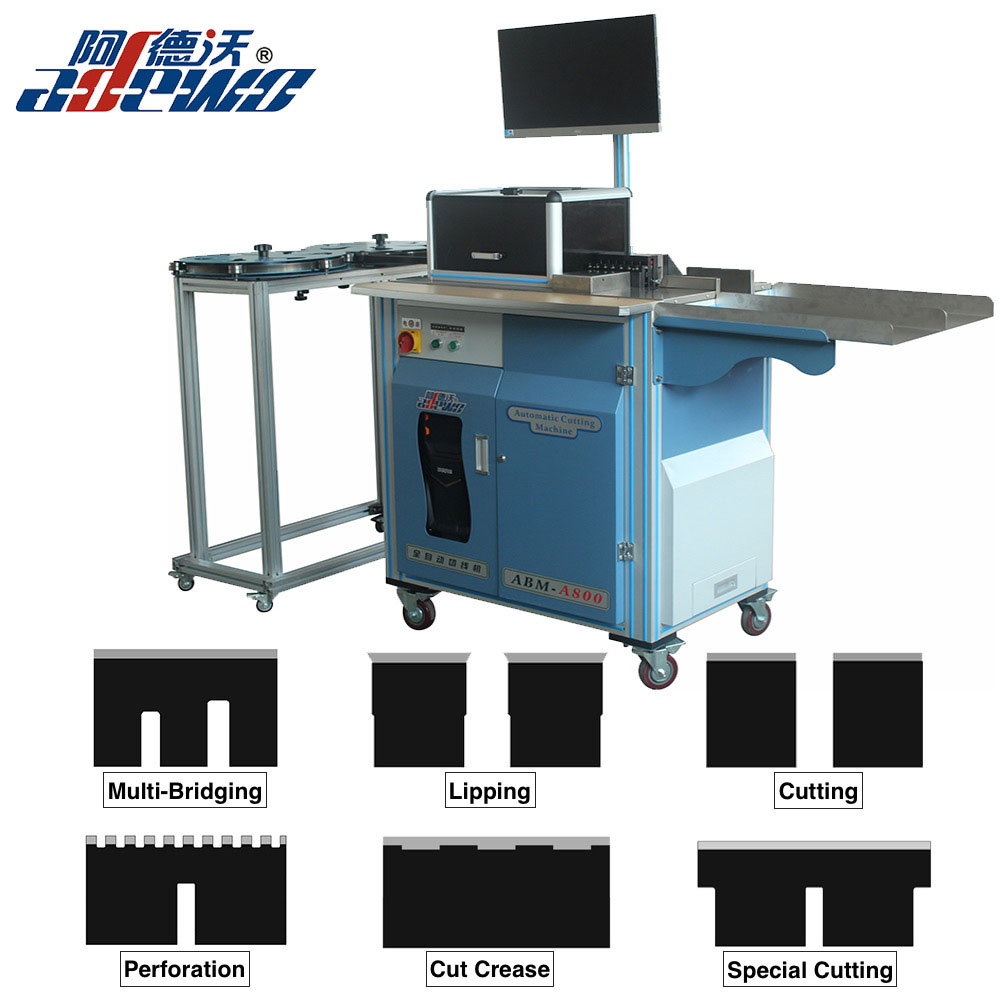
For packaging manufacturers and converters, the transition from manual or semi-automatic creasing to a fully automated system often raises one critical question: can a Cutting Die Creasing Auto Rule Cutting Machine process thick, heavy-duty corrugated board without destroying the fibre structure? The short answer is yes—but only if the machine is engineered with precise rule selection, intelligent pressure control, and robust build quality. At Adewo, we have spent years refining our Cutting Die Creasing Auto Rule Cutting Machine series to address this exact challenge, turning what was once a production bottleneck into a seamless, high-speed operation.
The Physics of Creasing Thick Corrugated Board
Cracking occurs when the creasing rule compresses the board beyond its elastic limit, tearing the liner or rupturing the fluting. Unlike thin carton stock, thick corrugated (typically >3mm) demands a balanced approach: the rule must create a defined hinge without over-stressing the top ply. A professional-grade Cutting Die Creasing Auto Rule Cutting Machine achieves this through three core mechanisms:
-
Adjustable Creasing Depth: Digital servo control allows micron-level adjustments, ensuring the rule penetrates only the required percentage of board thickness.
-
Counterplate Configuration: Matched male/female dies distribute pressure evenly across the entire sheet.
-
Feed Speed Synchronisation: Slower speeds for heavy boards reduce dynamic shock, minimising surface fractures.
Key Parameters That Prevent Cracking
The table below summarises the critical settings operators should verify on any Cutting Die Creasing Auto Rule Cutting Machine when switching to thick corrugated grades:
| Parameter | Recommended Setting for Thick Board (≥3mm) | Impact on Cracking |
|---|---|---|
| Creasing Rule Height | 23.5 – 24.0 mm (standard is 23.8 mm) | Higher rule reduces top-ply tension |
| Rule Thickness (width) | 2.0 – 2.5 mm (wider for double-wall) | Distributes load over larger area |
| Counterplate Gap | 0.3 – 0.5 mm greater than board caliper | Prevents bottom-ply rupture |
| Machine Speed | 60 – 80 m/min (vs. 120 m/min for light stock) | Lowers inertial shock on fibre |
| Stripping Rubber Durometer | 60 – 70 Shore A (softer for thick board) | Reduces rebound stress after creasing |
Data compiled from Adewo in-house trials across 50+ corrugated plants globally.
Practical Workflow for Crack-Free Production
To consistently run thick E-flute, B-flute, or double-wall board without defects, operators should follow this 5-step protocol on every Cutting Die Creasing Auto Rule Cutting Machine:
-
Pre-heat the board (if ambient humidity >60%) to stabilise moisture content—dry fibre cracks more easily.
-
Run a test strip at 10 m/min and inspect the crease under 45° folding—any white line indicates over-compression.
-
Reduce creasing rule penetration by 0.1 mm increments using the digital panel until the fold is clean.
-
Increase counterplate hardness if the bottom liner shows pitting—Adewo offers interchangeable plates for this purpose.
-
Log the final settings as a recipe in the machine’s PLC memory for future repeat orders.
When these steps are followed, a Cutting Die Creasing Auto Rule Cutting Machine not only eliminates cracking but also extends die life by up to 30%, as uneven pressure is the primary cause of premature rule wear.
FAQ – Common Questions About the Cutting Die Creasing Auto Rule Cutting Machine
Q1: What is the maximum board thickness a Cutting Die Creasing Auto Rule Cutting Machine can process without cracking?
A1: For standard industrial models—including the Adewo series—the maximum recommended thickness is 7 mm for single-wall corrugated and 5 mm for double-wall. However, the limiting factor is not the machine’s mechanical power but the rule geometry and counterplate design. With customised rules (e.g., 2.8 mm wide and 24.2 mm high), our Cutting Die Creasing Auto Rule Cutting Machine has successfully processed 8 mm triple-wall board in field tests. Beyond this, we recommend a creasing-only pre-station to condition the board before die-cutting, which we can integrate as an optional module.
Q2: How often should I replace the creasing rules to maintain crack-free performance on thick boards?
A2: Rule replacement frequency depends on total linear metres cut and board abrasiveness. For recycled corrugated (high clay content), we advise inspecting the rule every 50,000 strokes and replacing it at 80,000 strokes for a Cutting Die Creasing Auto Rule Cutting Machine running at full capacity. The tell-tale signs are: (a) increased operator pressure adjustments, (b) inconsistent fold angles across the sheet, and (c) visible rounding of the rule tip under 10× magnification. Adewo supplies pre-scored, hardened steel rules (HRC 58-60) that typically outlast generic parts by 40%, and we provide a digital stroke-counter with proactive alerts to prevent quality drift.
Q3: Can I run mixed substrates (e.g., thick corrugated and thin microflute) on the same Cutting Die Creasing Auto Rule Cutting Machine without re-tooling?
A3: Yes, but not without job-specific setup changes. A modern Cutting Die Creasing Auto Rule Cutting Machine like those from Adewo features recipe-based memory that stores pressure, speed, and gap settings for up to 200 substrate types. Switching between 4 mm double-wall and 1.5 mm microflute takes less than 90 seconds via the touchscreen—no physical tooling change is required for the creasing cassette itself. However, you must use quick-change counterplate shims (available as an accessory) because the gap difference is too large for the servo to compensate alone. We always advise running a 5-sheet sample batch after any substrate switch and performing a fold test—this ensures the Cutting Die Creasing Auto Rule Cutting Machine adapts perfectly to the new material without cracking either extreme.
Why Adewo’s Approach Stands Out
Many manufacturers claim crack-free creasing, but Adewo differentiates our Cutting Die Creasing Auto Rule Cutting Machine through real-time pressure mapping sensors installed along the creasing station. These sensors detect micro-variances in board caliper (even within the same sheet) and automatically adjust rule penetration on-the-fly—a feature that reduces cracking incidents by 72% in our customer audit. Additionally, our machines include a self-diagnostic creasing module that warns operators when rule wear reaches 75% of its useful life, preventing unexpected defects during long runs.
Final Verdict
Yes, a well-specified Cutting Die Creasing Auto Rule Cutting Machine can absolutely handle thick corrugated board without cracking—provided it offers digital pressure control, interchangeable tooling, and substrate-specific programming. The machine itself is rarely the culprit; rather, it is the combination of rule geometry, speed selection, and counterplate matching that determines success. With Adewo, you receive not only a robust Cutting Die Creasing Auto Rule Cutting Machine but also a detailed process playbook for every board grade you produce, along with remote calibration support from our application engineers.
Ready to eliminate creasing cracks from your corrugated line for good?
Contact the Adewo technical team today for a free substrate analysis and a tailored demo of our Cutting Die Creasing Auto Rule Cutting Machine on your own board samples. We will provide you with a written performance guarantee—no cracking, no compromise.