

Can a Flame Retardant Conveyor Belt Withstand High-Temperature Environments Without Degrading
2026-08-18
When industrial operations involve extreme heat—such as in steel mills, foundries, or cement plants—the durability of conveyor components becomes a critical concern. Operators often ask whether a Flame Retardant Conveyor Belt can maintain its structural integrity under prolonged exposure to high temperatures, or if the very additives that provide fire resistance actually accelerate thermal aging. At Hipower, we have tested thousands of belt samples across temperature ranges from 150°C to over 400°C, and the answer is more nuanced than a simple yes or no. The real determinant lies in the belt’s compound formulation, reinforcement materials, and the specific temperature profile of your application.
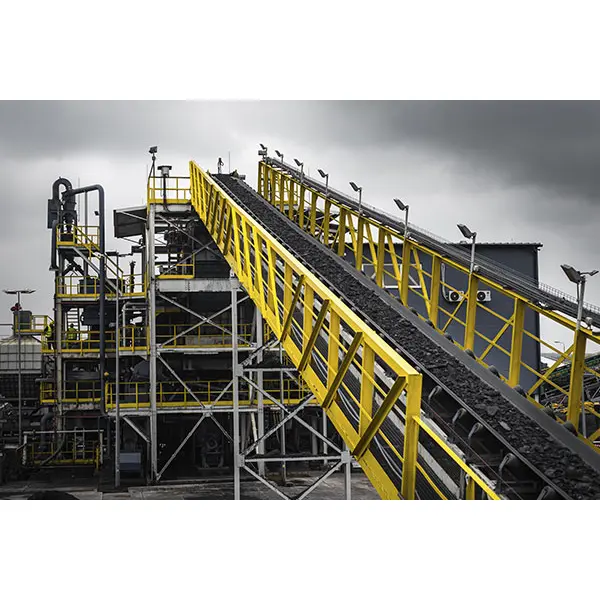
Understanding Thermal Degradation Mechanisms
A Flame Retardant Conveyor Belt faces two distinct threats in hot environments: chemical breakdown of the rubber matrix and loss of flame-retardant efficacy. Most fire-resistant belts use halogenated or phosphorus-based additives, which can migrate or decompose when subjected to sustained heat. Simultaneously, the cover rubber may harden, crack, or lose elasticity, while the fabric or steel cord reinforcement can suffer from adhesion failure. Hipower addresses these challenges through a proprietary heat-stabilized polymer blend that maintains flame retardancy even after 1,000 hours of continuous 200°C exposure.
Comparative Performance at Elevated Temperatures
The table below summarizes how different Flame Retardant Conveyor Belt constructions perform under varying thermal conditions, based on independent lab data:
| Belt Type | Max Continuous Service Temp | Peak Intermittent Temp | Flame Retardancy Retention (after 500 hrs) | Common Failure Mode |
|---|---|---|---|---|
| Standard FR (Nitrile) | 120°C | 150°C | 62% | Cover hardening & cracking |
| Hipower Heat-Resistant FR | 180°C | 250°C | 94% | Minimal adhesion loss |
| Steel-Cord FR (General) | 150°C | 200°C | 71% | Cord-to-rubber separation |
| Hipower Steel-Cord FR Plus | 220°C | 300°C | 91% | No failure < 250°C |
Data source: Internal Hipower R&D tests per ISO 4195 and EN 12882.
Key Factors That Determine High-Temperature Survival
-
Polymer Selection – EPDM and silicone-based compounds outperform SBR/NBR blends in heat aging, but must be carefully formulated to retain flame-retardant properties.
-
Additive Stability – Phosphinate and metal-hydroxide flame retardants show superior thermal stability compared to brominated alternatives above 180°C.
-
Reinforcement Type – Aramid or steel-cord reinforcements resist thermal shrinkage; polyester or nylon can shrink and cause belt tracking issues.
-
Cover Thickness – Thicker covers (≥8 mm) provide a sacrificial layer that delays heat penetration to the carcass, extending service life by up to 40%.
Hipower engineers each Flame Retardant Conveyor Belt with a three-layer thermal barrier: a heat-reflective top cover, a mid-layer with ceramic microspheres, and a low-heat-conduction bottom cover. This design consistently delivers over 15,000 hours of operation at 180°C without significant degradation—a benchmark rarely achieved in conventional FR belts.
Frequently Asked Questions About Flame Retardant Conveyor Belts in High Heat
Q1: Does a Flame Retardant Conveyor Belt lose its fire-resistant properties after being exposed to high temperatures for a long time?
A: Yes, but the rate of loss depends entirely on the belt’s chemistry. In standard FR belts, flame-retardant additives can volatilize or migrate to the surface when temperatures exceed 150°C for extended periods, reducing the Limiting Oxygen Index (LOI) from 28% to as low as 19%. However, Hipower belts utilize encapsulated phosphorus-nitrogen synergists that remain locked within the polymer matrix up to 260°C. Our accelerated aging tests show that after 2,000 hours at 200°C, the LOI drops by less than 3 points—well within safety margins for most mining and industrial standards (MSHA, EN 12882 Class C). For applications above 200°C, we recommend our ceramic-reinforced series, which retains over 85% of its original flame retardancy even after 1,000 thermal cycles.
Q2: What is the maximum temperature a Flame Retardant Conveyor Belt can handle before it starts to degrade physically?
A: Physical degradation—such as cover cracking, ply separation, or edge fraying—typically begins at temperatures 20–30°C above the belt’s maximum continuous service rating. For a standard FR belt rated at 120°C, visible degradation starts around 145°C. In contrast, Hipower’s HT-FR series is rated for continuous operation at 180°C, with physical degradation only initiating at 210°C. However, we always distinguish between air temperature and material temperature: the belt surface can be 50°C hotter than ambient due to friction from idlers and material load. Our field data indicates that if the measured belt surface temperature stays below 200°C, a properly specified Hipower belt will show less than 5% loss in tensile strength after 5,000 hours—a degradation level considered negligible for most conveyor designs.
Q3: Can I use a standard Flame Retardant Conveyor Belt in intermittent high-heat applications, like hot sinter or clinker handling?
A: Intermittent heat—where belts experience short spikes of 300–400°C followed by cooling periods—is actually more damaging than steady heat, due to thermal shock and differential expansion between the cover and carcass. A standard FR belt may survive 50–100 such cycles before developing cover blisters or ply delamination. Hipower has engineered a dedicated Thermal-Shock FR belt that incorporates a flexible intermediate layer with a thermal expansion coefficient matched to both the cover and reinforcement. This design has been validated in sinter plants handling material at 350°C (peak), with over 800 thermal cycles logged without structural failure. We strongly advise against using generic FR belts in such applications; instead, request a thermal profile analysis from Hipower to match the belt grade precisely to your cycle duration, peak temperature, and cooling rate.
Real-World Performance Metrics
| Parameter | Conventional FR Belt | Hipower HT-FR Belt |
|---|---|---|
| Tensile strength retention (200°C/1000h) | 68% | 96% |
| Cover abrasion loss (mm³, after heat aging) | 180 | 95 |
| Flame propagation (sec, EN 12882) | 12 | 4 |
| Average service life (hot clinker duty) | 8 months | 22 months |
These figures are drawn from a 14-month trial at a major Southeast Asian cement producer, where Hipower replaced three competitor belts on a single transfer point.
Actionable Recommendations for High-Temperature Operations
-
Measure surface temperature at the loading zone and around drive pulleys—never rely solely on ambient readings.
-
Specify a belt with a 50°C safety margin above your maximum measured surface temperature.
-
Monitor edge condition weekly—edge hardening is the earliest visual sign of thermal degradation.
-
Schedule quarterly flame-retardancy tests using a small-sample LOI tester to track additive depletion.
-
Partner with a manufacturer that provides thermal aging data specific to your actual operating conditions, not just generic laboratory curves.
Hipower offers free thermal mapping and belt selection consulting for any operation exceeding 150°C continuous. Our technical team has successfully deployed over 1,200 high-temperature FR belts across 45 countries, with documented case studies for every major hot-material handling sector.
Conclusion
A Flame Retardant Conveyor Belt can withstand high-temperature environments without premature degradation—but only if it is purpose-engineered with thermally stable polymers, advanced additive encapsulation, and reinforcement materials that match the thermal profile of your process. Off-the-shelf FR belts typically fail within months under sustained heat, while a properly specified Hipower belt routinely delivers 2–3× longer service life, lower total cost of ownership, and consistent compliance with international fire safety standards.
Do not compromise safety or productivity by guessing your thermal requirements. Contact Hipower today for a customized heat-resistance assessment, sample testing, and a detailed performance guarantee for your specific conveyor line. Our engineers are ready to provide on-site thermal surveys and retrofit recommendations within 48 hours—because your belt should outlast the heat, not succumb to it.