

Can a Low-Rail Gantry Barrel Zinc Plating Line Handle High-Volume Production Requirements
2026-09-18
For plating facilities scaling up output, the real question is not whether automation works, but whether it works under sustained load. A Low-Rail Gantry Barrel Zinc Plating Line from JUNDA is engineered precisely for that pressure point, combining overhead gantry transfer, barrel rotation, and synchronized process sequencing into one continuous production flow. JUNDA has supplied these systems to job shops and captive plating departments where uptime, cycle consistency, and throughput directly determine profitability.
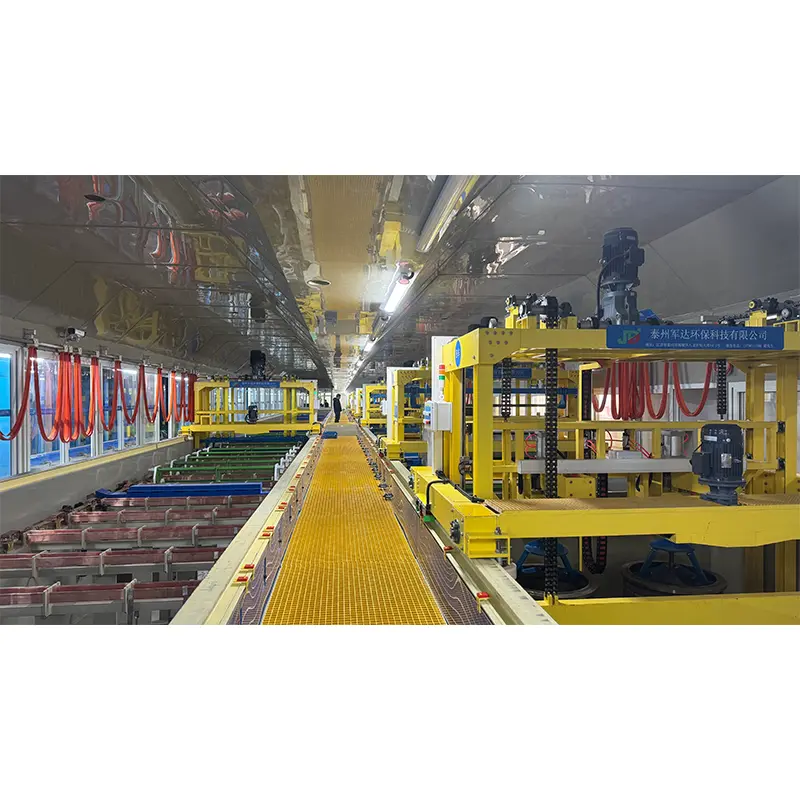
Understanding High-Volume Demands in Barrel Zinc Plating
High-volume production is not simply "more parts." It means:
-
Consistent cycle times across thousands of batches per month
-
Minimal manual intervention between process stages
-
Stable current density and zinc deposition across every barrel load
-
Reduced downtime for loading, transfer, and maintenance
-
Repeatable thickness and adhesion results for downstream QC
A Low-Rail Gantry Barrel Zinc Plating Line addresses these demands through a low-profile rail structure that shortens transfer distances, reduces crane travel time, and improves structural rigidity under repetitive motion.
Key Performance Factors That Determine Volume Capacity
| Factor | Impact on High-Volume Output | JUNDA Design Approach |
|---|---|---|
| Gantry transfer speed | Directly affects cycle time per batch | Optimized acceleration and deceleration profiles |
| Barrel loading capacity | Determines parts per cycle | Custom barrel sizing based on part geometry |
| Rail height and layout | Influences footprint and transfer efficiency | Low-rail design minimizes vertical travel |
| Rectifier and busbar configuration | Affects deposition uniformity | Modular power supply with balanced current distribution |
| Automation and PLC control | Reduces human error and idle time | Integrated recipe management and fault diagnostics |
| Tank arrangement | Determines process flow continuity | Linear or U-shaped layouts for optimized throughput |
Throughput and Cycle Time Analysis
A typical Low-Rail Gantry Barrel Zinc Plating Line can process multiple barrels per hour depending on process steps, coating thickness, and barrel size. In JUNDA-configured lines, cycle time optimization focuses on:
-
Reducing transfer dead time between tanks
-
Synchronizing barrel rotation with dwell time
-
Eliminating bottlenecks in pre-treatment and post-treatment stages
-
Enabling continuous loading and unloading at designated stations
For facilities running 20–24 hours per day, this translates into predictable daily output rather than variable batch results.
Automation and Consistency at Scale
High-volume production exposes weaknesses in manual or semi-automatic systems. A Low-Rail Gantry Barrel Zinc Plating Line integrates:
-
PLC-based process control with recipe storage
-
Automatic barrel loading and unloading sequences
-
Real-time monitoring of current, voltage, and temperature
-
Alarm and diagnostic systems for rapid fault resolution
-
Data logging for traceability and quality auditing
JUNDA engineers these controls around the actual production mix, not a generic template, which is critical when part sizes and coating specifications vary across shifts.
Scalability and Customization
Not every high-volume requirement looks the same. JUNDA approaches scalability through modular design:
-
Expandable tank sections for additional process stages
-
Adjustable gantry travel for future line extension
-
Configurable barrel sizes and perforation patterns
-
Optional automation upgrades without full line replacement
This allows a Low-Rail Gantry Barrel Zinc Plating Line to grow with production demand rather than becoming obsolete.
FAQ: Common Questions About Low-Rail Gantry Barrel Zinc Plating Line
Q: What is the maximum throughput a Low-Rail Gantry Barrel Zinc Plating Line can achieve?
A: Throughput depends on barrel size, coating thickness, and the number of process stages. A well-configured JUNDA line can handle several barrels per hour per gantry, and with multiple gantries or extended tank arrangements, daily output can reach thousands of kilograms of plated parts. The key is matching gantry speed, barrel capacity, and rectifier output to the specific part mix.
Q: How does a Low-Rail Gantry Barrel Zinc Plating Line maintain consistent coating thickness at high volumes?
A: Consistency comes from stable current density, uniform barrel rotation, and controlled dwell time in each tank. JUNDA integrates rectifiers with balanced busbar distribution and PLC-controlled recipes, ensuring every barrel receives the same electrical and chemical exposure. This reduces thickness variation and rework rates significantly.
Q: Is a Low-Rail Gantry Barrel Zinc Plating Line suitable for continuous three-shift operation?
A: Yes. The low-rail gantry structure is built for repetitive, high-cycle motion with reduced mechanical stress compared to taller gantry designs. JUNDA reinforces wear points, uses corrosion-resistant materials, and provides predictive maintenance schedules that support 24/7 operation with minimal unplanned downtime.
Conclusion
High-volume production demands more than speed. It requires repeatability, uptime, and a system designed around real output targets. A Low-Rail Gantry Barrel Zinc Plating Line from JUNDA delivers that balance through optimized transfer geometry, modular scalability, and integrated process control.
Contact us today to discuss your production capacity, part specifications, and facility layout. JUNDA will provide a tailored configuration and throughput estimate for your Low-Rail Gantry Barrel Zinc Plating Line project.