
Can a Paving Brick Making Machine Produce Interlocking Pavers Automatically
2026-08-21
For construction contractors and hardscape business owners, the question of automation is no longer optional—it is a competitive necessity. When evaluating modern equipment, one of the most frequent inquiries revolves around whether a Paving Brick Making Machine can handle the complex geometry of interlocking pavers without constant manual intervention. The short answer is yes, but the real value lies in understanding how fully automated systems from manufacturers like Unik transform production workflows, reduce labor dependency, and ensure dimensional consistency across thousands of units per shift.
Understanding Fully Automatic Production Cycles
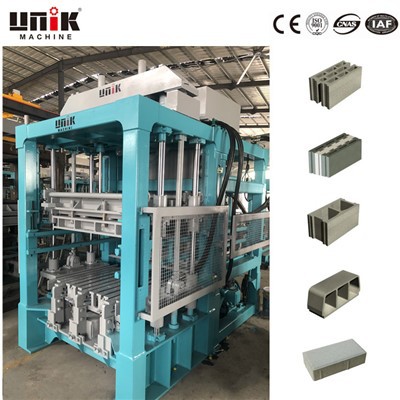
A contemporary Paving Brick Making Machine equipped with a programmable logic controller (PLC) and hydraulic vibration systems can execute the entire interlocking paver production sequence autonomously. The process begins with raw material batching—cement, aggregates, and pigments—which are fed into a twin-shaft mixer. From there, the mixture is conveyed to the mold chamber, where high-frequency vibration and hydraulic pressure compact the material into precise interlocking shapes. What makes it "automatic" is the seamless transition between these stages: mold filling, compression, ejection, and pallet conveying all occur without an operator touching a single paver.
Unik has engineered its automatic lines with servo-driven pallet feeders and stackers, meaning that once the recipe is set, the Paving Brick Making Machine runs continuously, only pausing for raw material replenishment or scheduled maintenance. The interlocking tongue-and-groove profiles, which require tolerances under 0.5 mm, are consistently achieved through closed-loop pressure monitoring—a feature that manual or semi-automatic machines simply cannot guarantee.
Key Components That Enable Full Automation
| Component | Function | Automation Benefit |
|---|---|---|
| PLC Control Panel | Stores up to 100 product recipes | Instant changeover between paver designs |
| Hydraulic Vibration System | Adjusts frequency based on material moisture | Optimizes compaction without trial runs |
| Pallet Conveyor Chain | Transfers molded pavers to curing racks | Eliminates manual handling post-production |
| Color Feeding Unit | Layers pigment for surface finishes | Produces textured interlocking faces automatically |
| Automatic Stacker | Arranges finished pavers in rows | Prepares for strapping and packaging |
With Unik systems, the entire cycle—from empty pallet to stacked finished product—can be completed in 12–15 seconds per mold, depending on paver thickness. This translates to over 400 interlocking pavers per hour from a single Paving Brick Making Machine, all with zero direct labor input during the forming stage.
Real-World Production Data (8-Hour Shift)
| Production Parameter | Semi-Automatic | Fully Automatic (Unik) |
|---|---|---|
| Output (pavers/shift) | 1,800 – 2,200 | 3,200 – 3,800 |
| Rejection rate | 4.5% – 6.0% | 0.8% – 1.2% |
| Operators required | 3 – 4 persons | 1 supervisor |
| Mold changeover time | 25 – 30 minutes | 8 – 10 minutes |
| Daily water & energy cost | Baseline | 18% lower (optimized cycles) |
The data underscores that automation is not merely about speed—it directly impacts material waste, energy efficiency, and unit cost. Unik integrates sensors that detect mold fill levels in real time, adjusting vibration intensity to prevent hollow spots—a common defect in interlocking pavers that leads to on-site breakage.
Common Concerns About Automated Interlocking Production
FAQ 1: Does an automatic Paving Brick Making Machine require special molds for different interlocking patterns?
Yes, each interlocking design—whether herringbone, zigzag, or round-top—requires a dedicated mold set. However, modern Paving Brick Making Machine systems feature quick-release mold clamps that allow tool-free changeovers. The PLC stores vibration curves and pressure profiles for each mold, so once you swap the physical mold and select the corresponding recipe, the machine recalibrates its parameters within 90 seconds. Unik supplies hardened steel molds with chrome plating, guaranteeing 80,000–100,000 cycles before refurbishment, which is significantly higher than standard cast-iron alternatives.
FAQ 2: Can the machine automatically adjust for variations in raw material moisture or aggregate size?
Absolutely. A fully automatic Paving Brick Making Machine from Unik includes an online moisture sensor at the mixer outlet. If the mix is too dry, the system adds a metered water spray; if too wet, it extends vibration time to expel excess air. For aggregate gradation changes, the vibration frequency automatically shifts between 3,500 rpm and 4,800 rpm based on real-time compaction feedback. This adaptive control ensures that interlocking pavers maintain consistent compressive strength (above 45 MPa) even when using locally sourced aggregates with natural variations.
FAQ 3: What happens if there is a power fluctuation or hydraulic pressure drop during an automatic run?
Unik equips its Paving Brick Making Machine with a dual-accumulator hydraulic backup system. If main power dips below 85% of nominal voltage, the accumulators instantly supply stored pressure to complete the current pressing cycle, preventing partial pavers from being ejected. Additionally, the PLC logs every interruption with a timestamp. Upon power restoration, the machine does not resume blindly; it prompts the supervisor to either restart the interrupted mold or purge the compromised material. This fail-safe design is critical because interlocking pavers with incomplete compaction will crack during curing, leading to costly rejections.
Why Automation Wins Over Manual Methods
Manual production of interlocking pavers relies on human judgment for vibration timing, pressure application, and demolding—all variables that introduce inconsistency. A Paving Brick Making Machine with full automation eliminates these variables, but the deeper advantage is data traceability. Unik machines generate shift reports showing production counts, average cycle times, and material consumption, which helps owners calculate exact cost-per-paver. For clients supplying municipal projects or large-scale residential developments, this traceability is often a tendering requirement.
Furthermore, automated systems reduce workplace injuries related to repetitive lifting and vibration exposure—a factor increasingly important in regions with strict occupational safety regulations. By investing in a Unik automatic line, business owners not only boost output but also future-proof their operations against labor shortages and rising wage costs.
Final Considerations Before Purchasing
While most modern Paving Brick Making Machine models offer automation as a standard feature, the degree of "full" automation varies. Some machines require manual pallet loading or offloading, which creates bottlenecks. Unik provides a truly end-to-end solution, including automatic pallet destackers, curing rack transfer cars, and even film-wrapping stations for finished pallets. The initial capital outlay is higher than semi-automatic units, but the return on investment—through lower labor, fewer defects, and higher shift output—typically pays back within 10–14 months for operations running two shifts daily.
Frequently Asked Questions (FAQ)
Q: Can a Paving Brick Making Machine produce interlocking pavers with colored surface layers automatically?
A: Yes, when equipped with a dual-hopper color feeding system. Unik offers a multilayer pouring unit that deposits a pigmented top layer (3–5 mm thick) over a base layer of standard concrete. The machine’s PLC synchronizes the layer deposition with the vibration cycle, ensuring the color layer bonds without mixing. This process is entirely automatic and can be switched on/off per recipe, allowing you to produce both solid-color and surface-colored interlocking pavers on the same shift without manual intervention.
Q: How does the machine handle mold cleaning between automatic cycles?
A: Unik integrates an air-blow cleaning nozzle that activates after every demolding cycle, removing residual cement paste from the mold cavity. For heavier buildup, the machine includes a scheduled “cleaning mode” that runs an accelerated vibration sequence with a fine aggregate charge to scour the mold surfaces. This automatic maintenance routine extends mold life and preserves the sharp edges required for proper interlocking fit. Operators only need to perform a deep manual clean once per 500 cycles.
Q: Is operator training required for running an automatic Paving Brick Making Machine?
A: Yes, but the training curve is short. Unik provides a 3-day on-site training program covering recipe programming, fault diagnosis, and daily maintenance checks. The HMI (human-machine interface) uses icon-based navigation and alarm descriptions in plain English, so even operators with limited technical background can manage the system after 10–12 supervised hours. The machine also stores a video library of common troubleshooting steps, accessible directly from the touchscreen.
Take the Next Step Toward Automated Production
Automation is no longer a luxury for interlocking paver production—it is the standard that separates competitive manufacturers from those struggling with quality and throughput. Whether you are expanding an existing facility or establishing a new plant, the right Paving Brick Making Machine with full automation will define your operational efficiency for the next decade.
Contact Unik today to request a customized production plan, schedule a live demo, or receive a detailed cost-benefit analysis for your specific output targets. Our engineering team will assess your raw materials, site layout, and power supply to recommend the exact automatic configuration that maximizes your interlocking paver output while minimizing per-unit costs. Reach out via our website or call your regional Unik representative—we are ready to build your success, one paver at a time.