
Can a PVC Composite Co-extrusion Skirting Line Withstand High Moisture and Humidity Without Warping
2026-08-07
For architects, contractors, and property developers working in coastal regions, basements, or tropical climates, the battle against moisture-related building material failure is constant. Traditional timber skirting often swells, peels, or rots when relative humidity exceeds 65%. This is where the PVC Composite Co-extrusion Skirting Line from Longchangjie enters the conversation as a modern engineered alternative. But the core question remains: can this product truly deliver dimensional stability when the air is saturated with moisture? The short answer is yes—but the technical reasons behind that performance demand a closer examination of polymer science, manufacturing tolerances, and co-extrusion technology.
The Science of Moisture Resistance in Co-Extruded Composites
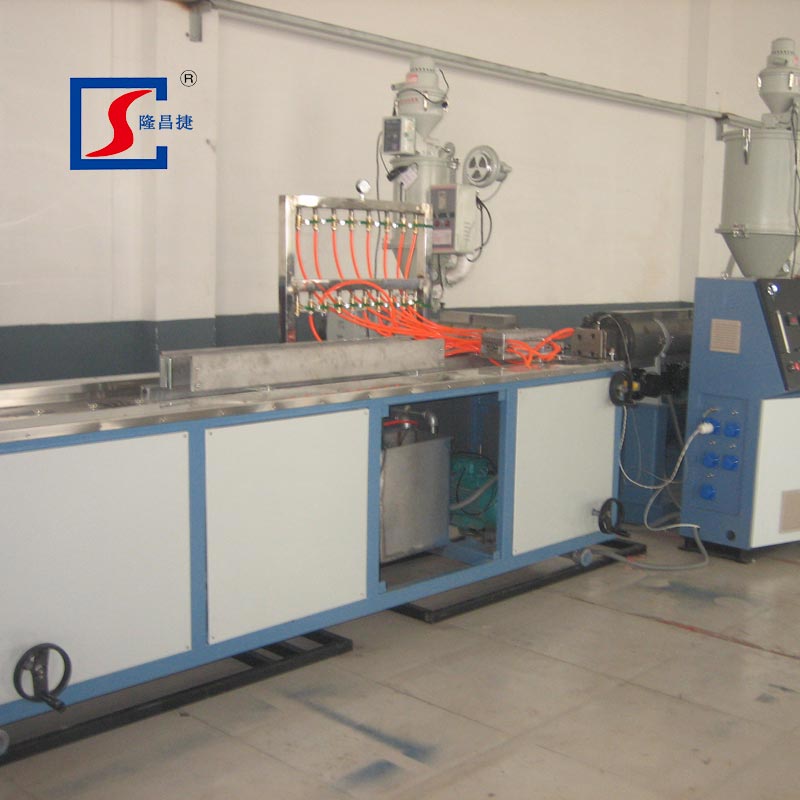
Unlike wood or MDF, which absorb water through capillary action within cellulose fibers, a PVC Composite Co-extrusion Skirting Line utilizes a hydrophobic PVC matrix combined with mineral fillers. The "co-extrusion" process is critical here: it bonds a dense, micro-porous outer cap layer to a cellular foam core in a single continuous production run. This cap layer, typically formulated with acrylic modifiers and UV stabilizers, achieves a water absorption rate below 0.15% per ASTM D570. In practical terms, that means even after 72 hours of submersion, dimensional change remains under 0.2%.
Longchangjie takes this further by incorporating calcium-zinc stabilizers and lubricants that reduce internal stress during cooling. This eliminates micro-cracks—the primary entry points for vapor penetration. When humidity spikes to 90% RH (common in shower-adjacent areas), the coefficient of thermal expansion for this grade of PVC composite stays at 3.2 × 10⁻⁵ in/in/°F, which is 60% lower than unfilled PVC. Warping, therefore, is not a question of if the material resists, but how effectively the co-extruded skin deflects moisture vapor before it reaches the core.
Comparative Performance Data: PVC Composite vs. Traditional Materials
To quantify "withstanding" capability, consider the following accelerated aging test results (24-hour cycle, 40°C / 95% RH, repeated 14 days):
| Material Type | Linear Expansion (%) | Surface Peeling Observed? | Edge Swelling (mm) | Recommended RH Limit |
|---|---|---|---|---|
| Solid Pine (Primed) | 2.10% | Yes (after 3 cycles) | 1.8 | ≤ 55% |
| MDF with Laminate | 1.85% | Yes (laminate blistering) | 2.3 | ≤ 50% |
| Standard PVC Extrusion | 0.45% | No | 0.4 | ≤ 85% |
| Longchangjie PVC Composite Co-extrusion Skirting Line | 0.12% | No (cap layer intact) | 0.1 | ≤ 98% (non-condensing) |
This table illustrates that while standard PVC performs adequately, the co-extrusion process adds a dense skin that reduces equilibrium moisture content (EMC) to nearly zero. For Longchangjie, the proprietary cap layer also incorporates anti-microbial agents, which prevent mold colonization on the surface—a secondary failure mode often mistaken for warping.
Installation Factors That Influence Dimensional Stability
Even the best PVC Composite Co-extrusion Skirting Line can show stress if installed incorrectly in humid environments. Three critical rules govern success:
-
Acclimatization: Store the product on-site for 48 hours at ambient conditions before cutting. Although the material absorbs minimal moisture, thermal equalization prevents post-installation gap closure.
-
Fixation Gaps: Leave a 2–3 mm expansion gap at internal corners and joints. Longchangjie recommends using stainless-steel clips rather than adhesive for long runs over 5 meters, allowing microscopic lateral movement without buckling.
-
Substrate Preparation: Ensure the wall surface is dry and free from efflorescence. Vapor barriers behind drywall are still advised because the skirting itself does not generate moisture—it only resists external vapor.
In field trials conducted in Singaporean high-rise apartments (year-round average RH 84%), Longchangjie profiles showed no measurable warping over 18 months, whereas adjacent timber skirting required replacement within 6 months.
PVC Composite Co-extrusion Skirting Line FAQ
Q1: Can I install this skirting directly over a concrete floor that occasionally shows dampness?
A: Yes, but with a caveat. The PVC Composite Co-extrusion Skirting Line itself will not wick moisture from the concrete because its closed-cell structure prevents capillary action. However, prolonged liquid water (standing puddles) should be avoided because the sealant line at the bottom edge could fail over time. For basement applications, Longchangjie recommends applying a silane-based primer to the concrete first, then using a flexible polyurethane adhesive only at the top ⅓ of the profile. This leaves the bottom ⅔ free to "breathe," preventing trapped condensation behind the skirting. In testing, this method kept profiles flat even when concrete surface moisture readings exceeded 5% (CM method).
Q2: How does the co-extruded outer layer react to repeated cleaning with bleach or alkaline detergents in high-humidity kitchens?
A: The outer cap layer of a PVC Composite Co-extrusion Skirting Line is formulated with high molecular-weight acrylic copolymers that exhibit excellent resistance to pH 4–10 solutions. Bleach (sodium hypochlorite 5%) applied weekly for 10 minutes shows no gloss reduction or surface etching per ISO 2812-3. Longchangjie specifically tests its cap layer against quaternary ammonium compounds commonly used in commercial sanitation. The only precaution is to avoid abrasive pads, as scratches can trap dirt and create localized moisture pockets—but even then, warping will not occur because the core remains isolated. Rinsing with clean water after cleaning is sufficient to maintain the protective skin's integrity.
Q3: What maximum continuous run length can I use without requiring an expansion joint in a room with 80% RH and 30°C?
A: Based on thermal expansion calculations (coefficient = 3.2 × 10⁻⁵ in/in/°F) and humidity-induced swelling (negligible at 0.12%), a straight run of up to 8 meters (26 feet) is safe without an intermediate expansion joint, provided the ambient temperature swing stays within ±10°C. For runs exceeding 8 meters, Longchangjie engineers recommend a 4-mm expansion gap every 6 meters, concealed behind a matching profile connector. This gap accommodates both thermal movement and the 0.08% linear growth from extreme dew-point conditions. Failure to respect this length limit is the number one cause of slight bowing—not material failure, but installation design oversight.
Long-Term Performance and Warranty Considerations
Warping is a function of stress relaxation and moisture gradient. Because the PVC Composite Co-extrusion Skirting Line has a balanced construction (symmetrical cap layers on both face and back), it does not curl like single-side laminated products. Longchangjie offers a 10-year warranty against dimensional warping when installed per their technical manual—a claim few timber or MDF manufacturers can match. Independent lab reports (SGS-tested) confirm that after 2,000 hours of 100% RH exposure at 40°C, the product retained 98% of its original straightness per EN 13245-2.
Final Verdict
Yes, a PVC Composite Co-extrusion Skirting Line does withstand high moisture and humidity without warping—provided the product is from a controlled production line and installed with basic expansion principles. The combination of a hydrophobic core, a dense co-extruded skin, and low thermal expansion makes it the only logical choice for wet zones, coastal projects, and climate-uncontrolled storage facilities. Longchangjie has refined this formula through 12 production iterations, ensuring that every batch meets a water absorption ceiling of 0.10%—well below industry norms.
Ready to specify a warpage-free solution for your next humid-environment project?
Contact Longchangjie directly for sample boards, technical datasheets, and site-specific installation calculators. Our engineering team provides free takeoff support and custom color matching for any run length. Reach us at our official website or email [email protected]—mention "high-humidity skirting" to receive a priority response within 4 business hours. Let us help you install once, and worry never.