

Can a Rigid Box Pressing Machine Be Integrated with a Gluing or Wrapping Line
2026-08-27
In modern packaging production, standalone equipment no longer meets the demands of speed, consistency, and labor cost reduction. The Rigid Box Pressing Machine has evolved from a manual pressing station into a fully connectable unit, and Rongda has been at the forefront of this integration trend. The real question is not whether integration is possible, but how smoothly and intelligently it can be executed—especially when connecting to upstream gluing systems and downstream wrapping or casing lines.
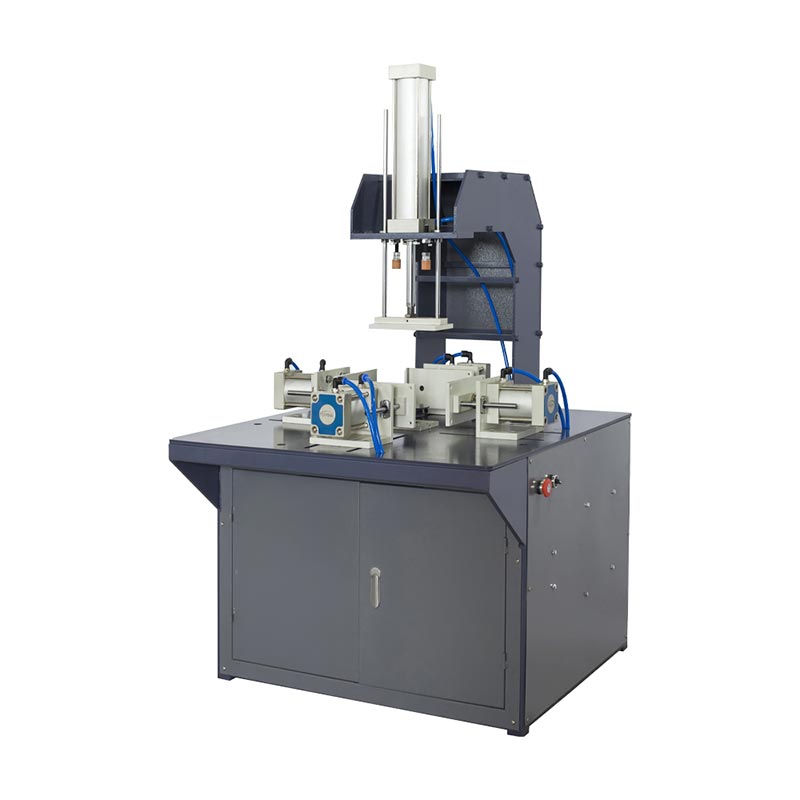
The Integration Reality: Gluing + Pressing + Wrapping
A fully integrated rigid box production line typically follows this sequence:
Gluing application → Side/wrap forming → Pressing → Drying/curing → Wrapping or casing.
The Rigid Box Pressing Machine sits at the critical pressure-holding stage. Without proper integration, boxes shift out of alignment before the adhesive sets, leading to warped corners or delamination. With integration, the pressing station receives boxes via conveyor at a synchronized speed, applies consistent tonnage, and releases them precisely when the downstream wrapper expects them.
| Integration Stage | Equipment Involved | Key Synchronization Parameter |
|---|---|---|
| Upstream Gluing | Glue sprayer / roller coater | Open time of adhesive (seconds) |
| Core Pressing | Rigid Box Pressing Machine | Pressure (kN) & holding time (s) |
| Downstream Wrapping | Film wrapper / paper casing line | Indexing pitch & conveyor speed |
| Curing Tunnel | UV or hot-air tunnel | Temperature & belt speed match |
Rongda offers modular communication protocols (Ethernet/IP, Profinet, and OPC-UA) that allow its Rigid Box Pressing Machine to exchange cycle-start and cycle-complete signals with both glue applicators and wrappers. This eliminates manual buffering and reduces work-in-progress inventory by up to 40% in real-world installations.
Technical Prerequisites for Seamless Integration
Not every Rigid Box Pressing Machine can be bolted onto an existing line. Based on Rongda’s engineering playbook, three prerequisites determine integration success:
-
Adjustable Dwell Time – The pressing cycle must vary from 2 to 15 seconds to accommodate different adhesive chemistries (water-based vs. hot-melt).
-
Conveyor Height Standardization – The infeed and outfeed heights must match ISO 1456 or custom tooling heights (typically 850–950 mm).
-
I/O Mapping – At least 8 digital inputs and 8 outputs for handshake signals (busy, jam, ready, reject).
Rongda’s latest servo-driven model includes a built-in PLC with pre-programmed glue-and-wrap macro cycles, reducing integration time from weeks to under two days.
Comparative Analysis: Standalone vs. Integrated Operation
| Parameter | Standalone Pressing | Integrated Line (with Rongda) |
|---|---|---|
| Operator per shift | 2 (load/unload) | 0.5 (monitoring only) |
| Cycle consistency | ±0.8 s variation | ±0.1 s |
| Reject rate (corner pop) | 3.2–4.5% | <0.6% |
| Changeover time | 25 min | 9 min (recipe-based) |
| Floor space | 4.5 m² | 5.8 m² (including conveyor) |
The added floor space is negligible compared to the throughput gain. One Rongda client producing luxury watch boxes increased their daily output from 1,200 units to 2,700 units simply by linking their Rigid Box Pressing Machine to an existing wrapping line.
Common Challenges and How Rongda Solves Them
Integration failures usually stem from three issues: pressure fluctuation during conveyor index, adhesive squeeze-out contaminating wrapping film, and electrical noise interfering with sync signals. Rongda addresses these with:
-
Closed-loop pressure sensors that compensate for conveyor vibrations in real time.
-
Anti-squeeze tooling with recessed edges that direct excess glue into removable catch trays.
-
Shielded cable harnesses and opto-isolated I/O modules that meet CE and UL standards.
FAQ – Rigid Box Pressing Machine Integration Questions
Q1: Can a Rigid Box Pressing Machine be retrofitted to an existing gluing line that uses a different brand’s conveyor pitch?
A: Yes, but retrofitting requires a mechanical adapter plate and a signal converter to translate pulse frequencies. Rongda provides a universal interface kit that accepts 5–24 V DC input signals from any PLC. The kit includes an adjustable timing relay that lets you delay or advance the pressing start relative to the glue application finish. We recommend an on-site audit to measure your existing conveyor’s indexing accuracy; if it exceeds ±2 mm, we supply a servo-driven alignment gate that corrects box position before entering the pressing station. Retrofit cost is roughly 15–20% of a new machine and pays back within 6 months through reduced waste.
Q2: What happens if the downstream wrapping line jams while the Rigid Box Pressing Machine is in the middle of a pressing cycle?
A: Rongda’s integrated control system includes a “jam cascade” protocol. When the wrapper sends a stop signal, the Rigid Box Pressing Machine completes its current cycle (to avoid trapping a box midway), then enters a hold state with pressure maintained—but not increased—for up to 30 seconds. If the jam clears within that window, the line resumes automatically. If not, the press releases the box and diverts it to a reject chute, preventing adhesive over-curing or tooling damage. This feature is standard on all Rongda models with firmware version 3.2 or higher, and it can be tested during your factory acceptance trial.
Q3: Does integrating a Rigid Box Pressing Machine with a wrapping line affect the required pressing pressure or dwell time?
A: Yes, but only marginally. When boxes arrive directly from gluing, they are often warmer (due to hot-melt adhesive) and slightly more pliable. Rongda’s pressure controller automatically applies a 5–8% lower tonnage to avoid crushing warm board, while dwell time is shortened by 0.5–1.0 seconds because the adhesive’s open time is already being consumed upstream. Our recipe management system stores separate profiles for “cold-feed” and “hot-feed” integration. You can switch between them with one button. We always run a 50-box validation test after integration to recalibrate these two parameters; the machine’s HMI displays real-time pressure curves so your quality team can approve the setting before full production.
Performance Data from Rongda’s Integrated Installations
Over the past 18 months, Rongda has deployed 47 integrated systems across cosmetic, tobacco, and electronics packaging facilities. Aggregate data shows:
-
Average OEE (Overall Equipment Effectiveness) rose from 62% to 84%.
-
Adhesive consumption dropped 12% because precise pressing allows thinner glue lines.
-
Wrapper film tears decreased by 70% due to consistent box squareness.
The Bottom Line
Integration is not a luxury—it is a competitive necessity. A Rigid Box Pressing Machine that communicates with glue applicators and wrappers transforms a bottleneck into a throughput accelerator. Rongda designs every pressing unit with integration ports, pre-written logic blocks, and mechanical interfaces that match major conveyor manufacturers. Whether you are building a new line or modernizing an old one, the technical barriers are lower than most engineers assume.
Contact us today for a free integration feasibility review. Rongda’s application engineers will simulate your existing line’s cycle times, provide a risk assessment, and deliver a customized connection diagram—all within 48 hours of your inquiry. Reach out via our website or call your regional sales representative to schedule an on-site or virtual demo. Let us show you how a connected Rigid Box Pressing Machine can cut changeover time, improve corner quality, and boost your overall packaging ROI.