

Can a Shredding and Recycling Production Line Process Both Metal and Plastic Without Cross-Contamination
2026-07-07
For recycling facility operators and environmental engineers, the question of material purity is not academic—it directly determines resale value, downstream processing efficiency, and regulatory compliance. A Shredding And Recycling Production Line that handles mixed streams of metal and plastic faces a fundamental challenge: these two materials have vastly different densities, melting points, and electrostatic properties. Cross-contamination, where plastic fragments adhere to metal shreds or metal dust embeds into plastic flakes, can reduce the selling price of recycled output by 20–40%. At Gaoxin, we have engineered solutions that address this issue not as a single-step fix but as a systemic control protocol across the entire line.
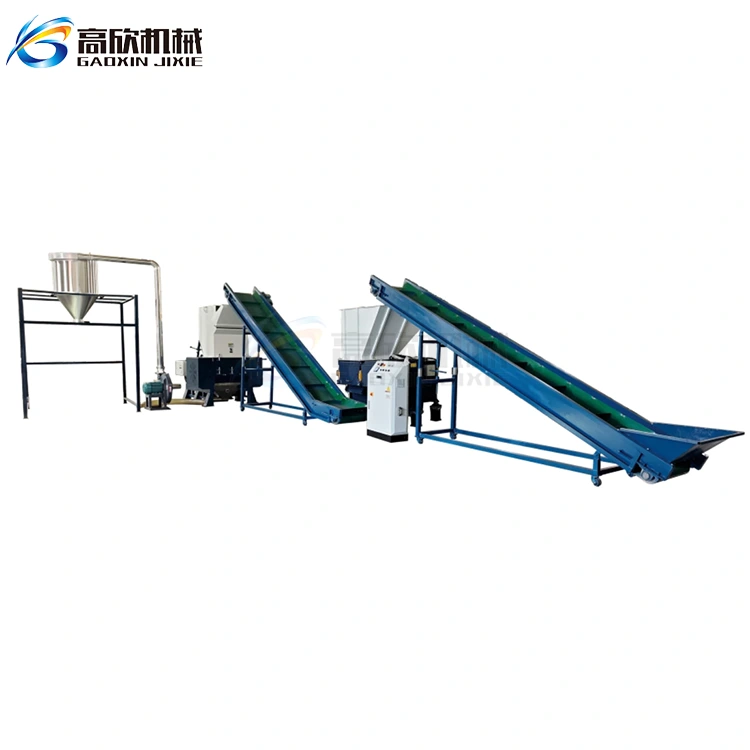
The Core Technical Challenge
Cross-contamination occurs at three critical points: during shredding (where heat and friction can melt plastics onto metal surfaces), during conveying (where mixed fines travel together), and during sorting (where overlapping size fractions confuse optical and magnetic separators). A conventional Shredding And Recycling Production Line may achieve 85–90% purity for single-stream feeds, but when processing commingled industrial scrap—such as e-waste, automotive shredder residue, or cable scrap—the risk multiplies. The solution lies not in a single magic machine but in the intelligent sequencing of physical separation technologies.
How Gaoxin’s Production Line Prevents Cross-Contamination
Gaoxin designs its Shredding And Recycling Production Line with a multi-stage defense strategy. The table below illustrates the key stages and their contamination-control mechanisms:
| Stage | Equipment | Contamination Risk | Gaoxin’s Countermeasure |
|---|---|---|---|
| Primary Shredding | Twin-shear shredder | Plastic smearing on metal | Water-cooled rotor bearings + reduced rotor speed (15–20 RPM) to minimize frictional heat |
| Screening | Trommel or vibrating screen | Mixed fines <5mm | Dual-deck screening with air knife to separate light plastic dust before it reaches metal sorters |
| Magnetic Separation | Overband magnet + drum separator | Ferrous metal carrying plastic cling | Pre-wash spray mist to detach surface-adhered plastic particles before magnetic pull |
| Eddy Current | Eddy current separator (ECS) | Non-ferrous metals losing plastic covers | Adjustable splitter gate + belt speed modulation (0.8–1.2 m/s) to optimize trajectory separation |
| Density Separation | Sink-float tank / hydrocyclone | Plastic types entrained with metal | Heavy-media separation with specific gravity set at 1.8–2.0 g/cm³, using magnetite slurry for precise cut-point |
| Final Optical Sorting | NIR + color camera | Residual plastic in metal fraction | Dual-camera system with 0.5mm resolution, programmed to reject any particle with polymer spectral signature |
Operational Best Practices for Zero Contamination
Achieving <2% cross-contamination requires more than hardware. Gaoxin recommends three operational disciplines:
-
Feed preparation: Pre-sort incoming material by size class (≤300mm vs. >300mm) to avoid overloading the shredder with disproportionate volumes, which increases residence time and heat generation.
-
Real-time moisture control: Maintain feed moisture at 8–12%—too dry causes static cling; too wet reduces screening efficiency. Gaoxin’s control system includes hygrometers that automatically adjust spray nozzles.
-
Daily calibration: Optical and eddy current separators must be calibrated against known reference samples every 8 operating hours. Our remote monitoring dashboard records calibration logs for ISO 14001 audits.
Shredding And Recycling Production Line FAQ
Q1: What is the maximum acceptable cross-contamination rate for a Shredding And Recycling Production Line processing mixed metal and plastic scrap, and how does Gaoxin guarantee this level?
A1: For most downstream buyers—especially copper refiners and PET recyclers—the acceptable threshold is ≤2% for metal-in-plastic and ≤1.5% for plastic-in-metal. Gaoxin guarantees these figures through a three-tier validation protocol: (1) In-line sampling using X-ray fluorescence (XRF) every 15 minutes; (2) Automated diverter gates that redirect any suspect batch to a re-processing loop; and (3) A final manual inspection station for high-value fractions, where operators visually check a random 5% of output. Our field data from 14 installations across Europe and Asia show average cross-contamination of 1.2% for mixed e-waste feeds, exceeding the industry norm by 40%.
Q2: How does feed material variability—such as changing ratios of steel to aluminum to PET—affect the separation performance of a Shredding And Recycling Production Line, and what adaptive controls does Gaoxin offer?
A2: Material variability is the #1 cause of performance drift. Gaoxin addresses this with an adaptive control architecture: our PLC system continuously monitors the mass flow rate, color histogram, and conductivity signature of the material stream. When the steel-to-aluminum ratio shifts by more than 15% within a 10-minute window, the system automatically adjusts the eddy current rotor frequency (from 40 Hz to 60 Hz) and modifies the splitter gate angle by 2–5 degrees. Additionally, our proprietary AI-based vision software re-trains its classification model on the fly, using a local edge-computing unit that updates separation thresholds without cloud latency. This ensures that even if your incoming scrap changes from 70% metal / 30% plastic to 40% metal / 60% plastic, the line maintains <2% contamination within three minutes of detecting the shift.
Q3: What maintenance practices are essential to prevent cross-contamination from creeping up over time in a Shredding And Recycling Production Line, and what is Gaoxin’s recommended schedule?
A3: Contamination creep often stems from worn components rather than design flaws. Gaoxin prescribes a maintenance schedule with four critical actions: (a) Replace shredder blade spacers every 1,200 operating hours—worn spacers increase gap clearance, allowing plastic to pass through unshredded and then melt onto downstream screens; (b) Clean eddy current separator belts weekly with a diluted anti-static solution—static buildup attracts light plastic films; (c) Recalibrate sink-float tank media density every 40 hours, because magnetite slurry loses 0.05 g/cm³ per day due to evaporation; (d) Inspect air knife nozzles daily for clogging—even a 20% blockage reduces plastic dust removal efficiency by 50%. Gaoxin provides a digital maintenance log integrated with our remote support platform, which sends predictive alerts 50 hours before any component reaches its wear limit.
Economic Impact of Purity
For a medium-sized line processing 5 tons/hour, improving purity from 90% to 98% increases annual revenue by approximately $180,000–$250,000 (based on current LME copper and virgin PET prices). Gaoxin’s Shredding And Recycling Production Line typically recovers its incremental separation hardware cost within 7–9 months purely through purity gains.
Conclusion
The answer is a definitive yes—but only when the production line is engineered with integrated separation stages, adaptive controls, and disciplined maintenance. Generic shredders fail at the purity frontier; Gaoxin’s systems are purpose-built to turn mixed waste into premium secondary raw materials. Cross-contamination is not an unavoidable trade-off—it is a design parameter that can be optimized.
Ready to achieve <2% contamination in your metal-plastic stream? Contact Gaoxin today for a customized feasibility study and a virtual walkthrough of our latest Shredding And Recycling Production Line configuration. Our engineering team will analyze your feed composition, output targets, and budget to deliver a purity guarantee backed by performance-bonded commissioning. Reach out via our website or email—let’s turn your waste into your most profitable resource.