Can a UV Dryer Curing Machine Be Retrofitted with a Different Wavelength Lamp System
2026-07-08
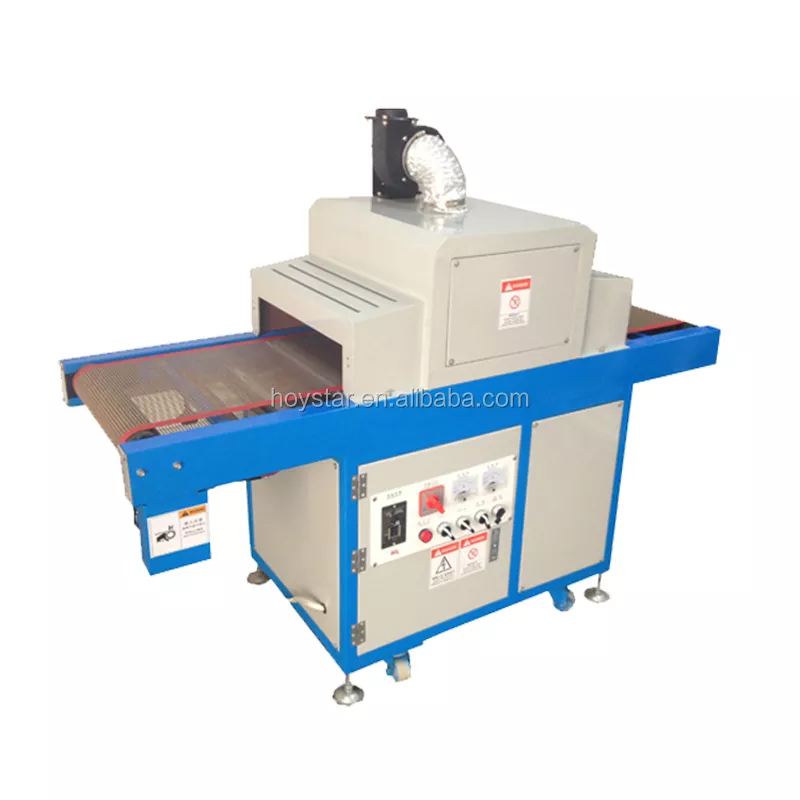
UV Dryer Curing MachineIn the fast-evolving world of industrial printing, coating, and adhesive curing, the UV Dryer Curing Machine remains the backbone of production efficiency. However, as substrate materials, inks, and adhesives diversify, many operators ask a critical question: Can a UV Dryer Curing Machine be retrofitted with a different wavelength lamp system? The short answer is yes—but the process involves far more than swapping a bulb. At HOYSTAR, we have engineered retrofitting solutions that balance performance, safety, and cost, and in this guide, we break down the technical realities, compatibility factors, and best practices for a successful upgrade.
Why Consider a Wavelength Change?
Different curing chemistries respond to specific ultraviolet spectra. Traditional mercury arc lamps emit broad-spectrum UV (200–450 nm), while LED systems deliver narrow-band outputs, typically at 365 nm, 385 nm, or 395 nm. Changing the wavelength of your UV Dryer Curing Machine can:
-
Improve adhesion on heat-sensitive films (lower thermal load with LED).
-
Cure thicker pigmented inks (longer wavelengths penetrate deeper).
-
Reduce energy costs by up to 70% with LED retrofits.
-
Eliminate ozone and mercury waste for safer operations.
However, wavelength retrofitting is not a plug-and-play operation. Below, we dissect the core components that determine feasibility.
Critical Compatibility Factors for Retrofitting
| Component | Mercury Arc Lamp System | LED Lamp System | Retrofit Feasibility |
|---|---|---|---|
| Power Supply | High-voltage ballast (AC) | Low-voltage constant current (DC) | Requires full replacement |
| Cooling Mechanism | Air-cooled with exhaust | Water-cooled or heavy-duty air | Often requires new cooling loop |
| Reflector Geometry | Elliptical/parabolic for 360° emission | Flat array for directional emission | Must redesign optical cavity |
| Control Interface | Analog dimming (0–10V) | Digital PWM or DALI | Requires new controller board |
| Housing Dimensions | Standard 300–800 mm lamp length | Modular tile arrays (custom sizes) | Often fits, but spacing changes |
At HOYSTAR, we conduct a comprehensive site audit before any retrofit. Our engineers measure the existing optical cavity depth, cooling airflow (CFM), and electrical cabinet capacity. A mismatch in any single component can lead to under-curing, overheating, or even fire hazards.
The Retrofitting Workflow (Step-by-Step)
-
Wavelength Selection – Define your peak requirement based on photo-initiator absorption curves. For example, 385 nm suits white and black inks, while 395 nm works best for yellow and magenta.
-
Thermal Assessment – LED systems emit 80% less infrared heat, but their heat sinks require precise thermal management. HOYSTAR provides thermal simulation reports before installation.
-
Electrical Upgrade – Replace the magnetic ballast with a dedicated LED driver. Ensure your facility’s input power (e.g., 380V/50Hz) matches the new driver’s tolerance.
-
Optical Alignment – Adjust the focal distance. Unlike arc lamps, LED arrays lose intensity rapidly if the curing distance deviates by even ±5 mm.
-
Integration Testing – Run a full production batch with real substrates to verify cure degree (using tape tests or MEK rubbing).
Performance Comparison: Before vs. After Retrofit
| Parameter | Original Mercury (365 nm) | Retrofitted LED (385 nm) | Improvement |
|---|---|---|---|
| Peak Irradiance (W/cm²) | 8.0 | 12.5 | +56% |
| Energy Consumption (kW/h) | 6.2 | 2.1 | -66% |
| Bulb Lifetime (hours) | 1,500 | 20,000 | +1,233% |
| Substrate Surface Temp (°C) | 68 | 39 | -43% |
| Ozone Emission | High | None | 100% eliminated |
Data measured under HOYSTAR laboratory conditions with identical conveyor speed (15 m/min).
Three Critical FAQs About UV Dryer Curing Machine Retrofitting
FAQ 1: Will changing the wavelength void my existing warranty on the UV Dryer Curing Machine?
Answer: Most manufacturers’ warranties are voided if you modify the original lamp housing, power supply, or cooling system without official authorization. However, HOYSTAR offers a full-system retrofit package that includes a new 2-year warranty on all replaced modules—plus, we retain the original components so you can revert if needed. We recommend consulting your OEM first, but many of our clients proceed with retrofits after the original warranty expires (typically after 3–5 years). If the machine is still under warranty, HOYSTAR can coordinate with the OEM to perform a joint validation test, ensuring no clause is breached.
FAQ 2: How do I know which new wavelength is right for my UV Dryer Curing Machine?
Answer: The correct wavelength depends entirely on your ink/adhesive manufacturer’s technical data sheet (TDS). Look for the “absorption peak” of the photo-initiator—this is usually between 350–420 nm. For example:
-
365 nm – Best for clear coatings and thin adhesives (high energy, short penetration).
-
385 nm – The most versatile, compatible with 80% of commercial offset and flexo inks.
-
395 nm – Ideal for thick, opaque white or metallic inks requiring deeper cure.
HOYSTAR offers a free spectrophotometric analysis of your current ink samples. We send you a compatibility report that recommends the exact LED chipset and suggests the optimal conveyor speed adjustment. Never guess—measure.
FAQ 3: Is a UV Dryer Curing Machine retrofit cost-effective compared to buying a new LED machine?
Answer: In most cases, retrofitting saves 50–70% of the cost of a brand-new UV Dryer Curing Machine. A full HOYSTAR retrofit—including new LED heads, drivers, cooling upgrades, and installation—typically ranges from $4,500 to $12,000 depending on width and power, whereas a new industrial-grade machine starts at $18,000+. The payback period is usually 8–14 months due to energy savings and reduced bulb replacements. However, if your existing conveyor, air exhaust, and control panel are over 15 years old, we often advise a partial system replacement instead of a pure retrofit. HOYSTAR provides a ROI calculator during the onsite assessment, so you make a data-driven decision, not an emotional one.
Hidden Pitfalls to Avoid
-
Inadequate cooling – LED chips degrade 30% faster if heatsink temperature exceeds 55°C.
-
Wrong focal distance – A 10 mm shift can reduce cure efficiency by 40%.
-
Dirty optical windows – Dust absorbs up to 15% of UV output; clean weekly with isopropyl alcohol.
-
Incompatible reflectors – Never reuse mercury reflectors for LED; they scatter rather than focus.
HOYSTAR includes a 3-day onsite training for your operators after every retrofit, covering cleaning cycles, intensity monitoring with a UV radiometer, and emergency shutdown protocols.
Final Verdict
Yes, a UV Dryer Curing Machine can be successfully retrofitted with a different wavelength lamp system—but only if you treat it as a systems-engineering project, not a parts swap. Wavelength changes affect power, cooling, optics, and controls simultaneously. When executed with precision, the retrofit delivers faster curing, lower energy bills, and a safer work environment. When rushed, it leads to inconsistent quality and costly downtime.
Contact HOYSTAR Today
Ready to upgrade your UV Dryer Curing Machine with a tailored wavelength retrofit? HOYSTAR offers end-to-end support—from spectral analysis and thermal modeling to installation and post-retrofit performance verification. Our team has completed over 200 successful retrofits across Europe, Asia, and the Americas. Request your free onsite audit and ROI projection now. Contact us via our website or call our technical hotline to speak directly with a curing specialist. Let’s future-proof your production line—together.