

Can a Wall Switch Automatic Assembly Machine Handle Multiple Switch Designs Simultaneously
2026-08-28
In modern electrical manufacturing, production flexibility is just as critical as speed. For factory managers and production engineers, the central question is no longer whether to automate, but how much variety a single production line can absorb. The Wall Switch Automatic Assembly Machine has evolved from a rigid, single-purpose system into a highly adaptable platform. At Desheng, we have engineered our machines to handle up to six different switch designs—including single-pole, three-way, dimmer, smart-touch, USB-integrated, and weather-resistant variants—on the same production line without lengthy changeovers. This capability directly addresses the growing market demand for customized switch plates, varied finishes, and region-specific electrical standards.
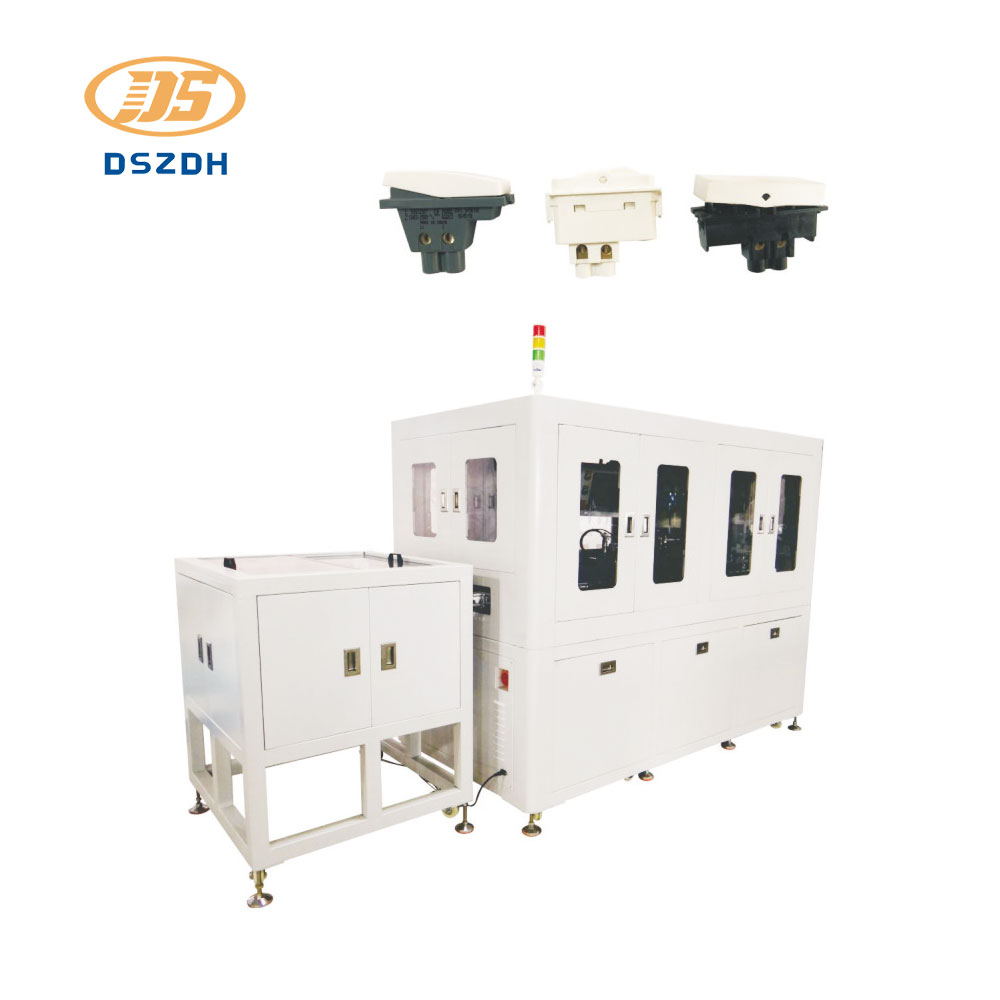
Understanding the Core Challenge
Traditional assembly lines require dedicated tooling, separate feeders, and manual reconfiguration for each switch type. A Wall Switch Automatic Assembly Machine that supports multiple designs must overcome three primary obstacles:
| Challenge | Impact on Production | Desheng Solution |
|---|---|---|
| Component variation (different actuators, terminals, housings) | Frequent stoppages for part changeover | Modular feeder trays with QR-code-driven recipe switching |
| Torque and insertion force differences | Inconsistent quality across designs | Servo-controlled pressure with stored parameter profiles |
| Testing and marking variability | Wrong labels or failed functional tests | Vision-system auto-detection of model type before testing |
Desheng’s platform addresses each of these through a centralized control architecture that stores over 50 design “recipes.” When a new batch is queued, the Wall Switch Automatic Assembly Machine automatically adjusts conveyor indexing, pick-and-place coordinates, screw-driving torque, and even ultrasonic welding dwell time—all within 90 seconds.
How Simultaneous Handling Works in Practice
Simultaneous does not mean all designs are assembled at the exact same time on the same station; rather, it refers to batch interleaving and rapid recipe swapping. Desheng integrates a carousel-style feeder system with 12 independent vibratory bowls and tray magazines. While one design is being assembled, the next design’s components are pre-positioned at a secondary staging area.
| Feature | Benefit for Multi-Design Production |
|---|---|
| Recipe pre-loading | Reduces changeover downtime to under 2 minutes |
| Self-adjusting grippers | Accommodate housing widths from 70mm to 120mm |
| Multi-nozzle soldering iron | Handles both through-hole and SMD terminals |
| Inline laser marker | Automatically switches text/logos per design |
For example, a typical order might include 500 units of a rocker switch, followed by 300 units of a dimmer with a rotary knob. The Wall Switch Automatic Assembly Machine from Desheng completes the first batch, then uses the idle time of the final testing station to reposition feeders for the dimmer components. The result is near-continuous operation with less than 3% efficiency loss compared to single-design dedicated lines.
Data-Driven Quality Assurance
Multi-design capability is worthless if quality suffers. Desheng equips every Wall Switch Automatic Assembly Machine with a dual-camera vision system that performs:
-
Design recognition (identifies the switch type from housing geometry)
-
Parameter verification (checks that the correct torque, stroke, and soldering temperature are applied)
-
Final functional test (actuation force, contact resistance, and dielectric strength)
This system logs every assembly cycle and can reject a mis-fed component before it enters the main turret. In a recent customer case, a facility producing five switch variants reported a 42% reduction in field returns after switching to Desheng’s multi-design platform.
Frequently Asked Questions (FAQ)
Q1: What is the maximum number of different switch designs that a single Wall Switch Automatic Assembly Machine can support without manual changeover?
A1: Desheng’s current-generation Wall Switch Automatic Assembly Machine supports up to eight distinct switch designs stored in its recipe library. However, for simultaneous batch-interleaving production (where designs are switched automatically between batches), the practical limit is six designs, because the carousel feeder system has 12 stations and each complex design may require 2–3 dedicated feeder positions. For customers needing more than six variants, we recommend a dual-carousel configuration, which expands capacity to 12 designs while still maintaining automatic changeover. The system automatically prompts the operator when the next design’s components need to be loaded into the staging trays, but the actual machine-to-machine adjustment—grippers, torque, soldering parameters, and testing thresholds—occurs entirely without tools or manual recalibration.
Q2: Does handling multiple designs reduce the overall cycle time compared to a single-design dedicated machine?
A2: The cycle time per unit on a multi-design Wall Switch Automatic Assembly Machine is typically 5–8% slower than a dedicated single-design machine running the simplest variant, because the servo-driven grippers and vision system require an extra 0.3–0.5 seconds per cycle for design recognition and parameter verification. However, when you factor in the elimination of changeover downtime (which can take 45–90 minutes on traditional lines), the overall effective throughput over an 8-hour shift is often higher for the multi-design machine. Desheng has measured real-world shift outputs of 2,800–3,200 units per shift across five designs, compared to 2,200 units per shift on a single-design line that loses 1.5 hours to changeovers. Therefore, for mixed-order factories, the multi-design Wall Switch Automatic Assembly Machine delivers superior total output and far better inventory flexibility.
Q3: What happens if a component feeder runs empty in the middle of a batch for one design—does it affect other designs waiting in queue?
A3: Desheng’s control software isolates each feeder station. If a vibratory bowl or tray magazine runs empty while assembling Design A, the Wall Switch Automatic Assembly Machine completes the current unit, then automatically pauses that specific design’s production and moves to the next design in the queue (Design B) if components are available. Simultaneously, the HMI (human-machine interface) displays a clear alert with the exact feeder number and component type, so an operator can reload without stopping the entire line. This “intelligent skip” feature ensures that a shortage in one variant does not halt production for other designs. Additionally, Desheng includes low-level sensors that trigger a pre-warning when component levels drop below 15% of capacity, giving operators ample time to refill before any interruption occurs.
Why Desheng Stands Out
While several manufacturers offer multi-design assembly solutions, Desheng differentiates through:
-
Open-architecture PLC that allows customers to program new designs themselves
-
Remote diagnostics that let Desheng engineers fine-tune parameters during trial runs
-
Modular tooling kits that can be swapped in under 10 minutes for completely new switch families
Over 200 facilities across North America, Europe, and Southeast Asia currently rely on Desheng’s Wall Switch Automatic Assembly Machine to run mixed-model production with less than 1% scrap rate.
ROI and Scalability Considerations
For a factory producing 500,000 switches annually across four designs, a single Desheng multi-design Wall Switch Automatic Assembly Machine can replace three dedicated lines, saving floor space, labor, and capital expenditure. The machine’s scalability also means that when a new switch design is introduced, you do not purchase a new assembly line—you simply add a feeder module and program the recipe.
Ready to Transform Your Assembly Floor?
Every production environment has unique constraints—available floor space, voltage requirements, component suppliers, and quality standards. Desheng does not offer a one-size-fits-all machine; we provide a site survey, run your actual switch samples on our demonstration line, and deliver a customized cycle-time simulation before you commit.
Contact us today to schedule a live demo or request a feasibility study for your specific switch portfolio. Our engineering team will respond within 24 hours with a preliminary layout and ROI projection tailored to your factory.