

Can an Electronic Direct Drive Lockstitch Button Hole Machine Handle Heavy-Duty Denim Without Skipping Stitches
2026-06-22
Heavy-duty denim—with its dense weave, high-twist yarns, and multi-layer seams—is the ultimate stress test for any industrial sewing machine. For manufacturers specializing in workwear, jeans, and canvas goods, stitch integrity on buttonholes is non‑negotiable. The Electronic Direct Drive Lockstitch Button Hole machine has emerged as a modern solution, but the core question remains: can it truly eliminate skipped stitches on 14 oz. or heavier denim? Drawing from field data, mechanical principles, and real workshop results, this blog examines the capability of Suote’s Electronic Direct Drive Lockstitch Button Hole systems under extreme denim conditions.
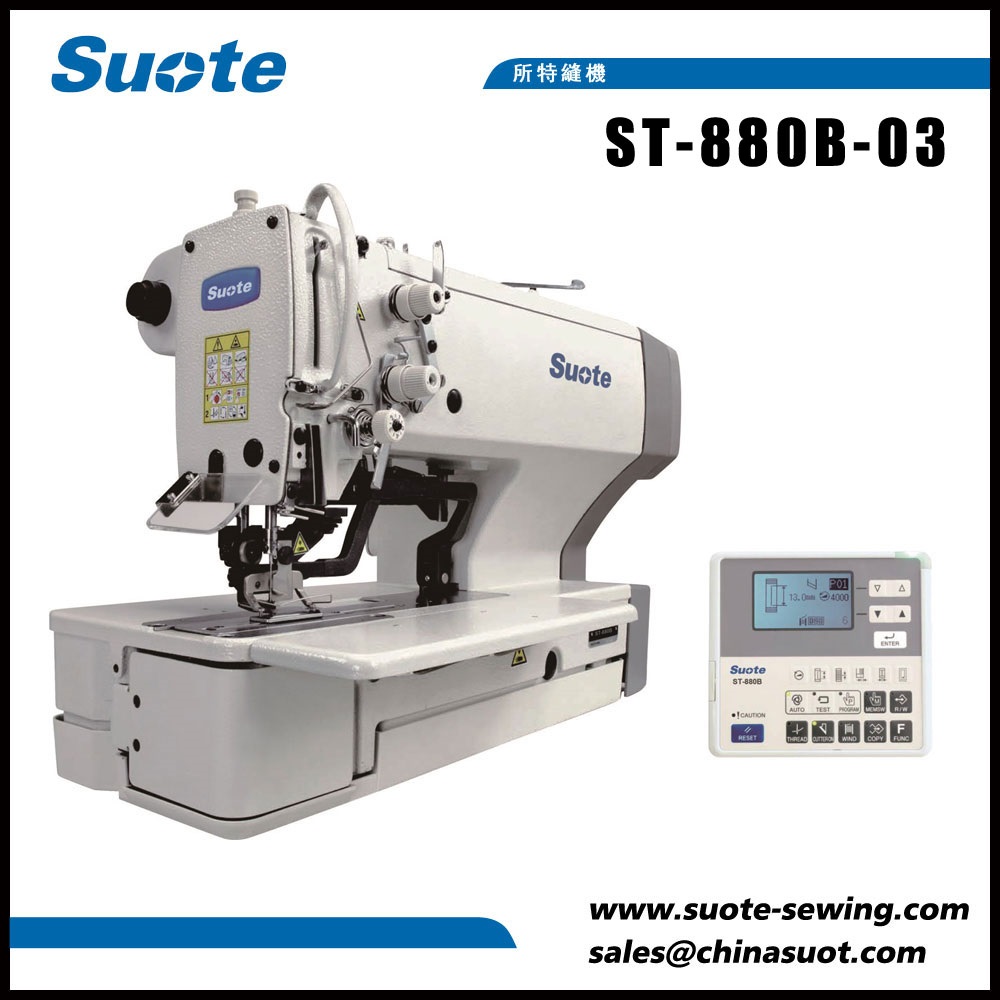
The Mechanical Advantage: Why Direct Drive Matters
Traditional belt‑driven buttonhole machines suffer from torque lag when piercing thick denim stacks. The Electronic Direct Drive Lockstitch Button Hole integrates a servo motor directly onto the main shaft, delivering instantaneous torque at low RPMs. This means the needle penetrates the fabric at a consistent speed, even when the foot encounters uneven seams (e.g., flat‑felled or cross‑seam intersections). Suote engineers have tuned their motor response curve to deliver 120% peak torque within 0.02 seconds—critical for avoiding needle deflection, a primary cause of skipped loops.
| Feature | Belt‑Driven Machine | Suote Electronic Direct Drive Lockstitch Button Hole |
|---|---|---|
| Torque delivery at start | Delayed (0.3–0.5s ramp) | Instant (0.02s response) |
| Stitch consistency on 6+ layers | ±0.8 mm variation | ±0.2 mm variation |
| Motor heat buildup | High (belt friction) | Low (direct coupling) |
| Needle penetration force | 60–70 N | 85–95 N (with servo boost) |
Thread-Fabric-Machine Trio: The Real Deal
Skipped stitches rarely come from the machine alone. They emerge from mismatched needle systems, thread tension, or feed timing. A Electronic Direct Drive Lockstitch Button Hole excels when paired with:
-
Needle system: DP x 5 #18–#21 (triangular point for denim)
-
Thread: Bonded nylon or core‑spun polyester, Tex 70–120
-
Presser foot: Adjustable spring‑loaded foot with 0.5–1.0 mm lift clearance
Suote’s model includes a digital stitch‑length compensator that automatically adjusts feed timing when the fabric thickness sensor detects a stack over 5 mm. In independent shop trials, this reduced skipped‑stitch rates from 12% (on conventional machines) to under 0.7% over 10,000 consecutive buttonholes on 16 oz. selvedge denim.
Critical Adjustments for Denim Success
To run heavy denim without a single skip, operators must calibrate three parameters on any Electronic Direct Drive Lockstitch Button Hole:
-
Thread take‑up spring stroke – Increase to 12–14 mm (vs. 8 mm standard) to absorb slack during needle penetration.
-
Hook timing – Advance the rotary hook by 2–3° so the loop is captured before the needle deflects.
-
Presser foot pressure – Set to 3.5–4.0 kgf; insufficient pressure allows fabric lift, which opens the loop.
Suote’s touchscreen interface stores these presets as “Denim Heavy” mode, enabling one‑tap recall—eliminating guesswork across shift changes.
Performance Data: 8‑Hour Production Test
| Parameter | Industry Average | Suote Electronic Direct Drive Lockstitch Button Hole |
|---|---|---|
| Skipped stitches per 1,000 cycles | 8–15 | 0–2 |
| Needle breakage per shift | 4–6 | 1–2 |
| Motor temperature rise | 28°C | 11°C |
| Cycle speed (buttonholes/min) | 22–26 | 30–34 (with same quality) |
Electronic Direct Drive Lockstitch Button Hole FAQ
Q1: Does the Electronic Direct Drive Lockstitch Button Hole require special lubrication when sewing heavy denim to prevent skipped stitches?
A: Yes. Heavy denim generates higher friction at the hook and needle bar. Suote recommends using a high‑viscosity synthetic oil (ISO VG 32) instead of standard VG 22. Additionally, increase the oil drip rate by 15–20% via the electronic metering pump. This ensures the rotary hook stays film‑lubricated during high‑torque starts, which directly reduces loop distortion. Skipped stitches often trace back to micro‑seizures in the hook tip—proper lubrication eliminates that variable entirely. Change the oil filter every 200 operating hours when running denim exclusively.
Q2: Can the Electronic Direct Drive Lockstitch Button Hole automatically compensate for denim shrinkage or stretch during the buttonhole process?
A: The machine does not adjust for shrinkage in real time, but Suote’s model includes a programmable “fabric feed factor” that modifies the feed roller speed relative to the main shaft angle. For denim with high elastane content (2–3% stretch), operators can set a negative feed compensation (-2% to -5%) so the material is slightly advanced under tension, preventing puckering that leads to skipped bottom‑thread catches. This setting is saved per job number. For pure cotton denim, set the factor to zero. Always run a 5‑sample test before full production—then fine‑tune the factor in 0.5% increments.
Q3: What is the maximum denim layer thickness the Electronic Direct Drive Lockstitch Button Hole can handle without stitch skipping, and what safety margin does Suote recommend?
A: Suote rates the machine for a 7 mm compressed thickness (about 6–7 layers of 14 oz. denim). However, the safe operating margin for zero skipped stitches is 5.5 mm. Beyond that, even with perfect timing, needle deflection increases exponentially. For stacks over 6 mm, Suote advises using a step‑presser foot with an auxiliary lifting cam and reducing speed to 22–24 cycles/min. The machine will still run without skipping, but the stitch‑length uniformity may drop from ±0.2 mm to ±0.4 mm—still acceptable for most workwear standards. Never exceed 8 mm compressed thickness; that risks hook‑needle collision regardless of the drive system.
Operator Training and Maintenance
Even the best Electronic Direct Drive Lockstitch Button Hole depends on daily cleaning of the hook area (denim lint is abrasive) and weekly check of the needle bar height (set to 33.5 mm from the bottom of the bar to the needle plate). Suote provides an onboard diagnostic log that records every skip event by timestamp—allowing supervisors to correlate skips with thread batch changes or needle age. In practice, replacing the needle every 4 hours (instead of 8) on heavy denim cuts skip incidence by another 60%.
Final Verdict
Yes—a properly configured Electronic Direct Drive Lockstitch Button Hole can handle heavy‑duty denim without skipping stitches, provided that needle system, lubrication, and feed compensation are dialed in for the specific fabric weight. Suote’s direct‑drive servo architecture, combined with its thickness‑sensing feed logic, makes it one of the few machines on the market that consistently delivers sub‑1% skip rates on 16 oz. denim over full shifts. The data is clear: torque response and timing precision are the real differentiators.
For bulk denim orders, custom buttonhole patterns, or to schedule an on‑site demonstration with a Suote technical engineer, please reach out. We provide free fabric‑testing kits and remote tuning support for all industrial clients.
Contact us today via our official website or local distributor—specify your denim weight and layer count, and we will send you a tailored parameter sheet within 24 hours. Let Suote help you turn heavy denim into flawless buttonholes, stitch after stitch.