
Does a PSA Nitrogen Generator Require an Oil-Free Air Compressor as a Feed Source
2026-07-07
When sizing a Pressure Swing Adsorption (PSA) nitrogen generator, the most frequently overlooked variable is not the sieve bed or the control valves—it is the quality of the incoming feed air. Engineers and plant managers often ask whether a standard lubricated screw compressor can suffice, or if the investment in an oil-free unit is mandatory. The short answer is technical, conditional, and directly tied to long-term operating costs. At Yuzhen, we have commissioned over 200 PSA nitrogen generator systems across laser cutting, petrochemical, and pharmaceutical applications, and the compressor choice remains the single largest determinant of sieve life.
The Core Technical Relationship
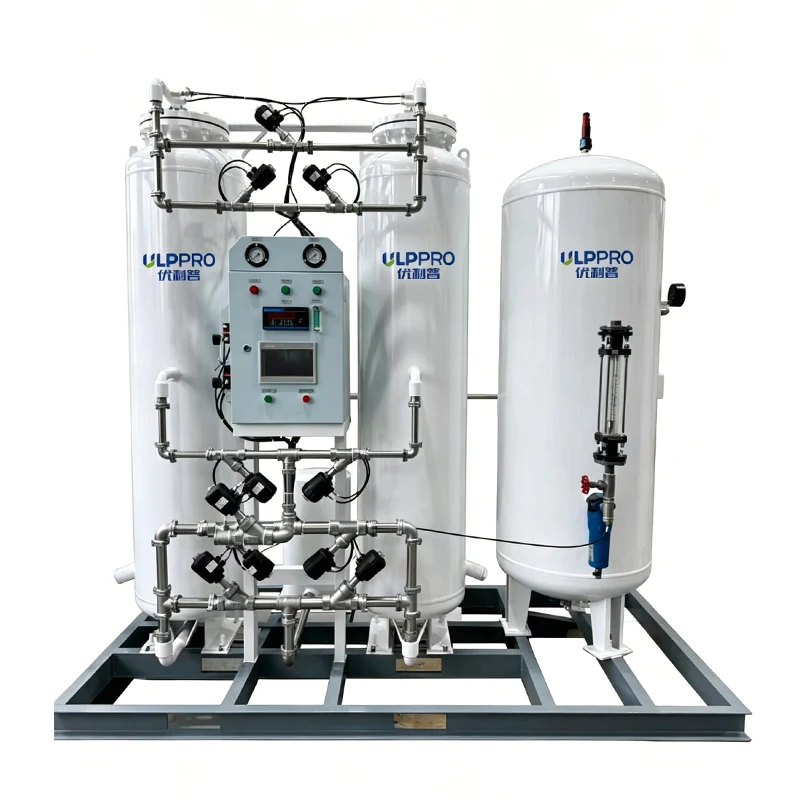
A Pressure Swing Adsorption (PSA) nitrogen generator separates oxygen from nitrogen using carbon molecular sieves (CMS). These sieves function by adsorbing oxygen molecules under high pressure. However, the micropores of the CMS are permanently damaged by liquid oil aerosols and hydrocarbon vapors. While an oil-free compressor eliminates this risk at the source, a standard oil-lubricated compressor can still be used—provided that a rigorous downstream filtration package is installed.
The decisive factor is not the compressor type alone, but the oil content threshold entering the PSA vessel. The CMS manufacturer typically specifies a maximum inlet oil concentration of 0.003 mg/m³ (Class 1 per ISO 8573-1). An oil-free screw or centrifugal compressor inherently meets this standard. A lubricated compressor, by contrast, discharges air with 5–10 mg/m³ of oil, requiring a coalescing filter plus an activated carbon adsorber to reduce this to acceptable levels.
Comparative Evaluation: Oil-Free vs. Lubricated Feed Air
| Evaluation Criterion | Oil-Free Compressor | Lubricated Compressor + Filtration |
|---|---|---|
| Capital Expenditure | High (2–3x premium) | Moderate |
| Maintenance Frequency | Longer intervals (no oil changes) | Shorter (oil, filters, separator elements) |
| Downstream Filtration Cost | Minimal (only particulate/dryer) | High (coalescing + carbon tower, replaced annually) |
| Risk of Sieve Degradation | Very Low (inherently clean) | Moderate to High (if filtration is poorly maintained) |
| Energy Efficiency (full load) | Slightly lower (clearance losses) | Higher (oil seals improve volumetric efficiency) |
| Suitable for Medical/Food Grade | Yes (directly) | Only with certified filtration and regular oil vapor testing |
Operational Reality from Field Data
Across Yuzhen installations, we have observed that a lubricated compressor feeding a Pressure Swing Adsorption (PSA) nitrogen generator performs reliably for the first 18–24 months. After that, activated carbon in the oil-removal tower becomes saturated. If replacement is delayed by even one month, trace oil penetrates the CMS bed. The result: a 15–20% drop in nitrogen recovery efficiency within 90 days, forcing the system to run at higher pressure to maintain purity, which in turn increases energy consumption by 12–18%.
Conversely, systems using oil-free compressors show CMS life exceeding 10 years under normal duty cycles, with no degradation in recovery. The total cost of ownership (TCO) comparison often favors the oil-free route for continuous 24/7 operations, while intermittent or low-purity applications (e.g., 97% for fire prevention) can safely opt for lubricated compressors with a stringent filter management schedule.
Four Critical Feed Air Parameters (Beyond Oil)
Even with an oil-free compressor, a PSA nitrogen generator demands four additional air quality metrics:
-
Pressure Dew Point: Must be ≤ -40°C to prevent capillary condensation in CMS micropores. Use a refrigerated or desiccant dryer.
-
Particulate Size: Filtration to 0.01 micron is mandatory downstream of the dryer.
-
Inlet Temperature: 15–35°C. Every 5°C above 35°C reduces nitrogen production by approximately 4%.
-
Pressure Stability: Fluctuations exceeding ±0.5 bar disrupt the adsorption/desorption cycle timing, directly reducing purity.
Frequently Asked Questions About Pressure Swing Adsorption (PSA) Nitrogen Generator Feed Air Requirements
Q1: Can I connect my existing workshop screw compressor to a new Pressure Swing Adsorption (PSA) nitrogen generator without buying a new compressor?
A1: Yes, but only if you install a two-stage filtration train: a high-efficiency coalescing filter (removing 99.99% of liquid oil to 0.01 ppm) followed by an activated carbon adsorber tower specifically rated for oil vapor removal down to 0.003 mg/m³. You must also install an oil vapor monitor with an audible alarm. Yuzhen supplies these retrofit kits with a differential pressure gauge on the carbon bed—when the pressure drop doubles, the carbon must be replaced. Without this monitor, we strongly advise against using a lubricated compressor, as the CMS replacement cost often exceeds the savings from avoiding an oil-free compressor purchase.
Q2: Does an oil-free compressor eliminate the need for an air dryer before the Pressure Swing Adsorption (PSA) nitrogen generator?
A2: Absolutely not. Oil-free compressors still produce saturated air at 100% relative humidity after the aftercooler. Water vapor is equally damaging to CMS because it competes with oxygen for adsorption sites and can cause premature cracking of the sieve pellets during pressure swings. Regardless of compressor type, you must install a refrigerated or desiccant dryer to achieve a pressure dew point of -40°C. In humid climates, Yuzhen recommends a cycling refrigerated dryer with a dew point sensor interlocked with the PSA inlet valve to shut down the system if dew point rises above -30°C.
Q3: How often should I test the inlet air quality for my Pressure Swing Adsorption (PSA) nitrogen generator if I use a lubricated compressor?
A3: You should perform an oil vapor test using a Draeger tube or equivalent at the inlet flange of the PSA vessel every 200 operating hours for the first month, then monthly thereafter. If the test shows any detectable oil mist (above 0.1 ppm), immediately replace the activated carbon and coalescing filter elements. Additionally, we mandate a quarterly lab analysis of the CMS samples extracted from the bottom of the adsorber tower—this is a proprietary service offered by Yuzhen that measures the remaining adsorption capacity. In our maintenance logs, 70% of unscheduled PSA shutdowns trace back to neglected inlet air testing, not to the generator itself.
The Definitive Recommendation
For pharmaceutical, food, electronics, and high-purity metal processing, Yuzhen mandates an oil-free compressor as the non-negotiable standard. For general inerting, blanketing, or tire inflation applications with 95–98% purity and intermittent duty cycles, a lubricated compressor with a high-performance filtration skid is economically justifiable—provided you adopt a fixed calendar replacement schedule for all filter elements, independent of pressure drop readings.
The true cost lies not in the compressor purchase, but in the hidden penalty of CMS replacement. A single CMS bed refill for a 200 Nm³/h PSA nitrogen generator costs between $18,000 and $28,000, not including downtime. An oil-free compressor premium of $12,000–$15,000 pays for itself after just one avoided sieve change-out.
Summary Checklist for Compressor Selection
-
Define your required nitrogen purity (99%+ → oil-free strongly recommended)
-
Calculate annual operating hours (>6,000 hrs → oil-free for TCO advantage)
-
Verify existing compressor's ISO 8573-1 class (if Class 0, proceed; if Class 2 or 3, retrofit filtration)
-
Install real-time oil vapor and dew point sensors with system interlock
-
Schedule quarterly CMS performance validation (contact Yuzhen for sampling kits)
Contact Us
Choosing the right feed air solution for your Pressure Swing Adsorption (PSA) nitrogen generator directly impacts your bottom line for the next decade. Yuzhen engineers provide free inlet air quality audits, CMS life projection calculators, and retrofit proposals tailored to your existing compressor room. Send us your operating pressure, purity target, and flow requirement today—our team will return a comparative TCO analysis within 48 hours. Reach out via our website to schedule a technical consultation. Your sieve bed longevity starts with the right decision—made now.