

Essential Maintenance Practices for Maximizing the Lifespan of a Fly Shearing Cut-To-Length Line
2026-04-24
A Fly Shearing Cut-To-Length Line is a high-speed precision system used to cut metal coils to predetermined lengths without stopping the material flow. To ensure decades of reliable operation and protect your capital investment, KINGREAL recommends implementing a structured maintenance regimen. Below are the essential practices that directly extend the service life of your Fly Shearing Cut-To-Length Line.
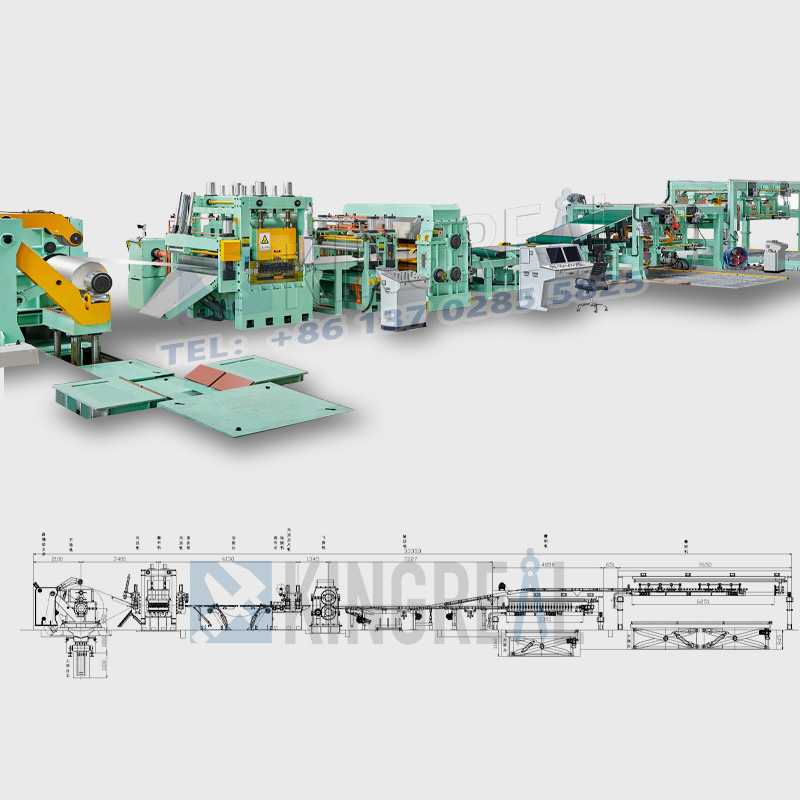
Core Maintenance Practices at a Glance
| Maintenance Area | Frequency | Key Actions | Impact on Lifespan |
|---|---|---|---|
| Shear Blade Inspection | Daily | Check for wear, chips, and gap alignment | Prevents catastrophic blade breakage and material defects |
| Fly Knife Cylinder Lubrication | Weekly | Apply high-pressure grease to pivot points | Reduces friction fatigue on mechanical joints |
| Encoder & Sensor Calibration | Monthly | Verify zero position and cutting signal timing | Maintains cut accuracy and avoids servo overload |
| Drive Belt & Coupling Tension | Quarterly | Measure tension and realign couplings | Eliminates vibration-induced bearing failure |
| Hydraulic Fluid Analysis | Semi-annually | Test for contamination and viscosity breakdown | Prevents valve sticking and cylinder scoring |
Detailed Preventive Actions
-
Blade Gap Optimization – Even a 0.01mm deviation in blade clearance on a Fly Shearing Cut-To-Length Line will increase shear force by up to 18%, accelerating wear on the fly knife mechanism. KINGREAL supplies laser-aligned blade fixtures to maintain factory tolerance.
-
Electrical Cabinet Climate Control – Dust accumulation on PLC and servo drives causes overheating. Use filtered positive-pressure cabinets. A KINGREAL case study showed that climate-controlled cabinets doubled the MTBF (Mean Time Between Failures) on fly shearing controls.
-
Linear Guide Rail Care – The flying shear carriage moves at speeds exceeding 120 m/min. Clean and relubricate rails every 200 operating hours using NLGI 2 lithium-based grease.
Fly Shearing Cut-To-Length Line FAQ – Common Questions
Q1: How often should I replace the shear blades on a Fly Shearing Cut-To-Length Line?
A: Blade replacement intervals depend on material type and throughput. For mild steel (≤4mm thickness), KINGREAL recommends inspecting blades every 200,000 cuts and reversing blades at 500,000 cuts. Full replacement is typically needed after 1.5 million cuts or when burr height exceeds 0.1mm. For abrasive materials like galvanized or stainless steel, reduce these intervals by 40%. Always use matched pairs of blades to maintain dynamic balance of the fly shear rotor.
Q2: What are the signs that my Fly Shearing Cut-To-Length Line requires immediate maintenance?
A: Three critical warning signs: (1) Uneven cut ends – indicates blade gap drift or carriage guide wear; (2) High-frequency vibration during fl y cutting – often caused by worn couplings or unbalanced fly knife cylinder; (3) Position deviation alarms – suggests encoder coupling slippage or backlash in the linear drive. Ignoring these symptoms can lead to catastrophic damage to the shear head, costing 4-5x more than routine maintenance. KINGREAL service engineers recommend immediate operational stop if any of these signs appear.
Q3: Does lubrication type affect the overall lifespan of a Fly Shearing Cut-To-Length Line?
A: Absolutely. Using the wrong lubricant is one of the fastest ways to shorten equipment life. The fly shear carriage requires high-speed, low-friction grease (e.g., Kluber Isoflex NBU 15). Never mix lithium-based and polyurea greases – incompatible thickeners form abrasive sludge. For the rotary shear drum bearings, KINGREAL specifies oil-mist lubrication at 8–10 drops per minute. Incorrect lubrication causes 34% of premature bearing failures in fly shearing lines, according to industrial reliability studies.
Long-term Strategy: Proactive Replacement Planning
Create a digital log for each Fly Shearing Cut-To-Length Line. Track vibrations using an accelerometer mounted on the fly knife housing. When RMS velocity exceeds 4.5 mm/s, schedule a bearing review. KINGREAL offers a predictive maintenance kit (model KM-FLY-PM) that includes vibration sensors, blade gap gauges, and OEM-certified hydraulic seals.
Keep a spare fly knife cylinder and one set of linear guides. Lead times for these customized components can exceed 8 weeks. Downtime of a Fly Shearing Cut-To-Length Line typically costs $2,500–$5,000 per hour in lost production, making parts inventory a financial necessity.
Need Expert Support for Your Fly Shearing Cut-To-Length Line?
Every Fly Shearing Cut-To-Length Line has unique wear patterns based on coil width, material strength, and cycle rate. KINGREAL provides on-site maintenance training, remote vibration diagnostics, and next-day blade delivery for critical orders. Contact our service team today to schedule a free line audit and receive a customized maintenance checklist tailored to your production schedule.