

How Can a Customized Automatic Machine Solve Real Production Bottlenecks Without Adding New Complexity?
2026-05-07
When I look at modern manufacturing challenges, I do not see a simple labor problem or a simple speed problem. I usually see a chain reaction of waste, inconsistency, rework, delayed delivery, and rising operating pressure. That is exactly why companies gradually turn to partners like Zhejiang Desheng Intelligent Equipment Tech. Co., Ltd. when they need a more practical path to automation. In my view, a well-designed Customized Automatic Machine is not just equipment placed on a factory floor. It is a production tool built around the actual product, the real process, and the daily pain points that standard machines often fail to solve.
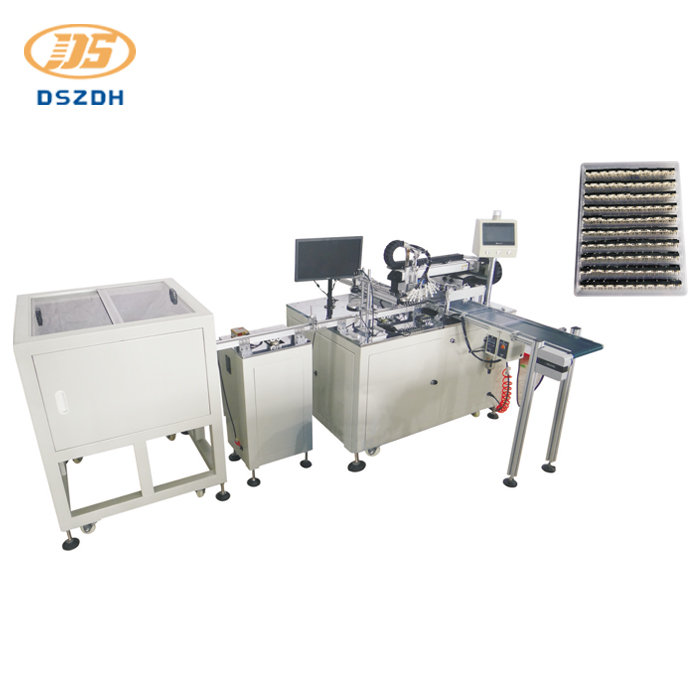
Why Do So Many Standard Machines Fail in Real-World Production?
I have noticed that many manufacturers start with a standard machine because it seems faster to purchase and easier to compare. On paper, that decision looks efficient. In practice, the machine often does not match the product structure, takt time, material behavior, accuracy target, or inspection needs. Then the team begins making compromises.
- I see operators adapting the process to fit the machine instead of using a machine that fits the process.
- I see engineering teams adding manual checks to cover gaps in automation.
- I see production managers accepting unstable output because replacement costs feel too high.
- I see quality teams spending more time on correction than prevention.
That is where a Customized Automatic Machine becomes valuable. It allows me to think from the product backward rather than forcing the product through a generic production route. Instead of asking whether a machine can basically run a part, I can ask whether it can run the part accurately, repeatedly, and profitably.
What Problems Can a Customized Automatic Machine Help Me Fix First?
When I evaluate automation from a buyer’s perspective, I focus on pain points that directly affect margins, scheduling, and customer trust. A properly engineered solution should not only automate movement. It should improve decision points within production.
| Production Pain Point | What Usually Happens Without Customization | How Custom Automation Helps |
| Labor dependence | Output changes with staffing level, skill level, and shift stability | Reduces manual handling and creates more predictable throughput |
| Inconsistent quality | Assembly and inspection vary from person to person | Standardizes critical actions and improves repeatability |
| Slow cycle times | Manual processes create bottlenecks between stations | Integrates multiple steps into a smoother workflow |
| High defect cost | Problems are found too late, after value has already been added | Supports earlier detection, inline control, and reduced rework |
| Frequent product variation | Standard equipment struggles to adapt to specific parts | Can be built around the dimensions, tolerances, and process logic of the product |
| Difficult expansion | Old processes do not scale well when orders grow | Creates a stronger base for future capacity planning |
For me, the biggest benefit is not simply replacing labor. The bigger value comes from turning unstable production into controllable production.
How Do I Know Whether Custom Automation Is Better Than Semi-Automation?
I would not automatically say that every factory needs a fully automated line. That would be careless. What I do believe is that the right decision depends on product complexity, output target, defect sensitivity, and future order expectations. Some businesses do well with semi-automatic equipment for a period of time. Others lose money every month because semi-automation leaves too many variables unresolved.
I usually compare the options this way.
| Decision Factor | Semi-Automatic Approach | Customized Automatic Approach |
| Initial investment | Often lower | Often higher but more process-focused |
| Labor requirement | Still significant | Usually reduced more deeply |
| Process consistency | Partly dependent on operator skill | More standardized when engineered well |
| Scalability | Can become a limitation as orders rise | Usually better suited for long-term expansion |
| Complex product adaptation | Limited in some applications | Designed around the actual product requirement |
| Return through defect reduction | Moderate | Potentially stronger in high-precision or repetitive processes |
If my product has repeated assembly actions, precision demands, inspection points, or labor-heavy handling steps, a Customized Automatic Machine often becomes the more sensible long-term choice.
Which Features Matter Most When I Evaluate a Customized Automatic Machine Supplier?
I do not judge a supplier only by whether they can manufacture a machine body. I care more about whether they understand process logic. A machine that looks solid but does not match the application will still become an expensive problem.
When I review a supplier, I pay attention to these areas.
- Process understanding so the solution addresses real assembly, feeding, testing, transfer, or inspection issues
- Customization capability so the machine can match part geometry, product variation, and output goals
- Integration thinking so separate operations can work together instead of creating new bottlenecks
- Stability focus so performance is not built around ideal conditions only
- Service communication so design changes and technical feedback do not become slow and frustrating
- Manufacturing practicality so the machine is not overcomplicated for the site that will actually use it
What I appreciate about a specialized automation manufacturer is the ability to move from concept to a more application-driven solution. That matters much more than flashy wording.
What Makes a Customized Automatic Machine More Valuable Than a Generic Speed Upgrade?
Many buyers first ask about speed, and I understand why. Throughput is easy to measure and easy to report upward. But I would be careful about treating speed as the only benchmark. If speed rises while feeding remains unstable, alignment drifts, inspection is delayed, or changeover becomes harder, the factory may only be accelerating waste.
The real value of custom automation usually comes from a wider set of improvements.
- I can reduce repetitive manual handling that often creates hidden inefficiency.
- I can improve assembly consistency across shifts.
- I can build inspection logic into the process rather than adding it only at the end.
- I can make cycle time more predictable for delivery planning.
- I can lower dependence on highly repetitive labor in difficult positions.
- I can improve overall line balance when multiple steps are connected logically.
So when I assess value, I ask a better question. I do not ask only whether the machine is fast. I ask whether the machine helps me produce good parts, on time, with less disruption.
How Can I Reduce Project Risk Before Buying Custom Equipment?
This is where many buyers become cautious, and honestly, they should. Custom equipment must be evaluated carefully because the wrong specification can waste both money and time. I would never recommend rushing through this stage.
These are the questions I would raise before moving forward.
- What exact process steps need to be automated?
- What product drawings, samples, or dimensional requirements are available?
- What output target is realistic for daily production rather than only peak demonstration conditions?
- What defect types are currently most expensive?
- What level of operator involvement is acceptable after installation?
- What future product changes might affect the machine design?
- What installation space, power conditions, and production flow limits already exist onsite?
When I clarify those points early, I reduce the chance of buying a machine that performs well in presentation material but poorly in daily manufacturing.
Why Does Industry-Specific Design Matter So Much in Automation?
Not every product behaves the same way in production. Small electrical parts, switch components, contact assemblies, socket and plug elements, relay-related parts, and auto parts all bring different demands. Feeding methods, orientation control, insertion force, riveting precision, testing logic, and packaging requirements can vary sharply.
That is why I do not trust broad promises that one machine architecture fits everything. A Customized Automatic Machine should reflect the mechanics of the actual product and the quality expectations behind it. That design logic is often the line between a machine that runs and a machine that truly supports business growth.
| Application Concern | Why It Matters in Equipment Design |
| Part orientation | Incorrect orientation can interrupt the entire cycle and reduce output stability |
| Assembly precision | Minor positioning errors can create electrical or mechanical failure later |
| Testing requirement | Inline validation can prevent poor-quality products from moving downstream |
| Product variation | Machines must handle model differences without creating constant adjustment problems |
| Transfer logic | Unstable transfer between stations often becomes a hidden bottleneck |
| Operator interaction | Human-machine coordination still matters for maintenance, replenishment, and monitoring |
To me, strong automation design always starts with process reality, not with generic claims.
What Return Can I Expect From a Better-Fit Automation Solution?
I prefer to think about return in layers. The direct return may come from labor reduction, higher output, or lower scrap. But some of the most important returns are less obvious at first.
- I can quote more confidently when production becomes more predictable.
- I can reduce late delivery risk caused by unstable manual processes.
- I can improve customer confidence when quality becomes more consistent.
- I can support future scale without rebuilding the production model from zero.
- I can reduce internal management pressure because process control becomes easier.
That is why I see a Customized Automatic Machine not just as a purchasing item, but as an operational decision. The machine affects scheduling, labor planning, defect control, and even how comfortably I can accept new orders.
How Should I Choose the Right Automation Partner Instead of Just the Lowest Quote?
I understand the temptation to compare only by price. Procurement teams are under pressure, and budget matters. Still, when I choose only the lowest quote, I may end up paying later through weak design logic, unstable output, slow support, or limited adaptability.
I would rather evaluate the full picture.
- Does the supplier ask detailed questions about my product and process?
- Do they understand the difference between automation for display and automation for continuous production?
- Can they discuss feeding, assembly, testing, transfer, and quality control in one connected conversation?
- Do they appear focused on solving pain points rather than simply selling a machine category?
- Can they communicate clearly enough to support technical alignment during the project?
When the answers are yes, I feel much more confident about the investment. In automation, clarity is often more valuable than aggressive promises.
Is Now the Right Time to Invest in a Customized Automatic Machine?
If I am already dealing with repeated labor shortages, rising quality claims, unstable cycle times, frequent manual intervention, or production limits caused by product complexity, then waiting too long may cost more than acting. The right timing is usually not when the factory is perfectly comfortable. The right timing is when existing methods are clearly blocking efficiency, consistency, or growth.
From my perspective, the strongest reason to move toward a Customized Automatic Machine is not fashion or trend pressure. It is operational logic. When a machine is built around the real application, it can help solve the very issues that generic equipment leaves behind.
If you are reviewing your production process and wondering whether a better-fit automation solution could reduce labor pressure, improve consistency, and support long-term output goals, this is the right moment to take the conversation seriously. If you want to discuss your product, workflow, or project requirements in more detail, contact us and leave your inquiry. I would strongly encourage you to connect with Zhejiang Desheng Intelligent Equipment Tech. Co., Ltd. to explore what a practical Customized Automatic Machine solution could look like for your business.