

How Can Automatic Assembly Equipment Help Manufacturers Build More Stable Output Without Losing Flexibility?
2026-05-19
When I look at modern electrical product manufacturing, I see one clear challenge repeated across many factories: customers want faster delivery, tighter consistency, and lower defect rates, yet production teams still need room to handle different product designs. This is where I naturally pay attention to companies such as Zhejiang Desheng Intelligent Equipment Tech. Co., Ltd., a manufacturer focused on intelligent automation solutions for switch, socket, plug, relay, low-voltage electrical, precision electronics, auto parts, and related industries. For buyers comparing production upgrades, Automatic Assembly Equipment is no longer just a machine purchase. It is a way to reduce unstable manual work, improve process control, and make daily production easier to manage.
I have seen many factories hesitate before investing in automation because the decision feels complex. They worry about compatibility, operator training, product changeovers, maintenance, and whether the equipment can truly match their production rhythm. These concerns are reasonable. A good automation project should not force the factory to adapt blindly to the machine. The machine should be designed around the product structure, assembly sequence, quality control points, and long-term production goals.
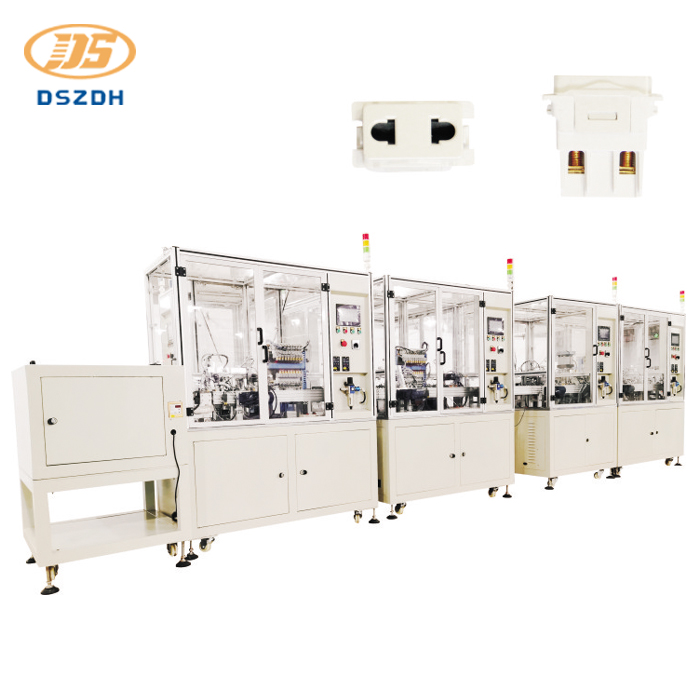
Why Does Manual Assembly Become A Bottleneck As Orders Increase?
Manual assembly may work well during the early stage of production, especially when order volume is small or product models change frequently. However, once demand becomes stable, manual work often creates hidden pressure. I usually see the same problems appear again and again.
- Different operators may assemble parts with slightly different force, speed, and accuracy.
- Small components such as terminals, springs, screws, covers, and plug inserts can be misplaced or missed.
- Inspection depends heavily on worker attention, which may drop during long shifts.
- Production speed becomes difficult to increase without adding more labor.
- Training new workers takes time, especially for products with detailed assembly steps.
- Quality data is harder to collect when each process depends on separate manual stations.
For socket and plug products, these problems matter even more because assembly quality is directly connected with safety, fit, electrical performance, and user experience. A loose part, poor insertion force, missing component, or unstable test result can lead to rework, returns, or customer complaints. That is why I see many manufacturers moving toward Automatic Assembly Equipment when they want more predictable production.
What Should Buyers Expect From Automatic Assembly Equipment In Real Production?
I do not view automation as a simple replacement for labor. A well-designed system should connect feeding, positioning, assembling, testing, counting, and unloading into a controlled production flow. For socket and plug applications, this may include automatic feeding of bases, plug bushes, cabling buckles, covers, screws, terminals, or other product-specific components.
In practical terms, Automatic Assembly Equipment should help manufacturers solve three major issues: speed, consistency, and traceable quality. Speed is easy to understand, but consistency is often more valuable. When every station works with controlled movement, stable pressure, fixed timing, and clear detection logic, the production result becomes easier to repeat.
For me, the best equipment is not the one that only runs fast in a showroom. It is the one that keeps running reliably in a real factory, with real operators, real components, and real production pressure.
| Production Concern | How Automation Helps | Value For Buyers |
|---|---|---|
| Unstable manual assembly | Uses controlled stations for feeding, insertion, pressing, screw fixing, and testing | Improves product consistency and reduces rework |
| Labor dependency | Reduces repetitive handwork and simplifies operator tasks | Helps factories manage labor pressure more efficiently |
| Missed parts or wrong assembly | Applies part presence detection and process confirmation | Lowers the risk of defective products entering later stages |
| Quality inspection gaps | Integrates testing such as force checks or product separation logic | Supports more reliable quality control before shipment |
| Different product requirements | Can be customized according to product structure and assembly sequence | Improves project fit instead of forcing a standard machine onto every product |
How Does The Right Equipment Improve Socket And Plug Assembly Quality?
Socket and plug assembly requires more than placing parts together. The equipment must understand the sequence of the product. For example, some parts need to be loaded before others. Some components require accurate orientation. Certain stations need to confirm whether the part is present before the next movement begins. Testing and sorting also need to happen before finished products move forward.
This is why I consider process design one of the most important parts of choosing Automatic Assembly Equipment. A strong system may include vibratory bowl feeding, automatic positioning, component insertion, screw locking, automatic detection, touch screen operation, counting functions, and separation of qualified and unqualified products.
For factories producing sockets or plugs, these functions can make a visible difference in daily operations. Operators no longer need to manually check every small step. Instead, they supervise the system, handle material supply, monitor alarms, and focus on stable output. That shift can help production managers reduce human error while keeping the line easier to control.
- I would look for stable component feeding because poor feeding creates downtime.
- I would check whether the machine detects missing or incorrectly placed parts.
- I would confirm whether the machine can separate good and defective products automatically.
- I would ask how the equipment handles product counting and output settings.
- I would pay attention to whether the touch screen interface is clear for operators.
- I would review whether the design allows future adjustment for similar product models.
Which Features Matter Most When Comparing Automatic Assembly Equipment Suppliers?
When I compare suppliers, I do not only look at machine appearance or a short product description. I look at whether the supplier understands manufacturing details. A supplier should be able to discuss the product structure, component tolerance, assembly force, testing requirements, output expectations, operator habits, and after-sales support.
For customized automation, communication matters. If a supplier does not ask enough technical questions, the final equipment may fail to match the actual production need. This is especially true for electrical accessories, where small design differences can change the assembly method.
| Selection Point | What I Would Ask | Why It Matters |
|---|---|---|
| Customization ability | Can the machine be designed around my product sample and production process? | Socket and plug structures may vary by market, standard, and design. |
| Process integration | Can feeding, assembly, detection, testing, and unloading be connected smoothly? | A complete flow reduces manual transfer and improves efficiency. |
| Control system | Is the equipment easy to operate, adjust, and monitor? | Operators need practical control, not complicated daily handling. |
| Testing function | Can the machine check key quality points before product output? | Testing helps prevent defective products from reaching customers. |
| Service support | Can the supplier provide clear technical communication and support after delivery? | Automation projects need cooperation before and after installation. |
How Can Customized Automatic Assembly Equipment Reduce Long Term Production Cost?
Many buyers first think about equipment price. I understand that. A machine investment must make financial sense. However, I prefer to calculate cost from a longer view. The real question is not only how much the equipment costs today, but how much instability, rework, slow output, wasted labor, and quality complaints cost over the next several years.
Customized Automatic Assembly Equipment can reduce long-term cost by improving repeatability. When the line performs assembly and inspection in a fixed process, the factory can reduce unnecessary handling and improve production planning. Stable equipment also makes it easier to train operators because the work becomes more standardized.
For growing manufacturers, this can support more reliable order fulfillment. When a customer increases order volume or requests more consistent quality, the factory can respond with a controlled production line rather than relying only on overtime or temporary workers.
- Lower labor intensity for repetitive assembly tasks
- Fewer defects caused by missed parts or inconsistent manual operation
- Better use of floor space through integrated production stations
- More predictable production output for planning and delivery
- Improved inspection control before finished products are packed
- Stronger ability to handle stable batch production
Why Is Product Testing Important Inside The Assembly Line?
I believe testing should not be treated as an afterthought. If a product is assembled first and checked much later, defects may already have moved through several production stages. That wastes time and increases sorting difficulty. When testing is built into the assembly process, the line can detect problems earlier.
For socket and plug manufacturing, testing may involve part presence, insertion and extraction force, assembly position, product count, and separation of qualified and unqualified products. The exact testing method depends on the product. What matters is that the equipment helps the factory catch problems before they become shipment problems.
This is one reason Automatic Assembly Equipment can be valuable for export-oriented manufacturers. Buyers in competitive markets do not only care about low price. They care about consistent batches, fewer complaints, and suppliers who can keep quality stable order after order.
How Should I Prepare Before Requesting A Quotation?
When I request a quotation for automation equipment, I try to provide enough information from the beginning. A vague inquiry usually leads to vague answers. A professional supplier needs product details before recommending a suitable machine structure.
Here is the information I would prepare before contacting a supplier:
- Product drawings, samples, or clear photos from different angles
- Target production capacity per minute or per hour
- List of components that need automatic feeding and assembly
- Current manual assembly process or existing production pain points
- Testing requirements for finished or semi-finished products
- Voltage, air pressure, factory layout, and available installation space
- Expected product models and whether future changeover is needed
- Packaging or downstream process requirements after assembly
Providing these details allows the supplier to design a more realistic solution. It also helps both sides avoid misunderstandings about machine capacity, function range, and customization requirements.
Is Automatic Assembly Equipment Suitable Only For Large Factories?
I do not think so. Large factories may benefit from automation first because their volume is higher, but medium-sized manufacturers can also gain value if they have stable product demand and clear quality requirements. The key is whether the equipment matches the business stage.
If a factory produces many small batches with constantly changing product designs, full automation may need careful evaluation. A semi-automatic or modular design may be more practical. If the factory produces stable socket, plug, switch, relay, or low-voltage electrical products, then Automatic Assembly Equipment may bring stronger returns because the production process can be repeated over time.
In my view, automation should be introduced with a clear purpose. It should not be purchased just because competitors are buying machines. It should solve a specific bottleneck, such as unstable output, high defect rate, difficult recruitment, slow delivery, or rising labor cost.
What Makes Desheng A Practical Choice For Electrical Product Automation?
From a buyer’s perspective, I would pay attention to Desheng because its product direction is closely connected with electrical product automation. The company covers automatic assembly machines, socket and plug automatic assembly solutions, relay automatic assembly equipment, automatic testing machines, and customized automatic machines. This product range is useful because many electrical manufacturers do not need a one-size-fits-all machine. They need a supplier that can understand different component structures and production steps.
For socket and plug manufacturers, Zhejiang Desheng Intelligent Equipment Tech. Co., Ltd. can provide equipment concepts that combine automatic feeding, assembling, testing, counting, and product separation. Instead of treating automation as a single station, the solution can be planned around the full assembly route. That is the kind of thinking I would look for when selecting Automatic Assembly Equipment for long-term production.
I also value customization because socket and plug products often vary by region and standard. A two-hole socket, three-hole socket, two-pin plug, or other plug socket product may require different feeding methods, fixtures, stations, and testing points. A practical supplier should be able to discuss these differences before finalizing the machine design.
How Can Automatic Assembly Equipment Support Better Customer Trust?
Customer trust is built through repeatable performance. When buyers receive one good batch and then another good batch, confidence grows. Automation helps manufacturers protect that consistency because key steps are controlled by the machine rather than left entirely to manual variation.
This does not mean people become unimportant. In fact, skilled engineers and operators become more important because they manage the process, maintain the equipment, adjust settings, and review quality data. The difference is that their work becomes more focused and less dependent on repetitive manual assembly.
For factories competing in electrical accessories, appliances, low-voltage components, or related industries, this can become a real advantage. Better consistency supports stronger customer relationships. Faster production supports better delivery. Integrated testing supports fewer quality disputes. Together, these improvements make the supplier more dependable in the eyes of buyers.
How Do I Know If It Is Time To Upgrade My Production Line?
I would consider upgrading when the same production problems keep returning. If workers are overloaded, defect rates are unstable, delivery schedules are tight, or customers are asking for better consistency, automation deserves serious attention. The goal is not to replace every manual process immediately. The goal is to identify where automation can create the most value first.
For many manufacturers, the best starting point is a product with stable demand and a clear assembly sequence. Once the first automation project runs smoothly, the factory can expand automation step by step. This approach reduces risk and gives the team time to build experience.
If your factory is preparing to improve socket, plug, switch, relay, or related electrical product production, choosing the right Automatic Assembly Equipment can help you build a more stable, efficient, and quality-focused production system. To discuss product samples, assembly requirements, capacity targets, or customized equipment options, contact us and leave your inquiry today. Zhejiang Desheng Intelligent Equipment Tech. Co., Ltd. can help you review your production needs and explore a practical automation solution for your next stage of growth.