

How Do Barrel Temperature Zones Affect Melt Homogeneity in a Conical Twin-Screw Plastic Extruder During Window Profile Extrusion
2026-08-28
For window profile manufacturers, achieving consistent melt quality is non-negotiable. Poor homogeneity leads to dimensional instability, surface defects, and mechanical weakness in finished PVC profiles. The Conical Twin-Screw Plastic Extruder remains the industry workhorse for this application, and among all process variables, barrel temperature zoning has the most direct impact on melt uniformity. At Fangli, we have spent over two decades refining thermal management strategies specifically for profile extrusion, and our data shows that even a 5°C deviation in a single zone can alter melt viscosity by up to 18%.
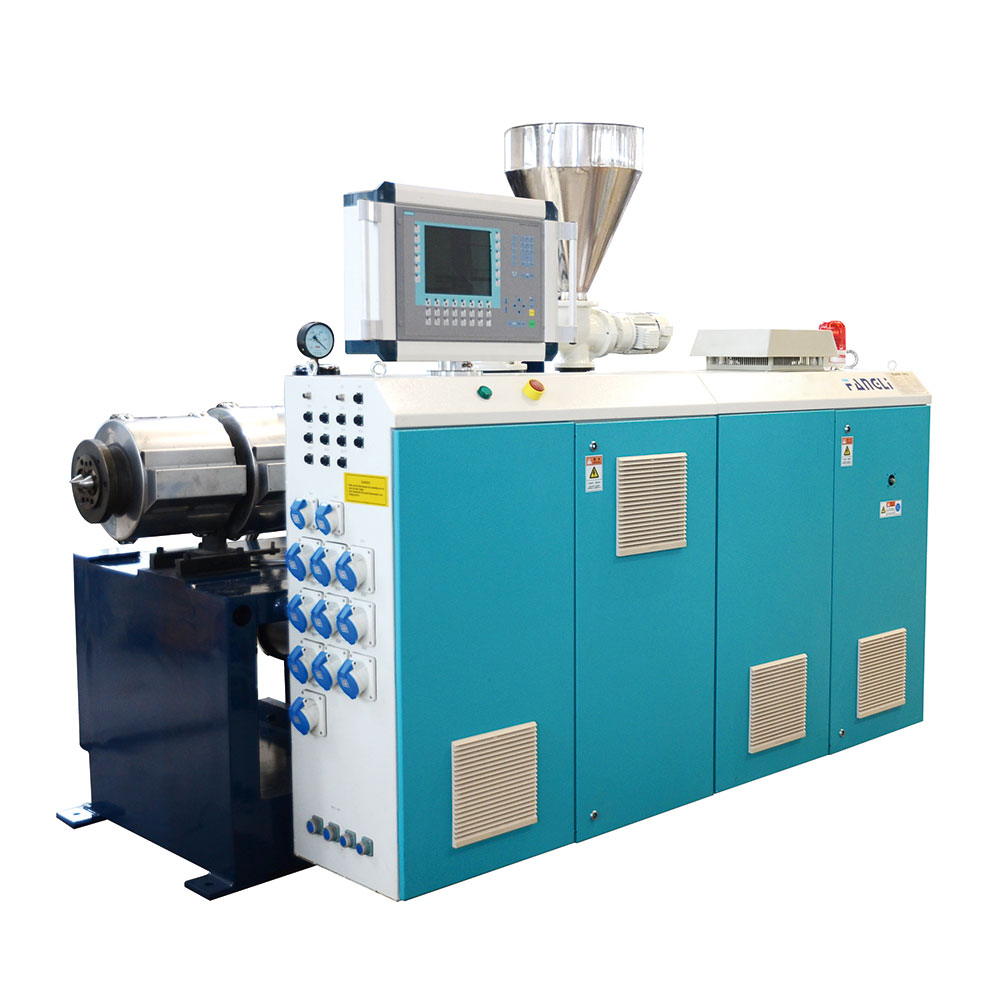
The Science of Zonal Temperature Control
A typical Conical Twin-Screw Plastic Extruder for window profiles features 5 to 7 independently heated/cooled barrel zones, plus a separate die zone. Each zone serves a distinct function:
| Zone | Typical Setpoint (°C) | Primary Function | Homogeneity Risk if Mismatched |
|---|---|---|---|
| Zone 1 (Feed) | 160–170 | Pre-heating and friction initiation | Poor feeding or screw slippage |
| Zone 2 (Compression) | 175–185 | Plasticizing and melting | Incomplete fusion of PVC resin |
| Zone 3 (Metering) | 180–190 | Viscosity reduction and mixing | Thermal degradation or cold slugs |
| Zone 4 (Degassing) | 185–195 | Volatile removal and stabilization | Blisters or porosity in melt |
| Zone 5 (Compression II) | 180–185 | Final homogenization | Phase separation of additives |
| Zone 6 (Die Adapter) | 170–180 | Pressure build and flow equalization | Flow imbalance across die width |
How Each Zone Disrupts or Enhances Homogeneity
Feed Zone (Zone 1) – The Foundation
If this zone runs too cold, the Conical Twin-Screw Plastic Extruder experiences insufficient frictional heat, causing unmelted resin particles to travel downstream. Too hot, and the PVC begins to fuse prematurely on the screw root, leading to resin hang-up and eventual degradation spots. Fangli recommends maintaining a 5–8°C gradient upward from Zone 1 to Zone 3 for optimal solid conveying.
Compression and Metering Zones – The Melting Heart
These zones determine the actual melting rate. A steep positive gradient (e.g., 170→190°C) accelerates melting but risks shear-induced overheating at the screw flights. A flat profile (e.g., 175→180°C) yields safer but slower melting, often requiring lower throughput. Our field tests at Fangli demonstrate that a 2-stage rising profile (Zone 2 at 178°C, Zone 3 at 188°C) produces the best balance, reducing melt temperature variance from ±3°C to ±0.8°C.
Degassing Zone (Zone 4) – The Hidden Variable
This zone must be slightly hotter than preceding zones to lower melt viscosity and facilitate volatile escape. However, excessive heat here decomposes heat stabilizers, releasing HCl gas that corrodes screws and barrels. For Conical Twin-Screw Plastic Extruder systems running lead-free stabilizers, Fangli engineers advise keeping Zone 4 within 2°C of Zone 3—never more than 5°C above.
Practical Thermal Strategy for Window Profile Grades
Different PVC formulations (impact-modified, high-filler, or recycled-content) require tailored zone maps. Below is Fangli’s recommended baseline for standard white window profile (K-value 67, 8 phr CaCO₃):
| Parameter | Recommended Setting | Effect on Homogeneity |
|---|---|---|
| Zone 1–2 differential | +12°C | Ensures complete pellet wetting |
| Zone 3–4 differential | +3°C | Prevents stabilizer depletion |
| Zone 5–6 differential | -5°C (cooling) | Builds die pressure without degrading |
| Melt temperature target | 192–196°C | Optimal fusion degree (65–70%) |
| Temperature oscillation per zone | ≤ ±1.5°C | Maintains constant viscosity index |
When all zones are properly synchronized, the Conical Twin-Screw Plastic Extruder delivers a melt with a fusion degree variation below 2%, which translates to impact strength consistency within ±5% across production shifts.
FAQ – Common Questions About Barrel Temperature in Conical Twin-Screw Plastic Extruder
Q1: Why does my Conical Twin-Screw Plastic Extruder show good melt homogeneity at startup but degrade after 2 hours of continuous running?
A1: This is typically caused by thermal drift in the cooling circuits. As the extruder reaches steady-state, the barrel expands, changing the clearance between screw flights and barrel wall. This alters shear heat generation. At Fangli, we address this by implementing adaptive PID control that recalibrates each zone’s power output based on actual barrel expansion measured by thermocouples placed 2 mm below the inner surface. Additionally, check your cooling water inlet temperature—if it rises more than 3°C from startup, your heat exchange capacity is insufficient. Install a chilled water buffer tank to maintain inlet at 20–22°C consistently.
Q2: Can I use the same temperature profile for a Conical Twin-Screw Plastic Extruder when processing recycled window profile scrap with 30% regrind?
A2: No. Regrind has lower bulk density and higher dust content, which traps air and reduces thermal conductivity. You must lower Zone 1 by 8–10°C to prevent bridging in the feed throat, and raise Zone 4 (degassing) by 5°C to improve volatile removal. More critically, reduce Zone 3 by 3°C because regrind already contains heat history and will degrade faster. Fangli has published a separate regrind profile table in our technical bulletin TB-2024-07—we recommend reducing overall melt temperature by 4–6°C and increasing screw speed by 8–10 RPM to compensate for the lower viscosity. Always run a spiral-flow test before production to verify homogeneity.
Q3: How do I know if a temperature zone is causing inhomogeneity versus a screw design issue in my Conical Twin-Screw Plastic Extruder?
A3: Perform a “zone cut-off test”: reduce each zone’s setpoint by 10°C one at a time while holding others constant, and sample melt for 5 minutes after stabilization. If homogeneity (measured by die pressure fluctuation or optical melt inspection) worsens significantly only when you cut a specific zone, that zone is the culprit. If all zones show similar mild effects, the problem lies in screw geometry—typically compression ratio or flight depth. At Fangli, we use a proprietary thermal mapping tool that plots actual vs. setpoint temperature across all zones in real-time; if the deviation pattern correlates with screw rotation speed, it’s a screw design issue. If it correlates with ambient temperature or cooling valve cycling, it’s a control system problem. We recommend checking your thermocouple immersion depth—shallow insertion (less than 15 mm) gives false readings that mislead the entire control loop.
Monitoring and Corrective Actions
To maintain homogeneity, Fangli advises operators to log three critical parameters every 30 minutes:
-
Melt temperature at adapter (actual)
-
Zone 3–Zone 4 differential (actual)
-
Die head pressure fluctuation (peak-to-peak)
If pressure fluctuation exceeds ±2.5 bar, immediately check Zone 3 and Zone 5—these two zones account for over 70% of homogeneity issues in field data from 200+ Conical Twin-Screw Plastic Extruder installations.
Final Thought – Thermal Precision Is Not Optional
Window profile extrusion demands melt uniformity within a narrow tolerance window. Barrel temperature zones are not independent islands; they form a thermal cascade where each zone’s setting influences the next. Fangli integrates high-response cartridge heaters and spiral-baffled cooling channels in our Conical Twin-Screw Plastic Extruder systems to achieve zone-to-zone isolation, ensuring that a change in Zone 2 does not thermally bleed into Zone 3. This engineering focus has helped our customers reduce scrap rates from 4.2% to 1.1% on average within three months of commissioning.
Have a specific formulation or throughput target in mind? Our process engineers at Fangli offer free thermal profile audits for your existing Conical Twin-Screw Plastic Extruder line. We can simulate optimal zone settings based on your actual resin batch and additive package. Contact us today with your production data—we will return a customized temperature strategy within 48 hours, complete with startup and shutdown protocols to preserve screw life.