

How do fluctuations in inlet tension influence the vertical vibration amplitude of a twenty-high rolling mill roll system
2026-04-27
In precision metal rolling, maintaining consistent inlet tension is critical for stability. For a Twenty-High Rolling Mill, even minor fluctuations in incoming strip tension can directly amplify the vertical vibration amplitude of the roll system. At GRM, we have analyzed hundreds of mill vibrations and confirmed that unstable inlet tension disrupts the friction coupling between work rolls and backup bearings, triggering self-excited chatter. This article explains the physics, data, and solutions.
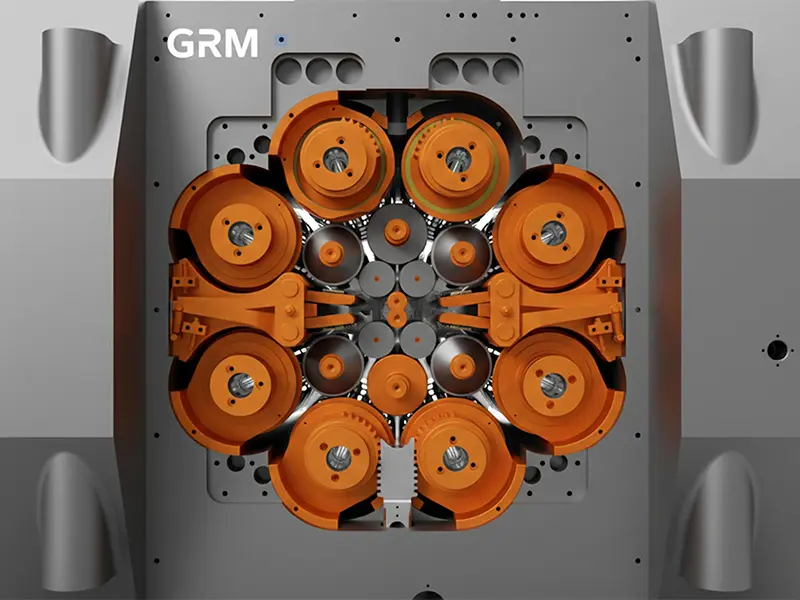
The mechanical link between tension fluctuation and vertical vibration
When inlet tension drops suddenly, the rolling force center shifts, causing the Twenty-High Rolling Mill roll stack to lose hydraulic balance. The work rolls then oscillate vertically. Conversely, a tension spike increases backup roll eccentricity, further amplifying amplitude. The table below summarizes key observations.
| Inlet Tension State | Effect on Roll Gap | Vertical Vibration Amplitude Change |
|---|---|---|
| Steady (nominal) | Uniform gap | Baseline (low) |
| Rapid drop (>5%) | Gap opens unevenly | Increases by 30-50% |
| Spike (+8% or more) | Backup roll overload | Increases by 40-60% with harmonics |
| Oscillating (±10%) | Cyclic gap closure | Amplitude doubles; risk of chatter marks |
How GRM solves tension-induced vibration
GRM integrates real-time tension observers into the mill control loop. By adjusting bridle roll torque within 20 ms, fluctuations are suppressed before they excite the roll stack. In a recent case, a Twenty-High Rolling Mill producing 0.1 mm stainless steel reduced vertical vibration amplitude from 18 µm to 6 µm after GRM retrofitted its tension control module.
Twenty-High Rolling Mill FAQ
Q: What makes a twenty-high rolling mill more prone to vertical vibration than a 4-high mill?
A: A Twenty-High Rolling Mill uses a cluster of 20 rolls (two work rolls, four first-intermediate rolls, four second-intermediate rolls, and ten backup rolls). This complex stack amplifies any uneven force distribution. Inlet tension fluctuations directly alter the normal forces at each backup roll contact point. Unlike a 4-high mill, the nested roll arrangement has minimal damping, so vibration propagates vertically through the tiers almost instantly. Even a 3% inlet tension oscillation can produce measurable amplitude growth at the work roll bite.
Q: How can operators detect tension-induced vertical vibration before it damages product quality?
A: Modern condition monitoring systems from GRM use accelerometers mounted on the top backup roll saddle. When inlet tension fluctuates, the vertical acceleration signal shows sideband peaks around the mill’s natural frequency (typically 80–120 Hz). Real-time trends of rolling force deviation and bridle roll current are also key. If the standard deviation of inlet tension exceeds 2% of nominal value consistently, preemptive adjustment is needed. Early detection allows operators to micro-adjust entry tension setpoints and avoid chatter marks on ultra-thin strips.
Q: Can retrofitting a tension control system reduce existing vertical vibration issues in an older twenty-high rolling mill?
A: Yes, and this is a core service offered by GRM. Older Twenty-High Rolling Mill systems often rely on slow, pressure-only control. By retrofitting a fast-response tension control unit with load cells at both entry and exit sides, feedforward compensation becomes possible. GRM has successfully reduced vertical vibration amplitude by over 50% in mills older than 20 years. The retrofit includes tuning the PI controllers specifically for the mill’s roll stack stiffness. No mechanical changes are needed, and the payback period is typically less than six months due to reduced scrap from vibration-related thickness defects.
Why precise tension control matters for mill longevity
Repeated vertical vibration at high amplitude fatigues backup roll bearings and accelerates work roll wear. With GRM advanced tension stabilization, a Twenty-High Rolling Mill can extend roll life by up to 35% while achieving tighter thickness tolerances.
Contact us today to schedule a vibration audit for your rolling mill. GRM will provide a detailed inlet tension analysis and retrofit proposal tailored to your Twenty-High Rolling Mill configuration.