

How Do Refrigerated Air Dryers Improve Industrial Compressed Air Systems?
2025-12-22
Abstract: Refrigerated air dryers are a critical component of modern industrial compressed air systems, designed to remove moisture efficiently and maintain air quality. This article explores their operational principles, technical specifications, applications, maintenance, and answers frequently asked questions to provide a comprehensive understanding for industrial users.
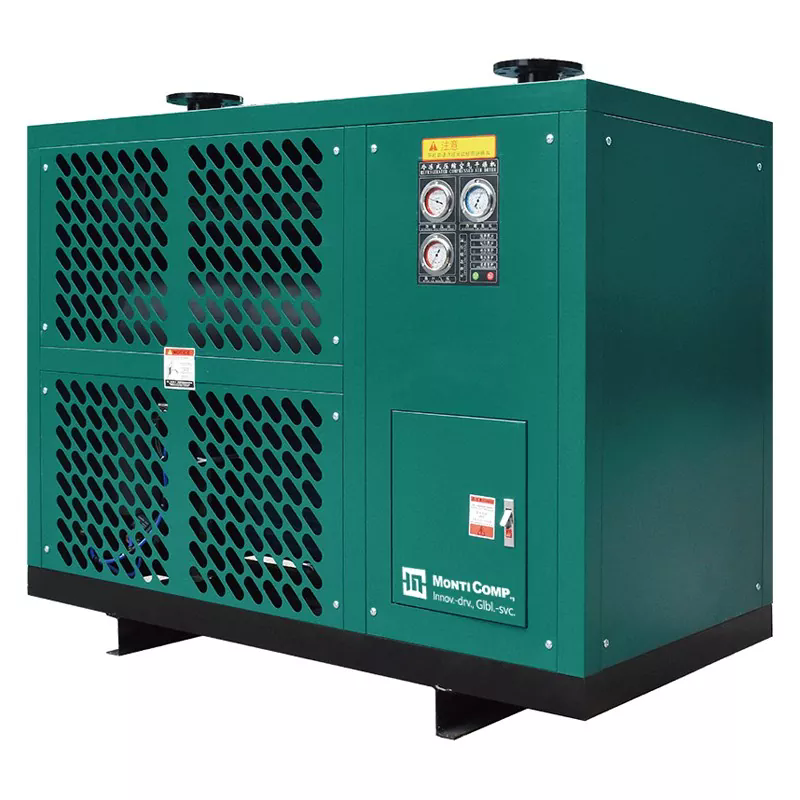
Table of Contents
- Introduction to Refrigerated Air Dryers
- Technical Specifications of Refrigerated Air Dryers
- Operation Principles and Maintenance
- Refrigerated Air Dryer FAQs
- Conclusion and Brand Information
1. Introduction to Refrigerated Air Dryers
Refrigerated air dryers are devices that remove water vapor from compressed air to prevent corrosion, equipment failure, and product contamination in industrial applications. They operate by cooling the compressed air to condense moisture, which is then removed via an automatic drain. These systems are widely used in manufacturing, automotive, electronics, food processing, and chemical industries.
The focus of this article is to explain the key technical parameters, operational advantages, and maintenance strategies of refrigerated air dryers, providing industrial decision-makers and engineers with the information required to select and optimize these systems efficiently.
2. Technical Specifications of Refrigerated Air Dryers
The following table outlines the main specifications of a typical industrial refrigerated air dryer:
| Parameter | Description | Typical Range |
|---|---|---|
| Air Flow Capacity | Maximum volume of compressed air processed per hour | 1 – 1000 m³/h |
| Operating Pressure | Optimal pressure for drying performance | 0.7 – 1.6 MPa |
| Power Consumption | Electrical power used by the refrigeration system | 0.5 – 15 kW |
| Dew Point | Lowest achievable temperature at which water vapor condenses | 2 – 10 °C |
| Operating Temperature Range | Ambient temperature range for stable operation | 5 – 45 °C |
| Refrigerant Type | Refrigerant used in the cooling system | R134a, R407C, R410A |
| Control System | Automatic electronic or mechanical control | Microprocessor or thermostat-based |
These parameters should be carefully evaluated when selecting a refrigerated air dryer to ensure optimal performance and energy efficiency within a specific industrial environment.
3. Operation Principles and Maintenance
3.1 How Refrigerated Air Dryers Operate
Refrigerated air dryers work by cooling compressed air below its dew point to condense moisture into liquid water. This process typically involves four steps:
- Compressed air enters the heat exchanger where it is pre-cooled.
- Air passes through the refrigeration coil where moisture condenses.
- Condensed water is collected and removed through an automatic drain.
- Dry air exits the system at a low dew point, ready for industrial use.
3.2 Regular Maintenance Practices
Proper maintenance ensures long-term reliability and efficiency. Key maintenance activities include:
- Checking and cleaning heat exchanger surfaces to prevent scaling.
- Inspecting refrigeration circuits and refrigerant levels.
- Testing and servicing automatic drains to avoid water carryover.
- Monitoring dew point performance for consistent drying.
- Replacing worn components such as filters and control valves.
3.3 How to Troubleshoot Common Issues
Common operational issues include high dew point, excessive condensate, and refrigerant leaks. Troubleshooting requires:
- Measuring air inlet and outlet temperatures to identify cooling inefficiency.
- Inspecting for blockages in drain valves or piping.
- Checking for refrigerant leakage and pressure drop in the cooling system.
- Adjusting or recalibrating the control system for optimal operation.
4. Refrigerated Air Dryer FAQs
Q1: How do Refrigerated Air Dryers maintain a low dew point?
A1: Refrigerated air dryers lower the temperature of compressed air to condense water vapor. By cooling air below its dew point, moisture forms droplets, which are then removed via automatic drains. The refrigeration cycle ensures consistent cooling, maintaining a dew point between 2–10°C, depending on the model.
Q2: How often should a Refrigerated Air Dryer be serviced?
A2: Regular maintenance should occur every 6–12 months depending on operating conditions. Critical tasks include cleaning heat exchangers, inspecting refrigerant levels, testing drain valves, and monitoring dew point performance. Frequent inspection prevents equipment failure and ensures optimal energy efficiency.
Q3: How to choose the right Refrigerated Air Dryer for an industrial facility?
A3: Selection depends on compressed air flow rate, operating pressure, ambient conditions, and required dew point. Matching specifications to industrial needs ensures efficient moisture removal, reduces energy consumption, and protects downstream equipment. Consulting manufacturers’ technical data and performing load calculations is essential.
5. Conclusion and Brand Information
Refrigerated air dryers play a vital role in maintaining the quality and reliability of industrial compressed air systems. By understanding technical specifications, operation principles, maintenance practices, and troubleshooting methods, industrial operators can optimize their air systems efficiently. The brand Dream offers a comprehensive line of refrigerated air dryers engineered for durability, high performance, and energy efficiency in demanding industrial environments. For inquiries, detailed specifications, or personalized solutions, contact us today.