

How Do You Choose the Right Fan Filter Unit for Your Cleanroom
2026-10-29
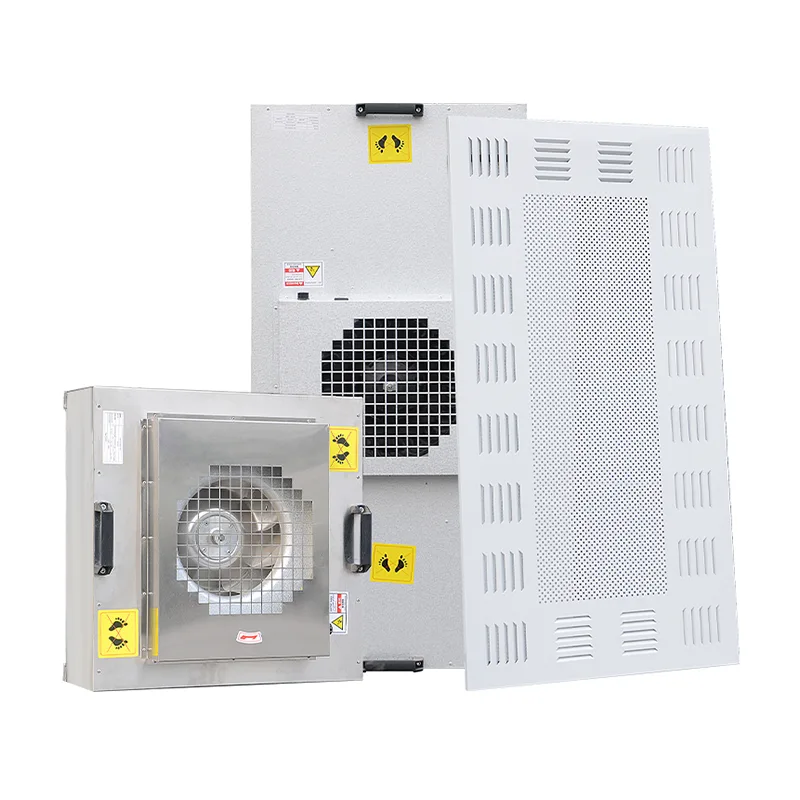
Selecting the appropriate Fan Filter Unit is one of the most consequential decisions in cleanroom design. A well-matched Fan Filter Unit from a trusted manufacturer such as Grandfort directly influences particle control, energy costs, and long-term operational reliability. This guide walks through the practical criteria engineers and facility managers should evaluate before specifying equipment.
1. Define Your Cleanroom Classification and Airflow Requirement
The ISO class of your cleanroom dictates the required air changes per hour (ACH) and filtration efficiency. ISO 5 environments typically demand HEPA H14 filters and higher airflow, while ISO 7 or ISO 8 spaces may perform well with H13 units at lower volumes. Grandfort offers models across the full HEPA grade spectrum, allowing precise matching to your classification.
| ISO Class | Recommended Filter Grade | Typical ACH |
|---|---|---|
| ISO 5 | H14 HEPA | 240–480 |
| ISO 6 | H14 HEPA | 120–240 |
| ISO 7 | H13 HEPA | 60–120 |
| ISO 8 | H13 HEPA | 20–60 |
2. Evaluate Airflow Capacity and Static Pressure
Every Fan Filter Unit must overcome filter resistance and ductwork static pressure while maintaining uniform face velocity. Check the fan curve against your actual operating conditions rather than relying on nominal ratings. Grandfort publishes verified performance curves for each model, enabling accurate system-level planning.
3. Consider Energy Efficiency and Noise Levels
Energy consumption accumulates across dozens or hundreds of units. EC fan technology in Grandfort units reduces power draw significantly compared with AC motors, and low-noise designs help meet workplace acoustic standards.
4. Assess Control and Monitoring Options
Modern facilities benefit from networked control. Look for units supporting BACnet or Modbus, group control, and filter loading alarms. These features simplify compliance auditing and predictive maintenance.
5. Confirm Build Quality and Serviceability
Stainless steel housings, gel-sealed filters, and tool-free filter replacement reduce contamination risk and downtime. Verify that spare parts and technical support are readily available.
6. Match the Unit to Your Ceiling Grid
Standard ceiling grids require consistent module dimensions. Confirm that the Fan Filter Unit footprint, weight, and mounting method align with your T-bar or custom ceiling system before procurement.
Frequently Asked Questions
Q: What is the difference between a HEPA and ULPA Fan Filter Unit?
A: A HEPA Fan Filter Unit typically removes 99.95% of particles at 0.3 microns (H13/H14), while a ULPA unit removes 99.999% at 0.12 microns (U15–U17). ULPA units suit ISO 4 and stricter environments, whereas HEPA units are sufficient for most ISO 5–8 cleanrooms and cost less to operate.
Q: How often should the filter in a Fan Filter Unit be replaced?
A: Replacement depends on differential pressure readings rather than a fixed schedule. When pressure drop reaches roughly 1.5 to 2 times the initial value, or when airflow falls below design specifications, the filter should be changed. In typical cleanrooms this occurs every two to five years, and Grandfort units include pressure monitoring to support timely replacement.
Q: Can a Fan Filter Unit be retrofitted into an existing cleanroom ceiling?
A: Yes, in most cases. Retrofitting requires verifying ceiling load capacity, available electrical circuits, and grid dimensions. Modular Grandfort units are designed for drop-in installation in standard grids, minimizing disruption, though a site survey is recommended before committing to a retrofit plan.
Conclusion
Choosing the right Fan Filter Unit requires balancing classification requirements, airflow performance, energy use, controls, and serviceability. Partnering with an experienced supplier simplifies every step of that process. Contact us today to discuss your cleanroom specifications and receive a tailored Grandfort recommendation.