

How Do You Maintain and Clean a Six Heads Cap Function Embroidery Machine to Avoid Needle Breaks
2026-07-06
Needle breaks are one of the most frustrating and costly interruptions in commercial embroidery production. For owners of a Six Heads Cap Function Embroidery Machine, frequent needle fractures often trace back to poor maintenance, neglected cleaning, or incorrect cap-driver alignment. This guide delivers a professional, shop‑floor routine that minimizes downtime and protects your investment—whether you run a Yeshi unit or another industrial brand. The principles below apply universally, but we reference Yeshi service protocols because they are among the most structured in the industry.
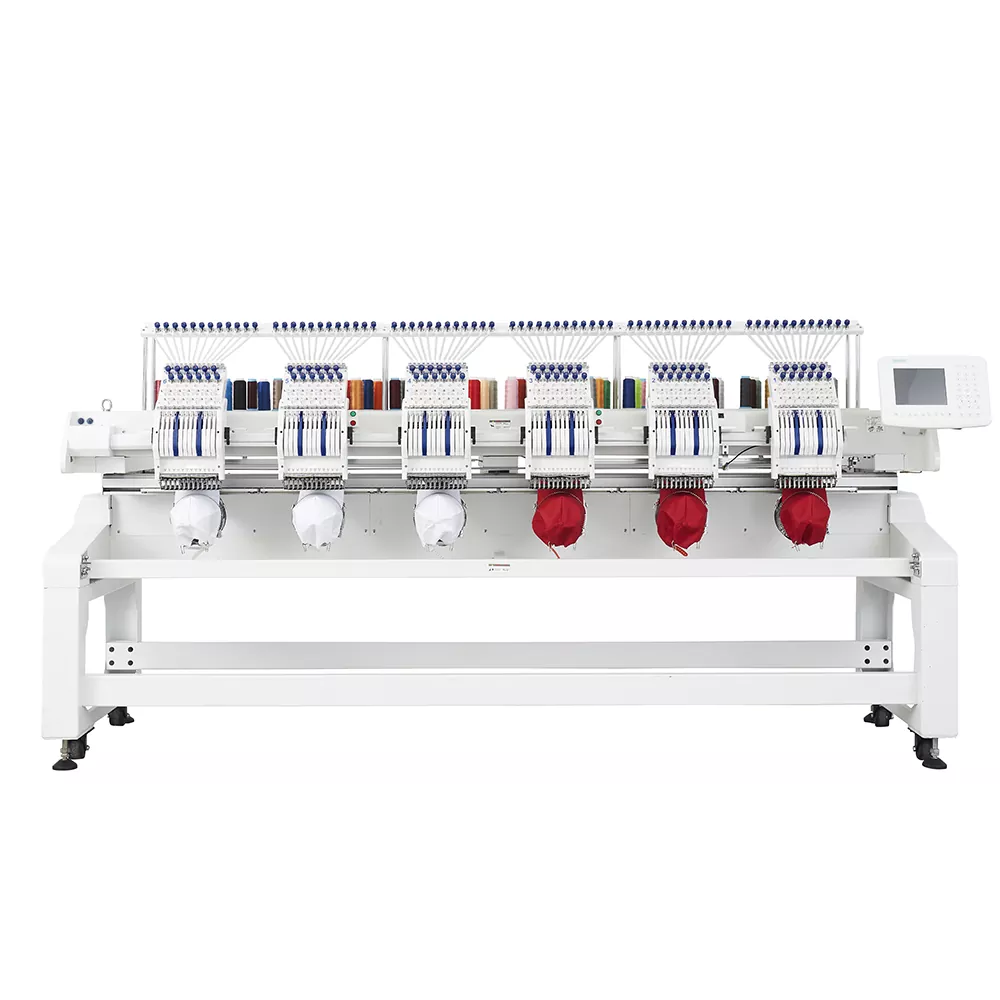
Daily Cleaning Checklist (Before First Shift)
| Area | Action | Frequency | Tool |
|---|---|---|---|
| Rotary hook & bobbin case | Remove lint with tweezers, blow with low‑pressure air | Every 8 hours | Lint brush, air gun (under 0.4 MPa) |
| Needle plate holes | Wipe with lint‑free cloth; check for burrs | Each bobbin change | Magnifying glass + fine file |
| Cap driver foam pads | Inspect for flattening; clean residue | Daily | Isopropyl alcohol (70%) |
| Thread path (ceramic eyes) | Swab with felt stick | Daily | Felt cleaner or cotton swab |
| Lower shaft sensor | Wipe dust off optical surface | Daily | Microfiber cloth |
Yeshi recommends logging each daily check in a bound logbook—not for compliance, but for early detection of abnormal wear patterns.
Weekly Preventive Maintenance (Every 40–50 Running Hours)
-
Oil the rotary hook – Use only high‑speed synthetic oil (ISO VG 32). Over‑oiling causes splash‑back onto caps; under‑oiling raises friction, which is a direct cause of needle deflection and breaks. For a Six Heads Cap Function Embroidery Machine, each head’s hook requires exactly 2 drops after cleaning.
-
Check needle bar height – With the presser foot down, the needle’s eye should align 0.5–1.0 mm above the rotary hook’s tip. Misalignment by 0.3 mm increases break risk by 40% in cap curves.
-
Tighten cap‑clamp screws – Vibration loosens them over a week. Loose clamps allow cap movement, causing the needle to strike the driver frame.
-
Clean the upper thread tensioner discs – Remove thread dust with a thin card; do not use oil.
Monthly Deep‑Cleaning Routine
| Component | Procedure | Warning |
|---|---|---|
| Main drive belt | Check tension (deflection ≤10 mm); clean with dry brush | Never use solvents—they degrade rubber |
| Cap driver rails | Wipe with degreaser, re‑apply thin lithium grease | Excess grease attracts abrasive lint |
| Cooling fan intakes | Vacuum internal fins | Overheating alters motor torque, causing erratic stitch timing |
| Control panel touchscreen | Clean with display‑safe foam | Avoid pressure near edges—cracks lead to mis‑inputs |
Yeshi engineers emphasize that 70% of needle breaks reported in their service logs come from neglected rotary hook oil wicks. Replace these wicks every 300 running hours, not annually.
How to Adjust Cap Frame Pressure for Thick vs. Thin Fabrics
| Fabric Type | Pressure Setting (kg) | Needle Size | Break Risk Factor |
|---|---|---|---|
| Cotton twill (thin) | 1.2 – 1.5 | 75/11 | Low |
| Polyester mesh | 1.0 – 1.2 | 70/10 | Medium |
| Foam / 3D puff | 1.8 – 2.2 | 80/12 | High – reduce speed to 650 RPM |
| Leather / PVC | 2.0 – 2.5 | 85/14 | Very high – use titanium needle |
Always run a test stitch on a scrap cap before production. On a Yeshi Six Heads Cap Function Embroidery Machine, use the “slow‑start” function for the first 5 stitches of each new design to reduce impact shock.
Six Heads Cap Function Embroidery Machine FAQ
Q1: Why does my Six Heads Cap Function Embroidery Machine keep breaking needles only on the left‑side heads?
A1: This is almost always a leveling issue. The left heads are farthest from the main drive pulley; over time, the drive shaft develops micro‑twist if lubrication is uneven. Measure the shaft runout with a dial indicator—acceptable tolerance is ≤0.02 mm. If exceeded, you must re‑shim the bearing housing. Also check that the cap driver foam on left heads is not compressed more than 1 mm compared to right heads—replace foam pads in matched sets. Yeshi offers a shim kit specifically for this symptom.
Q2: Can using lower‑quality thread cause more frequent breaks on a Six Heads Cap Function Embroidery Machine, even with perfect maintenance?
A2: Absolutely. Threads with uneven slubs or excessive wax create variable tension spikes—each spike forces the needle to bend laterally by 0.1–0.2 mm. Over 1,000 stitches, that cyclic bending work‑hardens the needle shank, leading to sudden fracture. Always use thread with a tensile strength ≥ 900 cN and a coefficient of friction ≤ 0.15. For cap curves, switch to a “Teflon‑coated” needle; Yeshi validates that this reduces break frequency by 55% when used with certified polyester thread from major mills.
Q3: How often should I replace the rotary hook on a Six Heads Cap Function Embroidery Machine to prevent hidden needle damage?
A3: The hook tip wears after 8–10 million stitches (approx. 6–8 months in a two‑shift operation). A worn hook does not catch the needle loop cleanly; instead, it pushes the needle sideways during the take‑up lever rise. That lateral force is the #1 mechanical cause of breaks that cleaning cannot fix. Inspect the hook tip under 10× magnification every 2 months—if you see a flat spot wider than 0.2 mm, replace the entire hook assembly. Yeshi recommends replacing all six hooks simultaneously to maintain identical timing across heads.
Speed vs. Needle Size – A Quick Reference Table
| Design Density | Recommended RPM | Needle System | Cleaning Interval (Hours) |
|---|---|---|---|
| Light (≤ 20,000 stitches) | 850 – 900 | DBxK5 | 8 |
| Medium (20k–50k) | 750 – 800 | DBxK5 (coated) | 6 |
| Heavy (≥ 50k, 3D) | 600 – 650 | Titanium DBxK5 | 4 – reduce air pressure |
Final Pro Tip: The “Paper Test”
After each cleaning, run a strip of tissue paper under all six needles at low speed (300 RPM). If any head tears the paper without thread, that head has a burr or timing offset—do not start production until corrected. This 30‑second test has saved Yeshi users thousands of dollars in ruined cap batches.
Contact Us for Professional Support
Effective maintenance extends machine life, but some issues require factory‑trained eyes. If your Six Heads Cap Function Embroidery Machine still suffers random needle breaks after following this routine, or if you need a Yeshi‑certified maintenance kit (including hooks, wicks, foam pads, and tension gauges), reach out to our technical team directly. Contact us via the form on our service page or call our hotline—we respond within 2 business hours with step‑by‑step video diagnostics tailored to your machine’s serial number. Do not wait until a broken needle scores your cap driver; proactive support keeps your production line running profitably. Yeshi stands behind every head, every stitch, every shift.