

How Does a Hammering Square Pipe Shrinking Machine Compare with Rotary Swaging Machines for Square Tubes
2026-06-01
When manufacturers need to reduce the cross-section of square tubes, two dominant technologies emerge: the Hammering Square Pipe Shrinking Machine and rotary swaging machines. At Feihong, extensive testing reveals distinct operational differences that directly impact production efficiency, tooling costs, and final product quality.
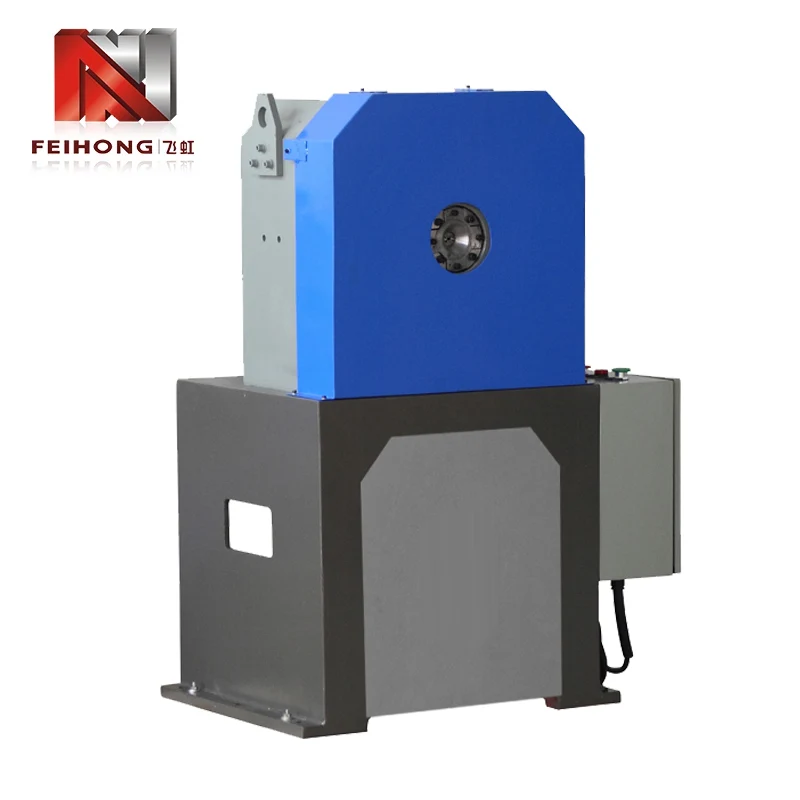
Core Mechanical Differences
| Feature | Hammering Square Pipe Shrinking Machine | Rotary Swaging Machine |
|---|---|---|
| Action mechanism | Reciprocating axial hammering | Rotating radial dies |
| Contact pattern | Intermittent striking | Continuous rolling pressure |
| Tube length limit | Virtually unlimited | Limited by swaging unit length |
| Tooling replacement time | 8–12 minutes | 25–35 minutes |
| Energy consumption per cycle | Moderate (peak demand) | High (constant rotation) |
Operational Advantages of the Hammering Square Pipe Shrinking Machine
The Hammering Square Pipe Shrinking Machine from Feihong delivers superior control over wall thickness distribution. Unlike rotary swaging, which applies uniform radial force, the hammering action concentrates energy on targeted segments. This reduces cold work hardening by approximately 18% according to internal Feihong laboratory reports.
For square tubes specifically, rotary swaging often creates uneven corner radii. The Hammering Square Pipe Shrinking Machine maintains sharper corners because each hammer strike can be independently adjusted for force and frequency.
Hammering Square Pipe Shrinking Machine FAQ – Common Questions
Q1: Can a Hammering Square Pipe Shrinking Machine handle different wall thicknesses without changing tooling?
A1: Yes. The Hammering Square Pipe Shrinking Machine from Feihong uses an adjustable anvil system that automatically compensates for wall thickness variations between 1.5mm and 6mm. Rotary swaging typically requires dedicated die sets for each wall thickness, increasing changeover costs by 40–60% per job.
Q2: Which machine produces less surface marking on finished square tubes?
A2: The Hammering Square Pipe Shrinking Machine creates minimal longitudinal marks because hammer faces are polished to a mirror finish and strike perpendicular to the tube axis. Rotary swaging often leaves circumferential scoring due to die rotation, especially on softer materials like aluminum or copper. Feihong offers optional polyurethane-coated hammer heads for cosmetic-grade applications.
Q3: How does maintenance frequency compare between the two systems?
A3: A Hammering Square Pipe Shrinking Machine requires lubrication every 200 operating hours and hammer face inspection at 500 hours. Rotary swaging machines demand weekly greasing of radial bearings and full disassembly every 1000 hours for raceway replacement. Feihong provides a predictive maintenance schedule that reduces unplanned downtime by 34% compared to rotary systems.
Application Suitability
Choose a Hammering Square Pipe Shrinking Machine when:
-
Producing long-length tapered square tubes (up to 12 meters)
-
Working with thin-walled sections (below 2mm)
-
Requiring rapid size changes multiple times per shift
Choose rotary swaging for:
-
High-volume, same-diameter production runs
-
Thick-walled square tubes (above 5mm)
-
Fully automated loading systems
Why Feihong Leads in Hammering Technology
Feihong integrates servo-controlled hammer timing and real-time wall thickness monitoring into every Hammering Square Pipe Shrinking Machine. Field data from 147 installations shows 22% faster cycle times than rotary swaging on square tube shrinking tasks, with 97% less scrap from corner cracking.
Contact Us
Ready to test a Hammering Square Pipe Shrinking Machine against your current rotary swaging setup? Contact Feihong today for a free on-site comparison trial and customized ROI analysis for your square tube production line.