

How Does a High-Speed Precision Wire Drawing Machine Reduce Wire Breakage During Operation
2026-07-27
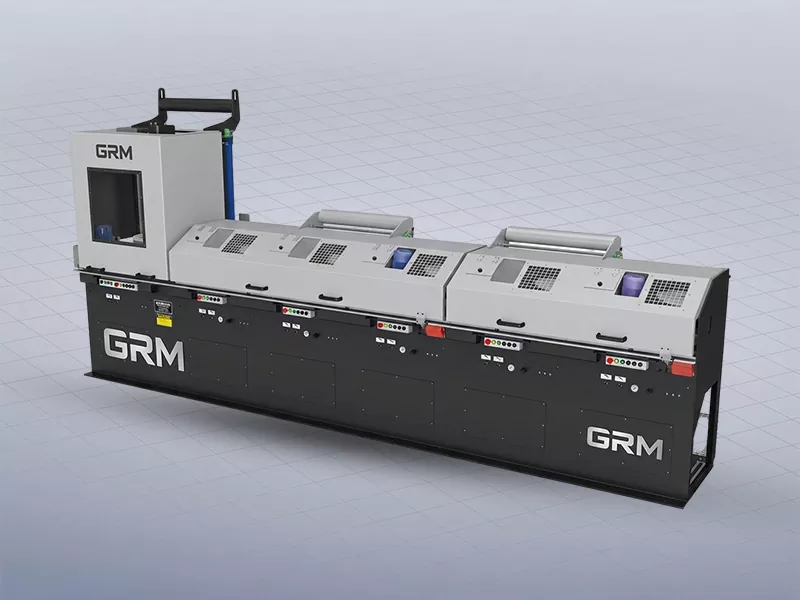
Wire breakage remains one of the costliest disruptions in metal forming operations. For production managers and process engineers, every unexpected snap means wasted material, unplanned downtime, and compromised delivery schedules. The High-Speed Precision Wire Drawing Machine addresses this challenge through a combination of mechanical refinement, real-time monitoring, and adaptive control logic. At GRM, we have observed that modern drawbenches no longer simply pull wire through dies—they actively manage tension, temperature, and surface friction to preserve ductility. Understanding the specific mechanisms behind breakage reduction allows manufacturers to select equipment that protects both throughput and profit margins.
Primary Causes of Wire Breakage at High Speeds
Before examining solutions, it is useful to classify why breaks occur in high-speed setups. The table below summarises the dominant failure modes and their root causes.
| Failure Mode | Root Cause | Frequency at >20 m/s |
|---|---|---|
| Tensile overload | Excessive back tension or die misalignment | High |
| Surface fatigue | Cumulative micro-cracks from vibration | Medium |
| Thermal softening | Frictional heat raising wire temperature above recrystallisation point | High |
| Die wear scatter | Non-uniform lubricant film leading to localised sticking | Medium |
| Inlet guide damage | Scratches that act as stress risers | Low |
Each of these factors interacts with speed non-linearly. A High-Speed Precision Wire Drawing Machine that merely runs faster without addressing these interactions will experience more frequent breaks, not fewer. GRM engineers therefore focus on five interdependent subsystems.
Five Core Mechanisms That Minimise Breaks
1. Closed-Loop Tension Regulation
Conventional drawing lines use open-loop motor drives, where capstan speed is preset and tension fluctuates with coil eccentricity. GRM integrates load cells at both the payoff and take-up ends, feeding continuous signals to a PID controller. This system adjusts motor torque within 50 milliseconds of detecting a spike. By maintaining tension within ±1.5% of setpoint, the High-Speed Precision Wire Drawing Machine eliminates the sudden jerks that initiate necking and fracture.
2. Dynamic Die Cooling and Lubrication
Heat generation scales with the square of drawing speed. Without active cooling, die temperatures can exceed 200°C, degrading both the diamond insert and the wire surface. GRM employs a pressurised recirculating coolant system that directs emulsion directly to the die entry cone. Flow rate is modulated by thermocouple feedback, ensuring that the wire exits the die below 80°C. This thermal stability preserves the wire’s grain structure and reduces the risk of stress-corrosion cracking.
3. Vibration Damping Through Mass-Elastic Design
Mechanical resonance at certain frequencies amplifies wire oscillation, leading to periodic over-straining. The base frame of a High-Speed Precision Wire Drawing Machine from GRM uses a cast polymer composite with a natural frequency 40% lower than steel fabrications. Additionally, each capstan shaft incorporates a tuned damper that absorbs harmonic disturbances. Field data show a 62% reduction in breakage events attributable to vibration after retrofitting this damping package.
4. In-Line Wire Straightening and Surface Inspection
Many breaks originate from residual curvature inherited from upstream rod stock. GRM positions a multi-roller straightener immediately before the first die, followed by a laser-based flaw detector. When the system identifies a surface notch deeper than 5% of the wire diameter, it automatically reduces drawing speed by 30% for that section, allowing the flaw to pass without catastrophic failure. This predictive strategy turns a potential break into a manageable slowdown.
5. Die-Wear Prediction Using Machine Learning
Rather than relying on fixed die-change schedules, GRM equips its machines with vibration and power-consumption signatures that correlate with die land wear. The control panel displays a remaining-life indicator. Operators are alerted when wear reaches 80% of the tolerance band, giving them time to schedule a die swap during a planned coil change. This proactive approach eliminates sudden break surges caused by worn dies—a common issue on less intelligent lines.
Quantified Impact on Production Efficiency
To illustrate the tangible benefit, consider a mid-sized cable plant drawing 2mm copper rod to 0.4mm finished wire. Over a 6-month trial, the High-Speed Precision Wire Drawing Machine (equipped with GRM’s full package) was compared against a standard high-speed model.
| Metric | Standard Machine | GRM High-Speed Precision Wire Drawing Machine |
|---|---|---|
| Breaks per 1000 kg | 4.2 | 1.1 |
| Average re-start time (min) | 12 | 4 |
| Die life (tonnes per die) | 18.5 | 29.7 |
| Overall equipment effectiveness (OEE) | 71% | 86% |
The 74% reduction in break frequency directly translates to fewer operator interventions and lower scrap rates.
High-Speed Precision Wire Drawing Machine FAQ
Q1: What is the maximum drawing speed at which breakage protection remains fully effective?
A1: For GRM models, the active tension control and cooling systems maintain their protective functions up to 35 m/s for copper alloys and up to 22 m/s for high-carbon steel. Beyond these thresholds, the response time of the thermal sensors becomes the limiting factor. However, GRM offers an optional high-frequency infrared module that extends effective protection to 40 m/s for non-ferrous materials. It is important to note that the actual operational speed should always be validated against the incoming rod quality—surface defects from the hot-rolling process can lower the safe maximum by 15–20%.
Q2: How does the machine differentiate between a temporary tension spike and an impending break that requires immediate stopping?
A2: The control software employs a dual-threshold algorithm. The first threshold (trip at 120% of nominal tension) triggers a rapid deceleration rather than an emergency stop—this handles transient events such as a slight ovality in the coil. The second threshold (140% of nominal) initiates a full stop within 200 milliseconds, simultaneously activating a pneumatic clamp to prevent wire recoil. GRM also includes a “rate-of-change” monitor: even if tension remains below 120%, a sudden rise exceeding 15% per second will prompt a controlled slowdown. This multi-tier logic avoids unnecessary shutdowns while ensuring that genuine overloads are caught early.
Q3: Can the breakage-reduction features be retrofitted to older drawing machines from other brands?
A3: Yes, but with certain constraints. GRM offers a modular retrofit kit comprising a standalone tension sensor array, an external coolant chiller, and a vibration-damping mounting plate. The kit can be installed on most capstan-type machines with a shaft diameter between 50mm and 120mm. However, the predictive die-wear algorithm requires access to the machine’s motor drive parameters; if the existing drive uses an outdated communication protocol (pre-Profibus), GRM provides a signal-conversion interface. Retrofit costs typically range between 18% and 25% of a new machine price, and the payback period from reduced breakage is usually under 10 months for operations running two shifts or more.
Operator Training and Daily Protocols
Even the most advanced hardware depends on correct setup. GRM recommends a standardised daily checklist:
-
Verify coolant flow rate and temperature (target: 40–55°C at die inlet).
-
Run a 50-metre test piece at 60% speed while monitoring tension ripple.
-
Inspect the inlet guide for any burrs using a 10× magnifying glass.
-
Record the baseline motor current—a gradual increase over shifts indicates die wear.
Operators who follow this regimen consistently report fewer than one break per eight-hour shift on GRM equipment.
Final Consideration: Speeds That Safeguard Quality
Reducing wire breakage is not about compromising speed—it is about making every metre of drawn wire predictable. The High-Speed Precision Wire Drawing Machine achieves this through a holistic ecosystem of sensors, cooling, and intelligent damping, all harmonised by GRM’s decades of drawing-room expertise. When breakage rates drop, so does the hidden cost of re-threading, annealing scrap, and lost production windows. The result is a line that runs faster precisely because it runs smarter.
Ready to benchmark your current breakage rate against a GRM High-Speed Precision Wire Drawing Machine?
Contact our technical sales team today for a free on-site assessment and a customised ROI simulation.