

How Does a Manual Steel Rule Bender Shape Die Cutting Rules?
2026-09-17
1. What Is a Manual Steel Rule Bender and How Does It Work?
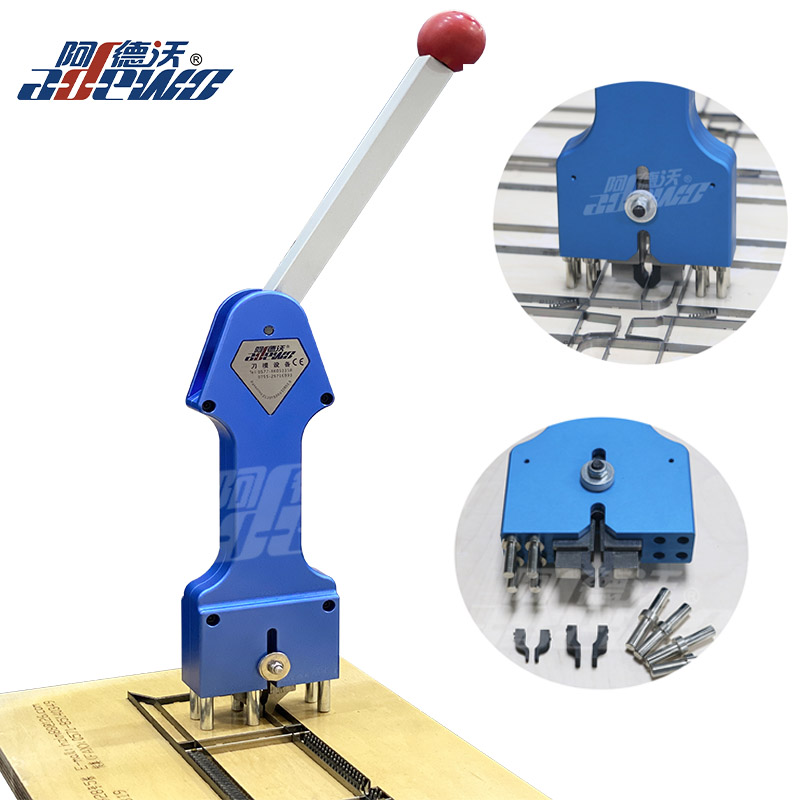
A manual steel rule bender is a bench-mounted device that holds the steel rule in a fixed position while a bending tool applies force to create a curve or angle. The Die Making Manual Machine typically consists of a base plate, a rule clamping mechanism, a bending arm with a handle, and a set of interchangeable bending dies. The operator places the rule in the clamp, aligns the bend position with the bending die, and pulls the handle to form the bend. The bending radius is determined by the size of the die. The angle is controlled by the rotation of the bending arm. Unlike a CNC bender, a manual bender relies on the operator's skill and experience to achieve the correct result. In our factory, we have seen that a skilled operator using a well-maintained Die Making Manual Machine can achieve bend angle tolerances of ±0.5 degrees and radius tolerances of ±0.1 mm.
Key components of a manual bender: The rule clamp must hold the rule securely without crushing it. The bending die must be smooth and free of burrs. The bending arm must rotate freely without backlash. The base plate must be rigid enough to resist deflection under the bending force.
Adewo Automation Equipment Co.,ltd. manufactures Die Making Manual Machine units that are designed for precision and durability. Our factory uses hardened steel for the bending dies and the clamping mechanism, which ensures a long service life and consistent performance.
2. What Happens to the Steel Rule During Bending and Why Does It Matter?
Steel rule is a hardened, high-carbon steel strip with a beveled cutting edge. When it is bent, the outer surface of the bend is subjected to tensile stress, and the inner surface is subjected to compressive stress. If the tensile stress exceeds the ultimate tensile strength of the steel, the rule will crack. If the compressive stress exceeds the yield strength, the rule will buckle or wrinkle. The minimum bend radius that a rule can withstand without cracking depends on its thickness and its hardness. The table below shows the minimum bend radius for common steel rule thicknesses.
| Rule thickness (mm) | Rule hardness (HRC) | Minimum bend radius (mm) | Typical application |
| 0.71 | 38 – 42 | 1.0 | Folding cartons, labels |
| 1.05 | 40 – 44 | 1.5 | Corrugated board, general die cutting |
| 1.42 | 42 – 46 | 2.5 | Heavy duty corrugated, thick materials |
| 2.00 | 44 – 48 | 4.0 | Industrial die cutting, gaskets |
The minimum bend radius is not a suggestion—it is a limit. Bending a rule tighter than its minimum radius will cause micro-cracks that may not be visible initially but will propagate under the cyclic loading of die cutting. In our factory, we recommend that die makers always check the rule specification before bending. Adewo Automation Equipment Co.,ltd. provides a bending radius chart with every Die Making Manual Machine that we manufacture.
3. How Do You Compensate for Springback During Bending?
Springback is the tendency of the steel rule to partially return to its original shape after the bending force is removed. It occurs because the steel deforms elastically before it deforms plastically. The amount of springback depends on the rule thickness, the bend radius, and the hardness of the steel. For a typical 1.05 mm rule with a 1.5 mm bend radius, the springback is approximately 2 to 3 degrees. This means that if you bend the rule to 90 degrees, it will spring back to 87 or 88 degrees. To compensate, the operator must over-bend the rule by the amount of springback. The table below shows typical springback values for different rule thicknesses and bend radii.
| Rule thickness (mm) | Bend radius (mm) | Springback (degrees) | Over-bend required for 90° bend |
| 0.71 | 1.0 | 1.5 | 91.5° |
| 1.05 | 1.5 | 2.5 | 92.5° |
| 1.42 | 2.5 | 3.5 | 93.5° |
| 2.00 | 4.0 | 5.0 | 95.0° |
The springback compensation is not a fixed value. It varies with the specific batch of steel rule and the condition of the bender. In our factory, we recommend that die makers perform a test bend on a scrap piece of the same rule before bending the production piece. This test bend allows the operator to measure the actual springback and adjust the over-bend accordingly. The Die Making Manual Machine from Adewo Automation Equipment Co.,ltd. includes a fine adjustment mechanism that allows the operator to set the over-bend angle precisely.
4. What Are the Common Failure Modes in Manual Rule Bending and How to Prevent Them?
There are four common failure modes in manual rule bending. The first is cracking at the bend. This is caused by bending the rule tighter than its minimum radius or by using a rule that has been work-hardened by previous bending. The second is wrinkling on the inside of the bend. This is caused by excessive compressive stress, which can occur if the bending die is too small or if the rule is not properly supported. The third is twisting. This occurs when the rule is not held flat in the clamp or when the bending force is applied unevenly. The fourth is incorrect angle. This is caused by inadequate springback compensation or by a worn bending die. To prevent these failures, the die maker should use the correct bending die for the rule thickness, support the rule properly in the clamp, and perform a test bend before production.
Prevention checklist for die makers: 1) Verify the rule thickness and minimum bend radius. 2) Select the correct bending die. 3) Clamp the rule securely without crushing. 4) Perform a test bend to measure springback. 5) Adjust the over-bend angle. 6) Inspect the bend for cracks or wrinkles. 7) Repeat for each bend on the die layout.
Frequently Asked Questions About Manual Steel Rule Bending
Summary for Die Makers and Die Making Technicians
The manual steel rule bender is a precision tool that requires skill and attention to detail. The key to successful bending is understanding the relationship between rule thickness, bend radius, and springback. By selecting the correct bending die, compensating for springback, and inspecting each bend for cracks or wrinkles, the die maker can produce die cutting rules that are accurate and durable. Adewo Automation Equipment Co.,ltd. has been manufacturing Die Making Manual Machine units for over 15 years and supplies to die making shops worldwide.
Adewo Automation Equipment Co.,ltd. manufactures manual and hydraulic steel rule benders, bending dies, and rule clamping systems. We provide technical training and support for all of our products.