

How Does a Vertical Hoist Plating Line Improve Electroplating Efficiency and Quality?
2026-07-29
Article Summary
A vertical hoist plating line is an advanced automated electroplating solution designed to improve production efficiency, coating consistency, and operational safety for manufacturers requiring high-quality surface treatment. Traditional manual plating processes often face challenges such as unstable coating thickness, high labor costs, limited production capacity, and difficulties in maintaining environmental standards.
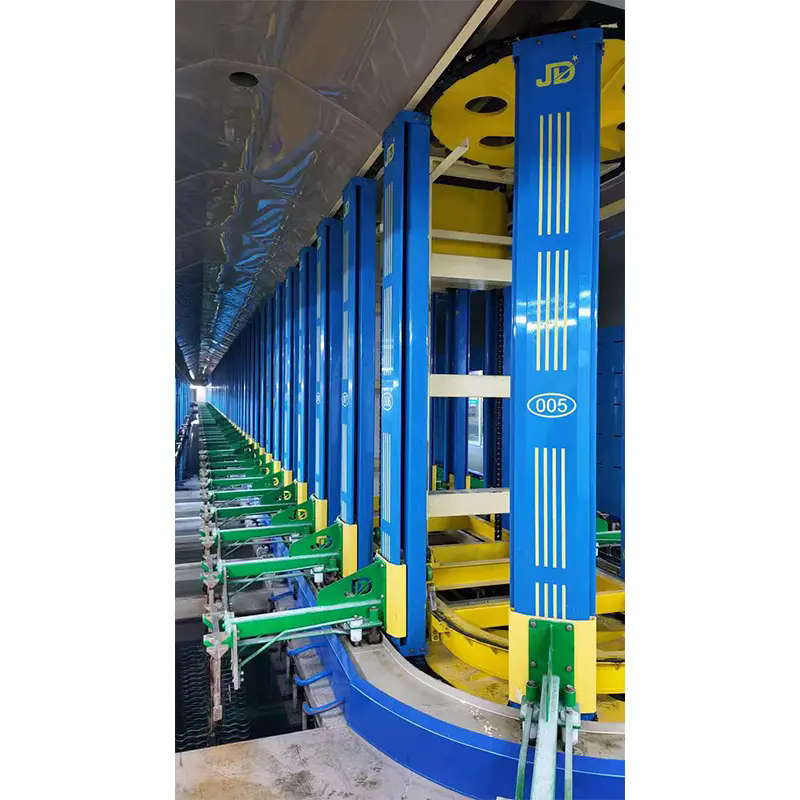
This article explains how a vertical hoist plating line works, why manufacturers choose automated plating systems, what problems it solves, and how companies can select the right equipment for their production requirements. With advanced automation technology and intelligent control systems, Taizhou Junda Intelligent Equipment Co., Ltd. provides reliable electroplating solutions that help industries achieve more stable and efficient manufacturing processes.
Table of Contents
- What Is a Vertical Hoist Plating Line?
- How Does a Vertical Hoist Plating Line Work?
- What Problems Can a Vertical Hoist Plating Line Solve?
- Key Features of Modern Vertical Hoist Plating Lines
- Why Choose Automated Vertical Hoist Plating Equipment?
- How to Select the Right Vertical Hoist Plating Line
- Maintenance Tips for Long-Term Performance
- Frequently Asked Questions
- Conclusion
What Is a Vertical Hoist Plating Line?
A vertical hoist plating line is an automated electroplating production system that uses vertical lifting mechanisms to transport workpieces between different treatment tanks. It integrates mechanical movement, electrical control, chemical processing, and intelligent management systems to complete surface treatment operations with high precision.
Unlike traditional plating methods that depend heavily on manual handling, a vertical hoist plating line automatically moves products through cleaning, degreasing, rinsing, electroplating, and post-treatment processes. This significantly reduces human intervention while improving production stability.
These systems are widely used in industries requiring corrosion resistance, decorative finishing, electrical conductivity, and enhanced surface durability, including automotive components, hardware products, electronic parts, precision components, and industrial equipment.
- Automotive metal components
- Electronic connectors and terminals
- Hardware accessories
- Precision mechanical parts
- Decorative metal products
- Industrial fasteners
How Does a Vertical Hoist Plating Line Work?
The working principle of a vertical hoist plating line is based on automated transportation and controlled electrochemical processing. The system uses hoists, rails, programmable controllers, and plating tanks to ensure every workpiece follows a predetermined production route.
The general operation process includes the following stages:
- Loading Stage: Workers or automated systems place workpieces onto dedicated carriers or hanging fixtures.
- Pre-treatment Stage: Products pass through cleaning, degreasing, and surface activation processes to remove oil, oxidation, and contaminants.
- Electroplating Stage: The hoist system transfers products into plating tanks where electrical current deposits a protective metal layer onto the surface.
- Rinsing and Post-treatment: Products are cleaned and processed to improve appearance, durability, and corrosion resistance.
- Unloading Stage: Finished products are removed for inspection, packaging, or further manufacturing.
Through accurate movement control and process management, the equipment ensures consistent plating thickness and reduces quality variations caused by manual operations.
What Problems Can a Vertical Hoist Plating Line Solve?
Many manufacturers encounter difficulties when using conventional plating methods. A vertical hoist plating line addresses these challenges through automation, precision control, and optimized production management.
- Unstable Product Quality: Manual transportation may cause inconsistent processing times. Automated hoist movement ensures every product receives the same treatment conditions.
- High Labor Requirements: Automated operation reduces dependence on manual handling and allows operators to focus on production monitoring.
- Low Production Efficiency: Continuous automated operation improves throughput and shortens processing cycles.
- Chemical Management Challenges: Intelligent control helps maintain stable process parameters and reduces material waste.
- Safety Risks: Reduced direct contact with chemicals improves workplace safety.
Key Features of Modern Vertical Hoist Plating Lines
Advanced vertical hoist plating systems combine mechanical reliability with intelligent automation technology. The major features include:
- Automatic Transportation System: Precision hoists move products smoothly between different processing stations.
- PLC Intelligent Control: Programmable systems manage movement sequences, processing times, and production parameters.
- Flexible Production Design: Equipment can be customized according to product dimensions, output requirements, and factory layouts.
- Stable Plating Performance: Accurate positioning helps maintain uniform coating quality.
- Improved Production Management: Automated operation makes production processes easier to monitor and optimize.
Why Choose Automated Vertical Hoist Plating Equipment?
Compared with traditional plating operations, automated vertical hoist plating lines provide significant improvements in efficiency, consistency, and long-term operating benefits.
- Higher production capacity for large-volume manufacturing
- More consistent coating thickness and surface quality
- Reduced labor costs and operational errors
- Better production repeatability
- Easier integration with modern factory management systems
For manufacturers competing in demanding markets, improving plating accuracy and reducing production instability are essential. An automated solution provides a practical approach to achieving these goals.
How to Select the Right Vertical Hoist Plating Line
Choosing suitable plating equipment requires careful consideration of production requirements, product characteristics, and future expansion plans.
Important factors include:
- Product Size and Weight: The hoist capacity and fixture design should match the workpiece specifications.
- Required Plating Process: Different surface treatments require different tank arrangements and process configurations.
- Production Volume: Equipment capacity should meet both current and future manufacturing needs.
- Factory Space: The system layout should fit the available production area efficiently.
- Automation Level: Manufacturers should evaluate whether they need basic automation or fully intelligent production management.
Working with an experienced supplier helps manufacturers avoid equipment selection mistakes and achieve better production results.
Maintenance Tips for Long-Term Performance
Proper maintenance ensures stable operation and extends the service life of a vertical hoist plating line.
- Regularly inspect hoist mechanisms and moving components.
- Check electrical control systems and sensors periodically.
- Maintain plating solution conditions according to production requirements.
- Clean tanks and fixtures to prevent contamination.
- Record equipment operation data for preventive maintenance planning.
A well-maintained plating line can provide reliable performance while reducing unexpected downtime and repair costs.
Frequently Asked Questions
Q1: What industries use vertical hoist plating lines?
Vertical hoist plating lines are commonly used in automotive, electronics, hardware, machinery, and metal processing industries where surface quality and durability are important.
Q2: Can a vertical hoist plating line be customized?
Yes. Professional manufacturers can customize tank layouts, lifting systems, automation functions, and production capacity according to customer requirements.
Q3: What are the main benefits of automated plating equipment?
The main benefits include improved coating consistency, higher productivity, reduced labor requirements, and safer operation.
Q4: How long can a vertical hoist plating line operate?
Service life depends on equipment quality, working environment, maintenance procedures, and daily operating conditions. Regular maintenance can significantly extend equipment lifespan.
Q5: Why choose Taizhou Junda Intelligent Equipment Co., Ltd.?
Taizhou Junda Intelligent Equipment Co., Ltd. focuses on developing intelligent electroplating equipment with reliable performance, customized solutions, and advanced manufacturing technology to help customers improve production efficiency and product quality.
Conclusion
A vertical hoist plating line is an effective solution for manufacturers seeking higher efficiency, stable coating quality, and safer production processes. By combining automated transportation, intelligent control, and precise electroplating technology, it helps companies overcome common challenges associated with traditional plating operations.
With professional experience and advanced equipment solutions, Taizhou Junda Intelligent Equipment Co., Ltd. supports customers in building efficient and reliable electroplating production systems. If you are looking for a customized vertical hoist plating line to improve your manufacturing performance, please contact us for professional assistance and tailored solutions.