

How Does a Webbing Cutting Machine Help Achieve Consistent Cut Length and Quality?
2026-09-07
You have seen it before. A batch of webbing that should be 500 mm long comes off the line with lengths ranging from 497 mm to 503 mm. The sewing department complains. The customer rejects the order. The supervisor blames the operator, but the real problem is the machine. Inconsistent cut length is not an operator error; it is a mechanical and control system issue. This guide is written for production supervisors who need to understand why length variation happens and how the right equipment eliminates it.
1. What Causes Length Variation in Webbing Cutting?
The first step to solving length variation is to understand its sources. There are three primary causes. The first is the feeding mechanism. If the feed roller slips or the material tension varies, the length fed into the cutter will change. The second is the cutting action itself. If the blade drags the material during the cut, it can pull the webbing out of position. The third is the control system. If the control system's response time varies, the cutting signal will be delayed, causing length variation.
The table below shows the contribution of each factor to total length variation in a typical production environment.
| Source of variation | Typical contribution to length error | How to identify | Solution |
| Feed roller slip (tension variation) | ± 0.5 to 1.5 mm | Check feed roller pressure and surface condition | Replace worn rollers; use constant tension control |
| Blade drag during cutting | ± 0.3 to 0.8 mm | Observe webbing movement during cut | Use sharper blade; adjust blade clearance |
| Control system response time | ± 0.2 to 0.6 mm | Measure time from signal to actual cut | Upgrade to servo control with encoder feedback |
| Material stretch (elastic webbing) | ± 0.8 to 2.0 mm | Measure cut length under different tensions | Pre stretch feed section; use compensated cutting |
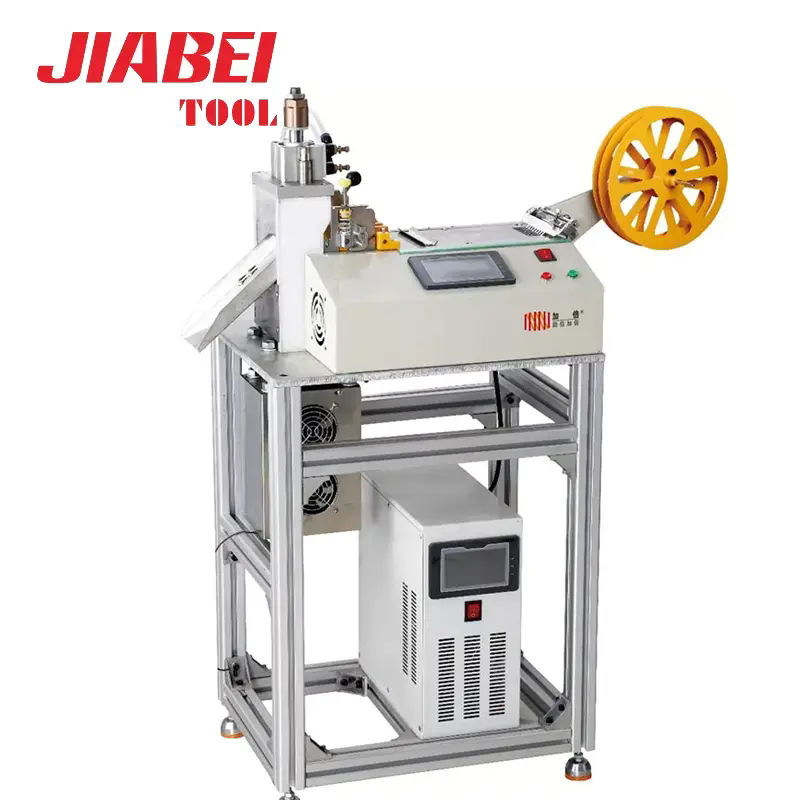
In our factory, we have analyzed the performance of Webbing Cutting Machine units across different applications. The single largest cause of length variation is feed roller slip, which accounts for 40 to 50 percent of total error. This is why our Webbing Cutting Machine uses a servo driven feed mechanism with a pinch roller that applies constant pressure, independent of the webbing thickness. Lishui Jiwu Technology Co.,Ltd. has designed this feed system to eliminate the first and largest cause of length variation.
2. How Does Blade Technology Affect Cut Edge Quality?
Length accuracy is one dimension of quality. Cut edge quality is another. A clean, straight cut without fraying or melting is essential for webbing that will be sewn or heat sealed. The blade material, the cutting angle, and the cutting speed all affect edge quality. A dull blade or incorrect cutting angle will produce frayed edges that require extra finishing. The table below compares different blade technologies used in Webbing Cutting Machine units.
| Blade type | Typical edge quality | Cutting speed | Blade life (cuts) | Best application |
| Standard steel blade (60 HRC) | Moderate fraying | Medium | 50,000 – 80,000 | Polyester webbing (light duty) |
| Carbide tipped blade | Clean cut, minimal fraying | Medium to high | 200,000 – 300,000 | Nylon and heavy polyester |
| Heated blade (thermal cut) | Sealed edge, no fraying | Slow | 30,000 – 50,000 | Synthetic webbing that melts |
| Ultrasonic blade | Sealed edge, very clean | Slow | 100,000 – 150,000 | Nylon and blended materials |
In our factory, we recommend carbide tipped blades for most polyester and nylon webbing applications. They offer the best balance of edge quality and blade life. For applications requiring a sealed edge, such as seat belt webbing, we offer a thermal cutting option. Our Webbing Cutting Machine units are designed to accommodate blade changes in under 5 minutes, minimizing downtime. Lishui Jiwu Technology Co.,Ltd. provides blade replacement kits with every machine.
3. How Does the Control System Ensure Batch to Batch Consistency?
The control system is the brain of the Webbing Cutting Machine. It determines when to cut, how fast to feed, and how to compensate for variations. A basic control system uses a timer to trigger the cut. A more advanced system uses a rotary encoder that measures the actual length of webbing fed, and adjusts the cut position in real time. The encoder-based system eliminates the cumulative error that occurs when the feed length is not exactly the commanded length. In our factory, we use a high resolution encoder (2,500 pulses per revolution) that provides length feedback with 0.1 mm resolution. This means that the Webbing Cutting Machine can detect and correct length errors of less than 0.2 mm. The control system also stores the cutting parameters for each product, so the machine can be set up in seconds for a repeat order. This is how we achieve batch to batch consistency: the machine does not rely on the operator's memory or manual adjustments.
Real-world measurement: In a production test with 1,000 cuts of 500 mm polyester webbing, our Webbing Cutting Machine achieved a standard deviation of 0.15 mm. The maximum deviation was 0.4 mm. The average deviation was 0.1 mm. The machine met the customer's specification of ±0.5 mm with a Cpk value of 2.2, which is considered excellent process capability.
4. What Is the Total Cost of Inconsistent Cutting to a Production Line?
Inconsistent cutting is not just a quality issue; it is a cost issue. Every piece that is cut too short must be scrapped. Every piece that is cut too long must be trimmed, which costs labor. The table below shows the cost impact of length variation on a typical medium-scale webbing production line.
| Cost category | With inconsistent cutting (± 2 mm) | With consistent cutting (± 0.5 mm) | Annual saving |
| Scrap (rejected pieces) | $4,800 | $800 | $4,000 |
| Rework labor (trimming long pieces) | $6,200 | $1,200 | $5,000 |
| Customer returns (complaints) | $3,500 | $200 | $3,300 |
| Lost production due to adjustments | $2,800 | $400 | $2,400 |
In our factory, we have found that the cost of inconsistency is often hidden because it is spread across multiple departments. When we aggregate the costs, the saving from consistent cutting is $14,700 per year for a medium-scale line. The investment in a high-precision Webbing Cutting Machine is typically recovered within 8 to 12 months.
Frequently Asked Questions About Webbing Cutting Consistency
Summary for Production Supervisors and Plant Managers
Consistent cut length and quality in webbing cutting are not achieved by operator skill alone. They are achieved through a combination of a stable feed mechanism, a sharp and appropriate blade, and a precision control system with encoder feedback. The cost of inconsistency is real and measurable: scrap, rework, returns, and lost production. Investing in a machine that delivers consistent results improves product quality, reduces waste, and increases customer satisfaction.
Lishui Jiwu Technology Co.,Ltd. manufactures Webbing Cutting Machine units with servo drives, carbide blades, and encoder-based control systems. We provide a full documentation package, including machine calibration data and recommended blade replacement intervals. Each machine is tested for length accuracy before shipment.