

How Does Raw Material MFI Influence the Welding Quality in an HDPE Spiral Winding Solid Wall Pipe Production Line
2026-04-23
The melt flow index (MFI) of raw material is one of the most critical yet often overlooked parameters affecting weld integrity in an HDPE Spiral Winding Solid Wall Pipe Production Line. At Comrise, extensive field data shows that improper MFI selection directly correlates with weak fusion zones, delamination, and premature pipe failure. Understanding this relationship ensures stable output and long-term pipeline performance.
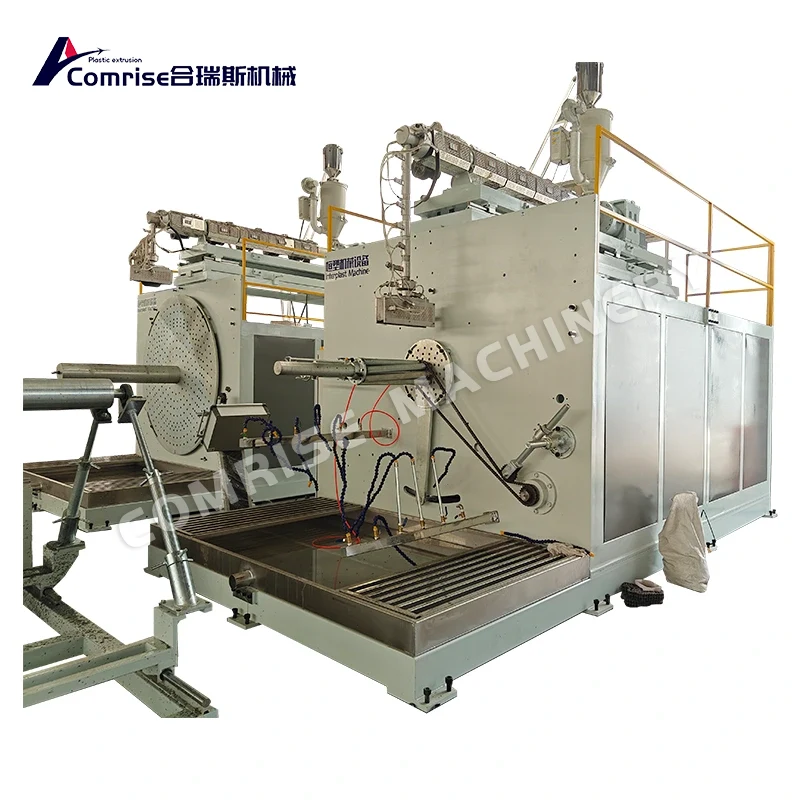
The Science Behind MFI and Welding
MFI measures how easily molten HDPE flows under pressure. In a spiral winding process, adjacent layers or strips must fuse seamlessly. If the MFI is too low (high viscosity), the material does not flow sufficiently into the weld zone, creating microscopic voids. If the MFI is too high (low viscosity), excessive flow leads to sagging and uneven weld thickness.
| MFI Range (g/10 min, 190°C/2.16 kg) | Effect on Welding Quality | Recommended Application |
|---|---|---|
| 0.2 – 0.4 | Poor flow, incomplete fusion, cold welds | Not recommended for spiral winding |
| 0.6 – 1.0 | Optimal flow, strong molecular entanglement | Standard solid wall pipes |
| 1.2 – 1.8 | Acceptable but risk of sagging in large diameters | Thin-wall or small diameter pipes |
| > 2.0 | Severe sagging, non-uniform welds, leaking risk | Avoid |
Key Factors Linking MFI to Weld Performance
-
Molecular weight distribution: A narrow distribution with moderate MFI (0.6–1.0) ensures consistent heating and cooling across the weld interface.
-
Thermal stability: Higher MFI grades often contain more processing aids, which can migrate to the weld surface and reduce adhesion.
-
Weld cooling rate: Low MFI materials retain heat longer, allowing more time for crystal formation at the bond line.
How Comrise Optimizes MFI Control
Comrise integrates real-time MFI monitoring sensors into each HDPE Spiral Winding Solid Wall Pipe Production Line. The system automatically adjusts barrel temperatures and screw speed to maintain optimal flow characteristics, reducing weld-related rejects by over 40% in recent customer audits.
HDPE Spiral Winding Solid Wall Pipe Production Line FAQ
Question 1: What welding defects are most commonly caused by using wrong MFI in an HDPE Spiral Winding Solid Wall Pipe Production Line?
Answer: Low MFI (below 0.5) typically causes cold welds, visible as a clear line between strips that separates under pressure. High MFI (above 1.5) leads to weld overlap thinning, where the material drips away before solidification, creating weak spots that often fail hydrostatic testing. The most dangerous defect is hidden micro-delamination, which cannot be seen externally but propagates under cyclic loading.
Question 2: Can I mix HDPE batches with different MFI values in one HDPE Spiral Winding Solid Wall Pipe Production Line?
Answer: Mixing batches with MFI differences greater than 0.3 g/10 min is strongly discouraged. Incompatible melt viscosities cause erratic flow at the welding point, where one material cools faster and acts as a foreign inclusion. Even blending in a single hopper does not create a homogeneous melt because different MFI fractions separate during spiral extrusion. Always use certified single-source resin or pre-blended compounds validated for spiral winding.
Question 3: How does the production line speed interact with MFI to affect welding quality?
Answer: At higher line speeds (above 1.5 m/min), low MFI material cannot remelt the previous layer sufficiently, resulting in mechanical rather than molecular bonding. Conversely, high MFI material at slow speeds pools and creates thick, brittle weld beads. For a stable weld, the combination of MFI and line speed must maintain a melt temperature window of 200–210°C exactly at the nip point. Comrise provides custom process tables matching resin MFI to target line speed for each HDPE Spiral Winding Solid Wall Pipe Production Line.
Conclusion
Selecting the correct MFI is not optional—it is the foundation of reliable welding in an HDPE Spiral Winding Solid Wall Pipe Production Line. Mismatched flow properties produce invisible defects that only surface years later under pressure. With Comrise precision control systems and application expertise, manufacturers eliminate MFI-related weld failures entirely.
Contact us today to have your resin tested and receive a customized MFI process chart for your production targets. Comrise engineers are ready to audit your current welding quality and propose immediate improvements.