

How Does Screen Size Selection Affect Regrind Quality in a Low Speed Granulator
2026-05-21
When optimizing a Low Speed Granulator for plastic recycling, screen size selection is often overlooked. At Sinburller, decades of real-world testing confirm that screen apertures directly determine regrind uniformity, dust content, and downstream processing efficiency. Choosing the wrong screen turns valuable scrap into unusable fines.
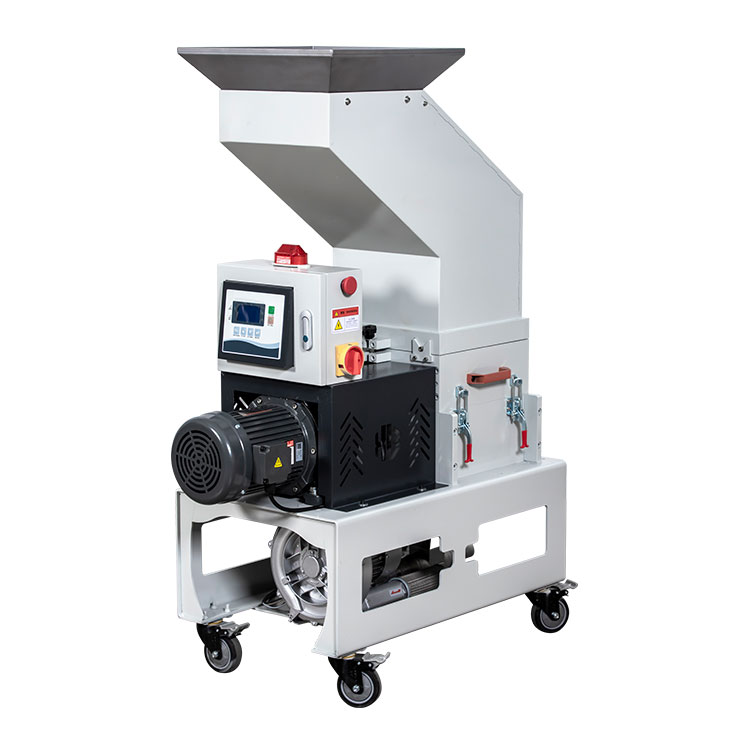
The Science Behind Screen Size and Regrind Quality
A Low Speed Granulator operates with shear-cutting rotors running below 150 RPM. Unlike high-speed units, it minimizes heat and dust. However, the perforated screen still controls particle exit. Smaller holes retain material longer, producing finer regrind. Larger holes allow faster exit but risk oversized flakes.
| Screen Hole Diameter | Typical Regrind Size | Dust Generation | Throughput (kg/h) | Best Application |
|---|---|---|---|---|
| 4 mm | 3-5 mm flakes | Very low | 60-80 | Injection molding, blow molding |
| 6 mm | 5-8 mm chips | Low | 100-130 | Extrusion, pipe recycling |
| 8 mm | 7-10 mm pieces | Moderate | 150-180 | Large purgings, thick-walled parts |
| 10 mm+ | Irregular chunks | High | 200+ | Pre-crushing only |
Critical Effects on Key Quality Metrics
Dust & Fines: A 4 mm screen in a Low Speed Granulator produces less than 2% dust. An 8 mm screen increases dust to 5-7% because particles break unevenly at exit.
Melting Behavior: Fine regrind (4-6 mm) melts uniformly. Coarse regrind (8-10 mm) creates unmelted spots in extruders, causing reject parts.
Energy Use: A Low Speed Granulator with a 6 mm screen uses 12% more energy than with an 8 mm screen due to longer cutting cycles.
FAQ - Low Speed Granulator Common Questions
Q1: Can I use the same screen size for all plastic types in a Low Speed Granulator?
A: No. Sinburller recommends 4-5 mm for rigid plastics (ABS, PS, PC) to prevent stress cracking. For soft plastics (LDPE, LLDPE, TPE), use 6-8 mm to avoid screen blinding. For fiber-filled materials, 8-10 mm prevents clogging from glass fibers. Testing each resin type on your Low Speed Granulator is essential.
Q2: How often should I replace screens in a Low Speed Granulator to maintain regrind quality?
A: Replace screens every 150-200 operating hours under normal conditions. Signs of wear include rounded perforation edges, regrind size inconsistency (variance over 30%), and a 15% drop in throughput. Sinburller screens use hardened AR400 steel which lasts 40% longer than standard screens. Always inspect screens weekly when processing abrasive materials like talc-filled PP.
Q3: Why does my Low Speed Granulator produce stringy regrind even with a small screen?
A: Stringy particles indicate a gap between the rotor knives and the screen. In a Low Speed Granulator, the recommended gap is 0.3-0.5 mm for general recycling. Gap exceeding 1 mm allows plastic to stretch before cutting. Also check for worn knife edges. Sinburller’s adjustable screen cradle maintains constant clearance, eliminating stringing issues.
Practical Selection Guide
| Material Type | Recommended Screen | Why |
|---|---|---|
| Purged sprues (hard) | 4 mm round holes | Minimizes dust, perfect regrind for re-feeding |
| Film scrap | 8 mm hexagon holes | Prevents smearing, allows airflow |
| Thick sheets (6-10 mm) | 6 mm with staggered pattern | Balances throughput and uniformity |
| Engineering plastics (nylon, acetal) | 5 mm reverse-taper holes | Prebridging, consistent exit |
Optimize Your Low Speed Granulator Today
Sinburller supplies custom screens for every Low Speed Granulator model. Our engineers analyze your regrind samples to recommend the exact hole pattern and diameter. Achieve 98% uniform regrind with zero oversized flakes.
Contact us now for a free screen consultation and regrind quality audit. Send your material type and target particle size to our technical team. Every Low Speed Granulator deserves the right screen.