

How Does Tooling Design Affect Performance in a Hammering Round Pipe Shrinking Machine
2026-03-30
When manufacturers invest in a Hammering Round Pipe Shrinking Machine, the primary focus often falls on motor power, frame rigidity, or automation levels. Yet experienced production managers know that tooling design is the true determinant of output quality, cycle efficiency, and long-term operational stability. At Feihong, we have observed that even the most advanced Hammering Round Pipe Shrinking Machine can underperform without properly engineered tooling. This article examines how die geometry, material selection, clearance parameters, and cooling strategies directly influence shrinking accuracy, tool life, and overall production economics.
The Critical Role of Tooling in Pipe Shrinking
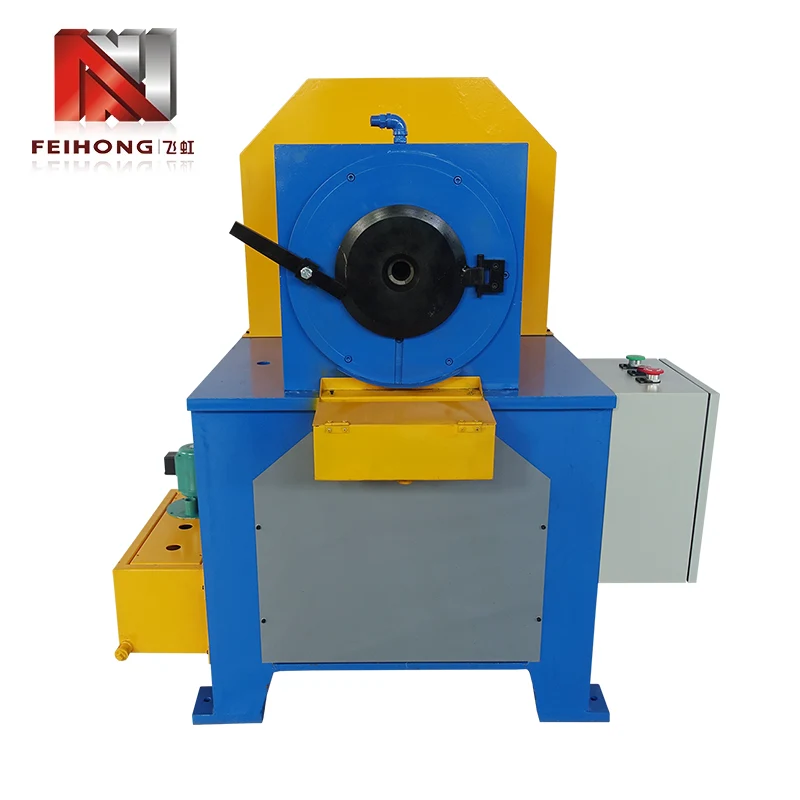
Tooling in a Hammering Round Pipe Shrinking Machine refers to the hammer dies, mandrels, and clamping components that shape the workpiece under high-frequency impact. Unlike hydraulic or rotary shrinking methods, hammering relies on repetitive radial blows to reduce pipe diameter with exceptional precision. Poor tooling design leads to surface defects, ovality, inconsistent wall thickness, and premature equipment wear. Conversely, optimized tooling transforms the Hammering Round Pipe Shrinking Machine into a high-efficiency system capable of handling demanding materials like stainless steel, titanium, and thick-wall tubes with repeatable accuracy.
Key Tooling Design Factors and Their Performance Impact
| Design Factor | Performance Impact | Best Practice for Feihong Tooling |
|---|---|---|
| Die Surface Hardness | Determines tool life and resistance to wear | 58–62 HRC with cryogenic treatment |
| Die Profile Radius | Affects material flow and surface finish | Progressive radius design reduces stress concentration |
| Clearance Fit | Controls ovality and concentricity | 0.03–0.08 mm per side depending on material |
| Cooling Channel Layout | Prevents thermal fatigue and sticking | Spiral cooling within 15 mm of forming face |
| Segment Count | Influences roundness and cycle speed | 6–8 segmented dies for optimal balance |
Material Compatibility and Die Geometry
Different materials respond uniquely to the hammering process. A Hammering Round Pipe Shrinking Machine equipped with Feihong precision-ground dies allows operators to adjust striking frequency, feed rate, and die approach angles. For ductile materials like low-carbon steel, wider die profiles reduce galling. For high-strength alloys, narrow profiles with polished surfaces minimize cold welding. Tooling designed with material-specific lead-in angles—typically 8° to 15°—ensures smooth transition without scoring or micro-cracking.
Hammering Round Pipe Shrinking Machine FAQ
What tooling materials offer the longest service life in high-volume shrinking applications?
Tooling for Hammering Round Pipe Shrinking Machine applications must balance wear resistance with impact toughness. Feihong recommends powder metallurgy tool steels such as Vanadis 4 Extra or CPM 10V, which provide superior resistance to abrasive wear from materials like galvanized pipe or stainless steel. For non-ferrous applications, D2 or A11 grades with deep cryogenic treatment extend die life by 200–300% compared to conventional tool steels. Coating technologies such as AlTiN or CrN further reduce friction and prevent material pickup, especially when shrinking coated or lubricated pipes.
How does die segmentation affect roundness and dimensional stability in a Hammering Round Pipe Shrinking Machine
Die segmentation directly governs how evenly radial force is distributed around the pipe circumference. A Hammering Round Pipe Shrinking Machine using 4-segment dies often produces acceptable results for general fabrication, but precision applications require 6 or 8 segments. Higher segment counts reduce the unsupported span between die faces, minimizing the risk of polygonal deformation. Feihong engineering data shows that upgrading from 4 to 8 segments reduces ovality by up to 60% in thin-wall tubes. Additionally, segmented dies with independent wear plates allow selective replacement, lowering long-term maintenance costs without sacrificing precision.
What clearance specifications should be maintained between the mandrel and the inner wall during shrinking
Mandrel clearance is one of the most overlooked yet critical parameters in Hammering Round Pipe Shrinking Machine tooling design. Excessive clearance allows inward buckling and wall collapse, while insufficient clearance creates frictional heat and scoring. Feihong recommends a baseline clearance of 0.2% to 0.4% of the finished inner diameter for steel materials, with adjustments based on wall thickness ratio. For thin-wall pipes below 2 mm thickness, increasing clearance by 0.05 mm helps prevent mandrel seizure. Advanced applications benefit from tapered mandrels that maintain progressive contact, ensuring uniform wall thickness across the entire shrunk length.
Thermal Management and Tooling Longevity
Heat generation is unavoidable in high-frequency hammering. Without proper thermal design, tooling in any Hammering Round Pipe Shrinking Machine undergoes accelerated wear, tempering, and dimensional drift. Feihong tooling incorporates internally routed coolant channels that maintain die face temperatures below 120°C even during continuous operation. This not only preserves die hardness but also stabilizes the shrinking process, preventing thermal expansion from altering finished diameters. For automated production lines, thermocouple-integrated tooling provides real-time feedback, allowing the machine control system to adjust striking energy or coolant flow automatically.
Conclusion and Contact Information
Tooling design is not an accessory to a Hammering Round Pipe Shrinking Machine—it is the core determinant of precision, efficiency, and profitability. From die segmentation strategies to material-specific clearances and advanced thermal management, every design decision directly impacts your bottom line. Feihong combines decades of metal forming expertise with precision manufacturing capabilities to deliver custom tooling solutions that maximize the performance of your Hammering Round Pipe Shrinking Machine.
Contact Feihong today to schedule a tooling audit or discuss your specific pipe shrinking requirements. Our engineering team provides comprehensive support from initial design through installation and on-site validation, ensuring your equipment achieves optimal performance from the first cycle.