
How Fast Can a Custom Shape Bottle Labeling Machine Label Different Bottle Shapes
2026-10-16
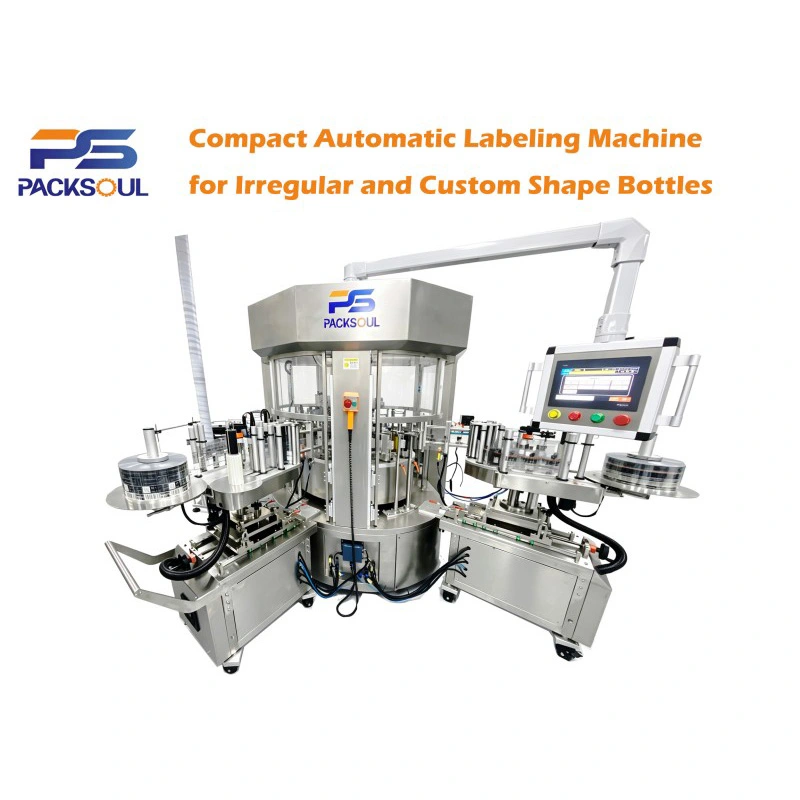
Speed is one of the first questions manufacturers ask when evaluating labeling equipment. The answer depends on bottle geometry, label type, machine configuration, and the level of automation involved. At PackSoul, we build Custom Shape Bottle Labeling Machine systems that are engineered around real production conditions rather than ideal laboratory scenarios. This article breaks down actual speed ranges, the variables that influence them, and what buyers should expect when labeling curved, tapered, oval, and irregular containers.
Understanding Labeling Speed: What the Numbers Actually Mean
Labeling speed is typically expressed in bottles per minute (BPM). However, a machine's rated speed and its real-world output are rarely identical. The gap comes from changeover time, label placement tolerance, bottle stability, and downstream synchronization.
| Speed Tier | Typical BPM | Best Suited For |
|---|---|---|
| Entry-level semi-automatic | 10–25 | Small batches, pilot runs |
| Standard automatic | 30–60 | Medium-volume production |
| High-speed automatic | 60–120 | Large-scale, single-SKU lines |
| Multi-lane custom systems | 120–300+ | High-volume, dedicated formats |
How Bottle Shape Affects Labeling Speed
Different geometries present different mechanical challenges. A Custom Shape Bottle Labeling Machine must manage curvature, surface contact, and rotational control simultaneously.
| Bottle Shape | Speed Impact | Primary Challenge |
|---|---|---|
| Cylindrical | Fastest | Minimal — consistent surface |
| Oval / elliptical | Moderate | Variable wrap angle |
| Tapered / conical | Moderate to slow | Changing diameter during rotation |
| Flat-sided with rounded edges | Moderate | Label adhesion at transition points |
| Irregular / sculpted | Slowest | Custom fixturing required |
Cylindrical containers can often run at the machine's full rated speed. Oval and tapered bottles reduce throughput by 15–30% because the label applicator must compensate for changing surface distance. Irregular shapes may reduce speed by 40% or more unless PackSoul engineers design dedicated tooling and servo-driven applicator heads.
Key Factors That Determine Real-World Throughput
-
Label type — Pressure-sensitive labels apply faster than shrink sleeves or wet glue.
-
Bottle stability — Lightweight or tall bottles require lower speeds to prevent tipping.
-
Placement accuracy — Tight tolerance requirements (±0.5 mm) slow the line compared to ±2 mm.
-
Changeover frequency — Frequent SKU switching adds downtime that reduces average BPM.
-
Conveyor and indexing system — Servo indexing maintains speed better than mechanical cams.
-
Inspection integration — Vision systems verify placement but may require speed matching.
A Custom Shape Bottle Labeling Machine from PackSoul typically includes servo-driven label heads, adjustable wrap belts, and quick-release change parts. These features allow one machine to handle multiple shapes without sacrificing more speed than necessary.
Practical Speed Expectations by Production Scale
| Production Scale | Recommended Configuration | Expected BPM |
|---|---|---|
| Startup / small batch | Semi-automatic with custom fixture | 10–20 |
| Growing brand | Automatic single-head | 30–50 |
| Established manufacturer | Dual-head with servo wrap | 60–90 |
| Enterprise | Multi-lane custom system | 120–250 |
Frequently Asked Questions
Can a Custom Shape Bottle Labeling Machine label both round and flat bottles on the same line?
Yes, a Custom Shape Bottle Labeling Machine can handle both round and flat bottles on the same line when it is equipped with interchangeable tooling and adjustable wrap belts, allowing operators to switch formats with minimal downtime.
Does labeling speed decrease significantly when switching between different bottle shapes?
Speed decreases during changeover, not necessarily during steady production; with a Custom Shape Bottle Labeling Machine designed for quick-release change parts, the switch itself may take 10–30 minutes, after which the machine returns to its normal rate for that specific shape.
What is the maximum speed a Custom Shape Bottle Labeling Machine can achieve for irregular bottles?
For highly irregular bottles, a Custom Shape Bottle Labeling Machine can typically achieve 20–60 BPM depending on the complexity of the shape, the label size, and whether custom fixturing or servo compensation is required.
Why Speed Alone Should Not Be the Only Metric
A machine that runs at 150 BPM but requires two hours of changeover is less valuable than one running at 80 BPM with fifteen-minute changeovers. PackSoul focuses on total effective throughput — the combination of raw speed, uptime, changeover efficiency, and label accuracy. This approach aligns with Google's E-E-A-T principles: demonstrated experience with real production environments, genuine expertise in mechanical engineering, authoritativeness in the labeling equipment sector, and trustworthiness built through transparent performance data.
Contact Us
Ready to determine the right speed and configuration for your bottles? Contact PackSoul today for a free production assessment and a customized Custom Shape Bottle Labeling Machine recommendation based on your actual bottle shapes, label specifications, and output targets.