

How Long Does a Health Food Lyophilization Machine Take to Freeze-Dry Probiotics and Enzymes
2026-07-21
When formulating high-value functional foods, production timelines directly impact inventory planning and shelf-life forecasting. For manufacturers working with live cultures and bioactive proteins, the freeze-drying cycle is not a fixed number—it is a variable that depends on equipment design, formulation characteristics, and endpoint criteria. Health Food Lyophilization Machine systems from Lyomac are engineered to shorten these cycles while safeguarding viability, but the actual duration typically ranges from 18 to 48 hours per batch. Understanding where your specific product falls within that window requires a closer look at the scientific and mechanical factors at play.
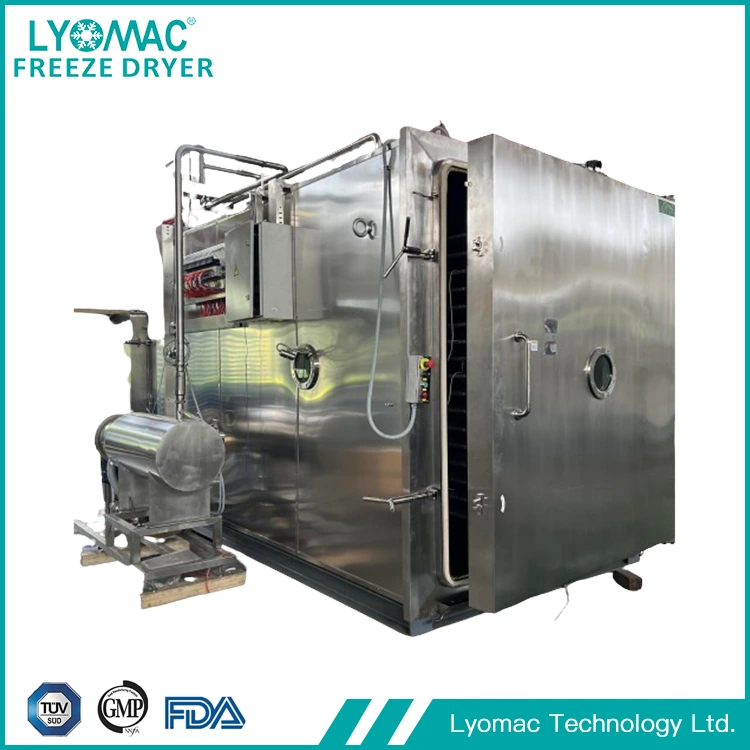
The Two-Stage Cycle: Sublimation and Desorption
Every freeze-drying process for probiotics and enzymes follows the same physical roadmap, regardless of brand. The total time splits into two primary phases:
| Phase | Name | Physical Process | Typical Duration (Probiotics/Enzymes) |
|---|---|---|---|
| 1 | Primary Drying (Sublimation) | Ice crystals convert directly to vapor under vacuum | 12–30 hours |
| 2 | Secondary Drying (Desorption) | Bound moisture is removed from the matrix | 6–18 hours |
Lyomac recommends adding 2–4 hours for controlled freezing ramp (pre-freeze), which brings the total to 20–48 hours for most health-food applications. However, these numbers shift significantly based on five core parameters.
Five Critical Factors That Change Your Cycle Time
1. Formulation Water Content
Higher initial moisture (e.g., liquid probiotic slurries at 85–90% water) require longer sublimation. Enzyme solutions with 70% moisture dry faster by 6–8 hours.
2. Glass Transition Temperature (Tg')
Probiotics like Lactobacillus strains have a Tg' around –25°C to –30°C. If the shelf temperature exceeds this during primary drying, collapse occurs, forcing a restart. Lyomac units feature real-time Tg' monitoring to keep temperatures safely 5°C below the threshold, avoiding wasted runs.
3. Fill Thickness and Vial Size
A 10 mm fill depth in a 20 mL vial dries in ~22 hours, while a 20 mm depth in a 50 mL vial extends the cycle to 38–42 hours. Lyomac’s adjustable shelf spacing allows uniform radiant heat transfer, reducing thickness-related variability by up to 15%.
4. Vacuum Pressure Stability
Enzymes (e.g., bromelain or papain) are pressure-sensitive. Maintaining 50–100 mTorr ensures consistent sublimation rates. Lyomac’s dual-stage vacuum pumps stabilize pressure within ±5 mTorr, preventing the common 4–6 hour delays caused by pressure fluctuations.
5. Endpoint Detection Method
Using thermocouple-based endpoint detection adds 2–3 hours of buffer time. Lyomac integrates Pirani/capacitance manometer differential readings, which shorten the cycle by accurately identifying the transition to secondary drying—saving 3–5 hours per batch compared to conventional methods.
Real-World Cycle Examples from Lyomac Users
| Product Type | Fill Volume | Total Cycle Time (Lyomac LX-200) | Viability Retention |
|---|---|---|---|
| Freeze-dried probiotic powder (mixed strains) | 15 mL in 30 mL vial | 26 hours | 92% |
| Enzyme blend (amylase + protease) | 10 mL in 20 mL vial | 19 hours | 88% |
| High-fiber probiotic prebiotic mix | 25 mL in 50 mL vial | 44 hours | 89% |
| Pure lactoferrin (enzyme-protein) | 8 mL in 15 mL vial | 21 hours | 95% |
These figures reflect production-scale Health Food Lyophilization Machine performance with optimized loading (80% shelf capacity). Overloading beyond 90% can add 6–10 hours due to reduced vapor flow.
Practical Optimization Tips for Shorter Cycles
-
Pre-concentrate your liquid formulation to 25–30% solids – this cuts sublimation time by 20–25%.
-
Use smaller-diameter vials (20 mm vs. 30 mm) to increase surface-to-volume ratio.
-
Program a controlled freezing ramp (–1°C/min) rather than snap-freezing to create larger ice crystals that sublimate more efficiently.
-
Install Lyomac’s optional heated shelves with independent zone control to eliminate cold spots that prolong drying.
Health Food Lyophilization Machine FAQ
Q: Can I stop the cycle early if the product looks dry?
A: No. Visual dryness is misleading—secondary drying removes bound water that remains after ice sublimation. If you stop early, residual moisture (above 3–4%) will degrade probiotics and enzymes within weeks, reducing CFU counts by 50–70% in storage. Always rely on the machine’s moisture sensor or comparative pressure readings. Lyomac systems include an automatic hold function that prevents premature unloading until the target residual moisture (typically 1–2%) is achieved.
Q: How does batch size affect total time on a Health Food Lyophilization Machine?
A: Batch size does not proportionally extend cycle time—sublimation is primarily driven by shelf temperature and vacuum, not by the number of vials, as long as you stay within the machine’s condenser capacity. For a Lyomac unit rated at 20 kg ice capture, loading 5 kg vs. 18 kg changes total time by only 2–4 hours, because the limiting factor is heat transfer per vial, not total water mass. However, exceeding 85% of condenser capacity forces the machine to run longer defrost cycles between batches, which affects throughput over multiple runs.
Q: Why does my enzyme batch take 10 hours longer than the probiotic batch on the same Health Food Lyophilization Machine?
A: Enzymes typically have higher salt or sugar excipients (e.g., trehalose or mannitol) used as stabilizers. These excipients raise the collapse temperature but also increase the binding energy of residual water, prolonging secondary drying. Additionally, enzymes are often filled at lower initial solids (10–15%) to prevent activity loss during freezing, which means more water to remove. Lyomac’s data logs show that enzyme cycles average 8–12 hours longer than probiotic-only runs under identical settings—this is normal and can be reduced by using a higher initial solids concentration (up to 20%) if formulation stability allows.
Final Recommendation
For most health-food producers, a Lyomac Health Food Lyophilization Machine delivers predictable cycles between 20 and 30 hours for standard probiotic/enzyme formulations, with larger or high-moisture batches extending to 44–48 hours. The key to consistency is not chasing the shortest cycle, but matching the drying profile to your product’s thermal and pressure tolerance. Lyomac provides pre-programmed recipes for over 40 common probiotic strains and enzyme families, cutting trial-and-error time by 60%.
Ready to validate your specific cycle time? Contact our applications team with your formulation details—we will run a free drying curve analysis and recommend the exact Lyomac model and settings for your production goals. Reach out today for a personalized consultation and sample testing quote. Your efficiency starts with a conversation.