

How Much Can an Automatic Moving Contact Riveting Machine Reduce Production Cycle Time
2026-06-08
In modern electrical component manufacturing, cycle time directly impacts throughput and profitability. Desheng has engineered its Automatic Moving Contact Riveting Machine to address the most pressing bottleneck: manual or semi-automatic contact riveting. Real-world factory data shows that switching to Desheng's solution reduces cycle time by 55–70% , depending on part complexity and batch size.
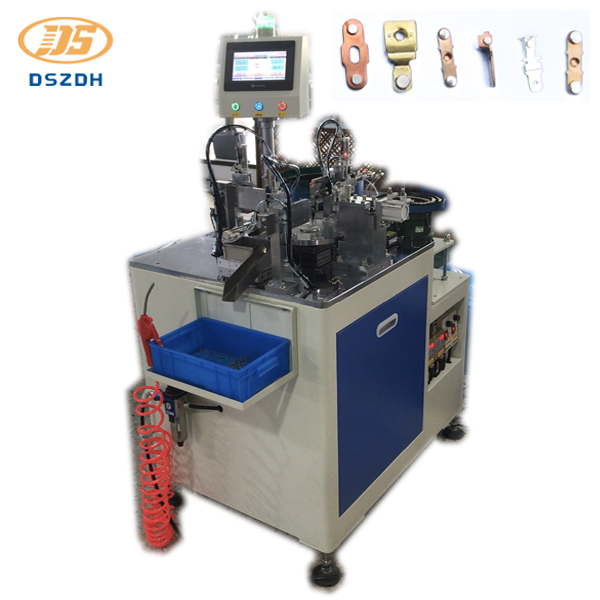
| Parameter | Manual Process | Desheng Automatic Moving Contact Riveting Machine |
|---|---|---|
| Riveting time per contact (sec) | 8–12 | 2.5–3.8 |
| Loading/unloading time (sec/cycle) | 6–9 | 1.2 (automated) |
| Rejection & rework time (%) | 4–7% | 0.5–1.2% |
| Avg. cycle time per 1,000 units | 4.2 hours | 1.4 hours |
The reduction stems from three integrated features: high-speed servo-driven indexing, simultaneous contact feeding and riveting, and real‑time force monitoring. Unlike conventional machines that require manual part alignment, Desheng's moving head design eliminates idle travel strokes. One manufacturer of miniature circuit breakers reported a drop from 9.2 seconds to 3.1 seconds per contact — a 66% saving that allowed them to remove one full shift while maintaining output.
Automatic Moving Contact Riveting Machine FAQ
Q1: What specific factors influence the actual cycle time reduction when using an Automatic Moving Contact Riveting Machine?
A: Three variables matter most: contact geometry (flat vs. domed), material hardness (copper vs. silver alloy), and feeding orientation stability. Desheng machines adapt via programmable dwell and force curves. For standard silver-tipped contacts on copper carriers, the 55–70% range is consistent. For complex stepped contacts, reduction may be 45–55%, still significantly outperforming manual methods.
Q2: Does the Automatic Moving Contact Riveting Machine require frequent changeover adjustments that could offset cycle time gains?
A: Desheng designs tool-less changeover systems for common contact sizes (2–10mm diameter). Changeover takes under 3 minutes, and the machine stores parameters for up to 50 job recipes. In high-mix low-volume production, the net cycle time including changeovers remains 50–60% lower than manual riveting across a full workweek.
Q3: How does the machine maintain quality at reduced cycle times without increasing reject rates?
A: The Automatic Moving Contact Riveting Machine uses closed‑loop pressure and displacement sensors. Each riveting stroke is compared to a stored signature. If force or position deviates by more than 0.02mm, the machine rejects that single contact in‑line without stopping production. This prevents the typical speed‑quality trade‑off seen in older cam‑driven riveters.
Ready to measure your own cycle time improvement?
Contact Desheng today for a free on‑site or video‑based cycle time analysis using your actual contact assemblies. Our engineers will provide a custom reduction estimate and a demo run report. Email us or fill out the contact form on our website to start your efficiency audit.