

How Much Production Capacity Can You Expect from a Multi-needle Twelve Heads Embroidery Machine Per Day
2026-08-26
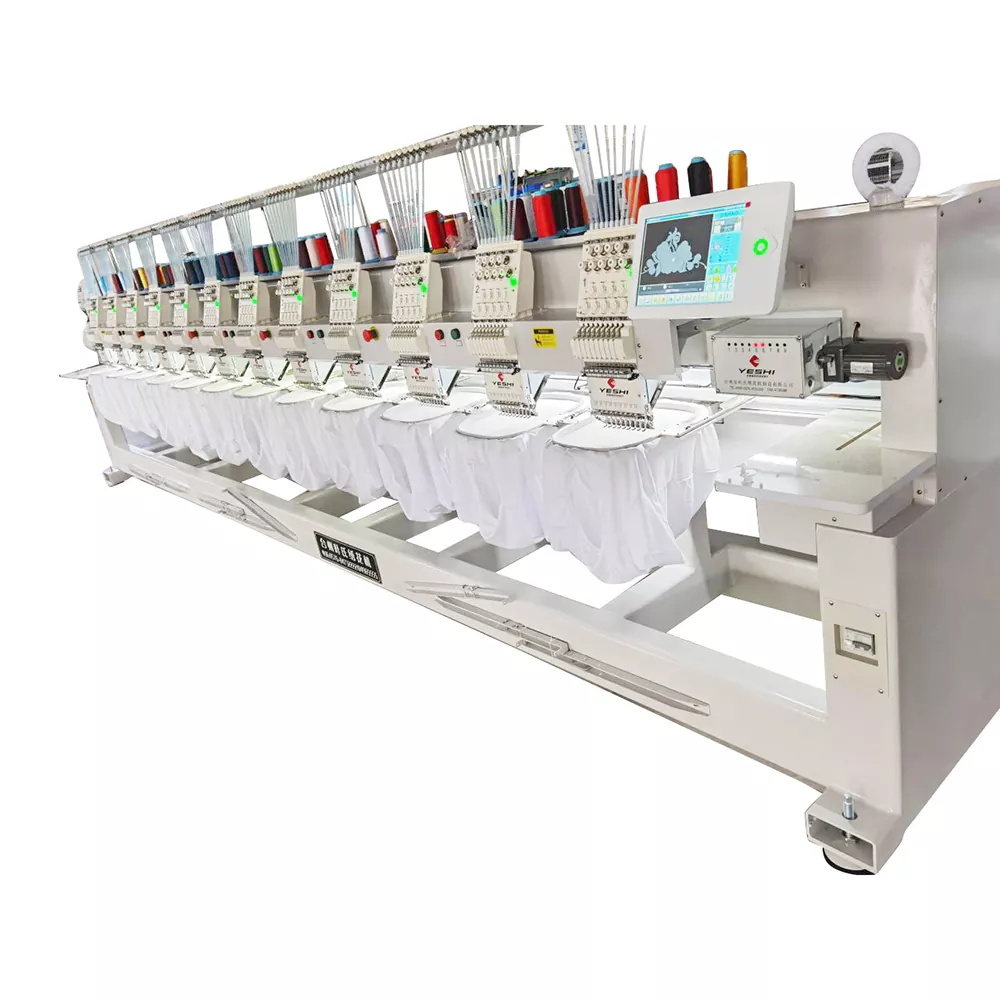
For commercial embroidery shop owners, production managers, and contract decorators, output volume is the single most critical metric before signing a purchase order. When evaluating a Multi-needle Twelve Heads Embroidery Machine, the daily production capacity directly determines whether you can meet bulk orders, hit delivery deadlines, and maximize return on investment. At Yeshi, we have installed over 200 multi-head units across North America, and the most frequent question we hear is not about stitch quality—it is about real-world, shift-based output. This blog breaks down the numbers, variables, and real factory data so you can calculate exactly what a Multi-needle Twelve Heads Embroidery Machine can deliver for your specific operation.
Baseline Production Formula
Every production estimate starts with three fixed parameters: machine speed, stitch count per design, and operating hours per shift. A standard Multi-needle Twelve Heads Embroidery Machine runs at a maximum mechanical speed of 850–1,200 stitches per minute (SPM), but practical sustained speed after acceleration, deceleration, and thread trims typically settles at 700–900 SPM for complex logos.
| Parameter | Industry Standard Value |
|---|---|
| Sustained sewing speed | 800 SPM (average) |
| Stitches per average cap logo | 8,000–12,000 |
| Stitches per left-chest design | 6,000–9,000 |
| Stitches per full-back design | 25,000–40,000 |
| Effective operating minutes per hour | 50 min (allow for hooping, thread breaks, color changes) |
Base daily capacity (single shift – 8 hours):
800 SPM × 50 min/hour × 8 hours = 320,000 stitches per head × 12 heads = 3.84 million stitches per day for the entire machine.
Dividing total stitches by design stitch count gives finished pieces. For a 10,000-stitch logo, one Multi-needle Twelve Heads Embroidery Machine produces approximately 384 finished pieces per 8-hour shift—before any efficiency losses.
Real-World Efficiency Factors
The theoretical number drops when you apply actual shop floor conditions. Through side-by-side timed trials at Yeshi demonstration centers, we recorded the following adjustment factors:
| Efficiency Variable | Impact on Daily Output |
|---|---|
| Thread breaks (average 3 per head per shift) | −8% to −12% |
| Color changes (6-color design) | −10% to −15% |
| Hooping/re-hooping time per piece | −7% to −10% |
| Machine warm-up & daily cleaning | −5% |
| Operator breaks and shift handover | −6% |
Adjusted realistic daily output (8-hour shift):
3.84 million stitches × 0.75 (net efficiency) = 2.88 million effective stitches per day
For a 10,000-stitch logo: ~288 finished pieces per day on a Multi-needle Twelve Heads Embroidery Machine.
Multi-Shift Production Scenarios
Most commercial users operate two or three shifts to leverage the machine’s fixed capital cost. Below is a comparative table based on Yeshi client data from 12 active production sites:
| Shift Configuration | Total Operating Hours | Net Stitches/Day | Pieces (10k stitches) | Pieces (30k back designs) |
|---|---|---|---|---|
| Single shift (1 × 8h) | 8 hrs | 2.88M | 288 | 96 |
| Double shift (2 × 8h) | 16 hrs | 5.76M | 576 | 192 |
| Triple shift (3 × 8h) | 24 hrs | 8.64M | 864 | 288 |
| Overtime (2 × 10h) | 20 hrs | 7.20M | 720 | 240 |
A well-managed Multi-needle Twelve Heads Embroidery Machine running double shifts can easily handle 500–600 unit orders for corporate polo shirts within a single working day, making it the preferred choice for mid-to-large decoration houses partnering with Yeshi.
Design Complexity & Color Count Adjustment
Stitch count alone does not tell the full story. A design with 12 color changes forces the machine to stop, trim, and reposition for each head—cutting productive time by nearly 18% compared to a 4-color design. Yeshi recommends using the following multiplier table when forecasting capacity:
| Design Characteristic | Efficiency Multiplier |
|---|---|
| 1–3 colors, open fill | 0.92 |
| 4–6 colors, medium density | 0.82 |
| 7–9 colors, high density + underlay | 0.72 |
| 10+ colors with puff or 3D effects | 0.60 |
Example: A 25,000-stitch back design with 8 colors on a double shift:
5.76M net stitches × 0.72 = 4.15M adjusted stitches ÷ 25,000 = 166 finished pieces per day.
FAQ – Multi-needle Twelve Heads Embroidery Machine Common Questions
Q: Can a Multi-needle Twelve Heads Embroidery Machine run different designs on each head simultaneously?
A: No. All 12 heads share a single control system and operate identically—they stitch the exact same design at the same time. This is the fundamental architecture of a multi-head machine. If you need different designs per head, you would require a single-head or multi-needle single-head machine with independent controls. However, many Yeshi clients solve this by grouping orders: they run one design for 2–3 hours, then switch to the next design for the remainder of the shift, effectively batching multiple SKUs across the same day.
Q: How much does thread tension variation affect daily output on a 12-head machine?
A: Significantly—more than most operators realize. Each of the 12 heads has its own tension assembly, and if tensions are not calibrated identically, you will experience frequent thread breaks on specific heads. A single head with high tension can break thread every 2–3 minutes, forcing the entire machine to pause (since all heads stop when any thread breaks). This can reduce total daily output by 20–30%. Yeshi recommends a daily tension check using a digital tension gauge before the first production run, and replacing worn tension springs every 600 operating hours to maintain consistent output across all 12 heads.
Q: What is the typical setup time when switching between hat hoops and flat hoop frames on a Multi-needle Twelve Heads Embroidery Machine?
A: For a full 12-head changeover, expect 35–50 minutes of downtime. This includes: removing all flat hoops (12 units), installing cap driver systems (12 units), adjusting presser foot height, changing needle plates to cap-specific plates, and running a test stitch on each head to verify registration. However, Yeshi offers a quick-change cap-drive kit that reduces this to under 20 minutes for trained operators. If you switch between caps and flats more than twice per day, we strongly recommend dedicating one machine exclusively to caps and another to flats—this single decision can recover over 2 hours of weekly production time.
Final Capacity Planning Recommendation
To accurately forecast your shop’s daily output, use this proven formula from Yeshi production engineers:
Daily pieces = (Heads × Sustained SPM × 50 min × Total Shift Hours × Efficiency Multiplier) ÷ Design Stitch Count
Always run a 2-hour trial with your actual design files before committing to order quantities. Yeshi provides free on-site production audits to help you calibrate these numbers for your specific thread types, fabric weights, and operator skill levels.
Ready to Maximize Your Multi-needle Twelve Heads Embroidery Machine Output?
Every production floor is unique, and generic numbers only take you so far. The Yeshi technical team offers personalized capacity simulations using your own design files, shift schedules, and fabric samples—at no cost. We will help you select the right machine configuration, train your operators on efficient hooping techniques, and provide ongoing maintenance schedules that keep your Multi-needle Twelve Heads Embroidery Machine running at peak performance.
Contact us today for a customized production projection and live demonstration. Email [email protected] or call our support hotline to speak directly with an applications engineer who has run these machines for over a decade. Let Yeshi turn your capacity questions into measurable daily results.