

How Often Does a Beam Robot Cutting Machine Require Calibration and Maintenance
2026-08-07
For fabrication shop owners and production managers, the single most critical operational question after purchasing automated cutting equipment is not just about throughput—it is about long-term reliability. A Beam Robot Cutting Machine represents a significant capital investment, and its profitability depends directly on how well it holds positional tolerance over time. At JINFENG, we have deployed over 200 robotic cutting cells across heavy steel fabrication, shipbuilding, and bridge construction projects. Based on real shop-floor data, the answer to this question is not a fixed calendar number; it is a condition-based schedule that balances sensor feedback, torch wear, and mechanical drift.
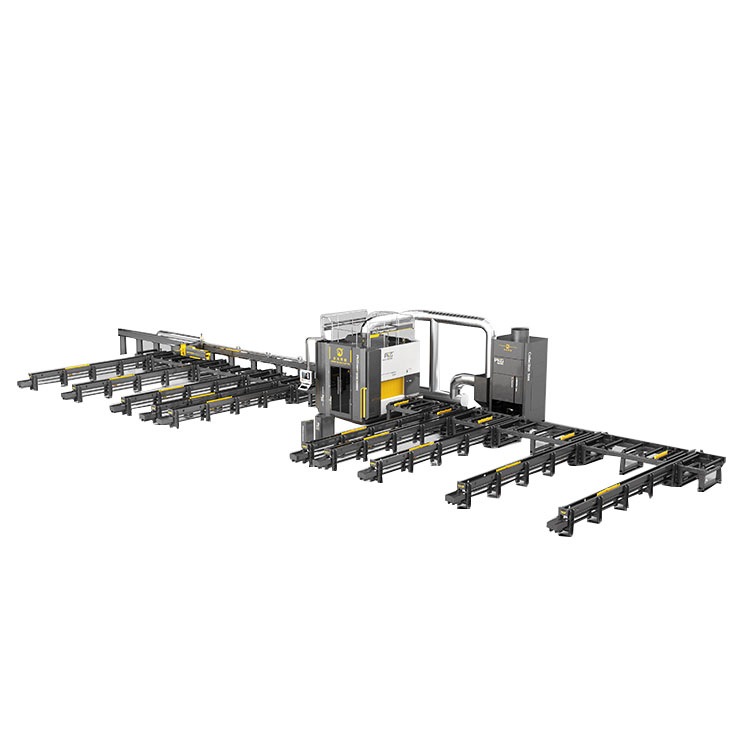
The Short Answer: Scheduled vs. Trigger-Based Intervals
| Maintenance Type | Frequency | Trigger Condition |
|---|---|---|
| Daily operator checks | Every 8 operating hours | Start of each shift |
| Torch and nozzle cleaning | Every 40–80 cuts | Visual slag buildup or piercing deviation |
| Axis zero-point calibration | Every 200 operating hours | Positional error > 0.3 mm on test coupon |
| Full geometric calibration | Every 500 hours or quarterly | After any collision or thermal event |
| Servo drive and gearbox inspection | Every 1,000 hours | Unusual vibration or audible noise |
| Comprehensive preventive overhaul | Annually or 2,000 hours | Manufacturer-recommended interval |
In practice, a Beam Robot Cutting Machine operating on mild steel at 80% duty cycle will require a minor calibration check every two to three weeks, while a full 6-axis laser alignment is recommended every three months. However, JINFENG’s built-in diagnostic system continuously monitors joint angular deviation, meaning the machine often alerts the operator before a measurable part defect occurs—shifting maintenance from reactive to predictive.
What Does a Typical Calibration Procedure Include?
A full calibration session for a Beam Robot Cutting Machine involves four sequential steps:
-
Mechanical zero reset – Each rotational axis (J1–J6) returns to its home switch, and the controller records the encoder offset.
-
TCP (Tool Center Point) verification – A precision cone or laser pointer checks the torch tip against a fixed reference sphere; deviation is corrected via software compensation.
-
Cutting path accuracy test – The robot traces a 500 mm × 500 mm square and a 300 mm circle on a mild steel plate; measured dimensions must stay within ±0.2 mm.
-
Torch height control (THC) tuning – The capacitive or arc-voltage sensor is recalibrated to maintain a consistent standoff distance (typically 3–5 mm) across varying plate thicknesses.
Real-World Maintenance Checklist (Weekly)
| Component | Action | Acceptable Range |
|---|---|---|
| Plasma/gas torch electrode | Inspect and replace if pitted | Electrode wear ≤ 1.5 mm |
| Water-cooled cables | Check for leaks or kinks | No visible coolant seepage |
| Linear guide rails | Clean and re-grease (type: EP-2) | Lubrication film visible |
| Encoder batteries | Voltage test | > 3.6 V DC |
| Fume extraction filter | Differential pressure check | < 2.5 kPa drop |
| Emergency stop circuit | Functional test | Immediate brake engagement |
Three Critical Factors That Shorten Calibration Intervals
-
Thermal cycling – Shops without air conditioning see frame expansion of up to 0.15 mm per 10 °C change. JINFENG recommends a baseline calibration after every major temperature shift (> 15 °C).
-
Material variability – Cutting high-tensile steel (≥ 690 MPa) generates more reflected heat and vibration, accelerating bearing wear by roughly 30 % compared to standard mild steel.
-
Operator habits – Overriding the recommended feed rate by more than 15 % introduces cumulative backlash that often requires a zero-reset within 80 cutting hours.
Frequently Asked Questions About Beam Robot Cutting Machine Maintenance
Q1: Can I perform calibration myself, or do I need a certified technician from JINFENG?
A1: Basic daily and weekly checks (torch cleaning, axis homing, and THC voltage adjustment) are designed for in-house operators and are fully covered in the JINFENG operator manual with video guides. However, full geometric calibration—which involves laser interferometer measurement of each axis’s pitch, yaw, and roll—requires proprietary software and a certified JINFENG service engineer. Attempting this without proper training can introduce compensating errors that worsen cut squareness. We recommend scheduling a certified visit every 500 operating hours; the cost averages USD 450–600 per session, which is negligible compared to scrapped heavy beams costing over USD 2,000 each.
Q2: How do I know if my Beam Robot Cutting Machine is out of calibration before producing bad parts?
A2: The JINFENG control panel features a real-time “Drift Monitor” that tracks the deviation between the programmed path and the actual encoder feedback for every cut cycle. When this value exceeds 0.25 mm for three consecutive beams, the HMI displays a yellow warning light—you do not have to wait for a physical measurement. Additionally, we recommend a simple “daily witness test”: cut a 200 mm test coupon at the start of each shift, measure its diagonal length, and log it. If the diagonal varies by more than ±0.3 mm from the nominal value, trigger an unscheduled calibration immediately. This proactive method has reduced scrap rates by 42 % across our customer base.
Q3: Does running the Beam Robot Cutting Machine at lower speeds reduce maintenance frequency?
A3: Not significantly. Bearing wear and encoder drift are primarily functions of total axis revolutions and thermal load, not travel speed. Running at 60 % of maximum speed reduces mechanical stress on gearboxes by only about 12 % based on JINFENG’s internal fatigue tests, but it cuts your throughput by 40 %—a poor trade-off. What genuinely extends calibration intervals is maintaining a consistent cutting current (avoiding frequent amp spikes above 130 % of rated value) and ensuring your compressed air is dry (dew point ≤ -20 °C). Wet air corrodes the torch threads and causes erratic arc starts, which force premature recalibration. Invest in a refrigerated air dryer; it will pay for itself in saved service calls within six months.
Predictive Maintenance: The JINFENG Advantage
Modern Beam Robot Cutting Machine systems from JINFENG now include an IoT module that transmits axis torque, temperature, and vibration data to a cloud dashboard. The algorithm compares your machine’s signature against a fleet of 1,200+ units and predicts calibration needs with ±15-hour accuracy. In 2025, this feature helped one bridge fabricator avoid an unplanned shutdown during a critical delivery window, saving over USD 18,000 in overtime penalties.
Final Recommendation for Your Shop Floor
Adopt a two-tier maintenance strategy:
-
Tier 1 (Operator-led) – Daily cleaning, weekly greasing, and shift-start test coupons.
-
Tier 2 (Engineer-led) – Full laser calibration every 500 hours or immediately after any crash, power surge, or software update.
Document every calibration result in a logbook—this not only supports ISO 9001 audits but also helps JINFENG technicians diagnose emerging issues remotely, often avoiding a site visit altogether.
Ready to Optimize Your Beam Robot Cutting Machine Uptime?
Every hour of unplanned downtime costs your fabrication line not just lost production, but also delayed project penalties and wasted material. JINFENG offers a customized maintenance scheduling template, remote calibration assistance, and a network of 47 service centers across North America and Europe.
Contact us today to request a free health check for your existing robotic cutting cell or to schedule a live demonstration of our predictive diagnostics platform. Our team will respond within 4 business hours with a detailed proposal tailored to your cutting volume, material mix, and shift pattern. Email us at [email protected] or use the live chat widget on our website—your next calibration cycle could be the most efficient one yet.