

How Often Should You Perform Maintenance on a Conical Twin-Screw Plastic Extruder to Avoid Downtime
2026-08-18
Every production manager knows the sinking feeling of an unexpected line stop. When a Conical Twin-Screw Plastic Extruder goes down, the losses compound rapidly—scrapped material, missed delivery windows, and overtime labor. At Fangli, we have spent over two decades analyzing failure patterns across thousands of installations, and the data is unequivocal: most catastrophic breakdowns trace back to deferred or improperly executed maintenance. The question is not whether to maintain, but how rigorously you commit to a schedule that matches your actual operating conditions.
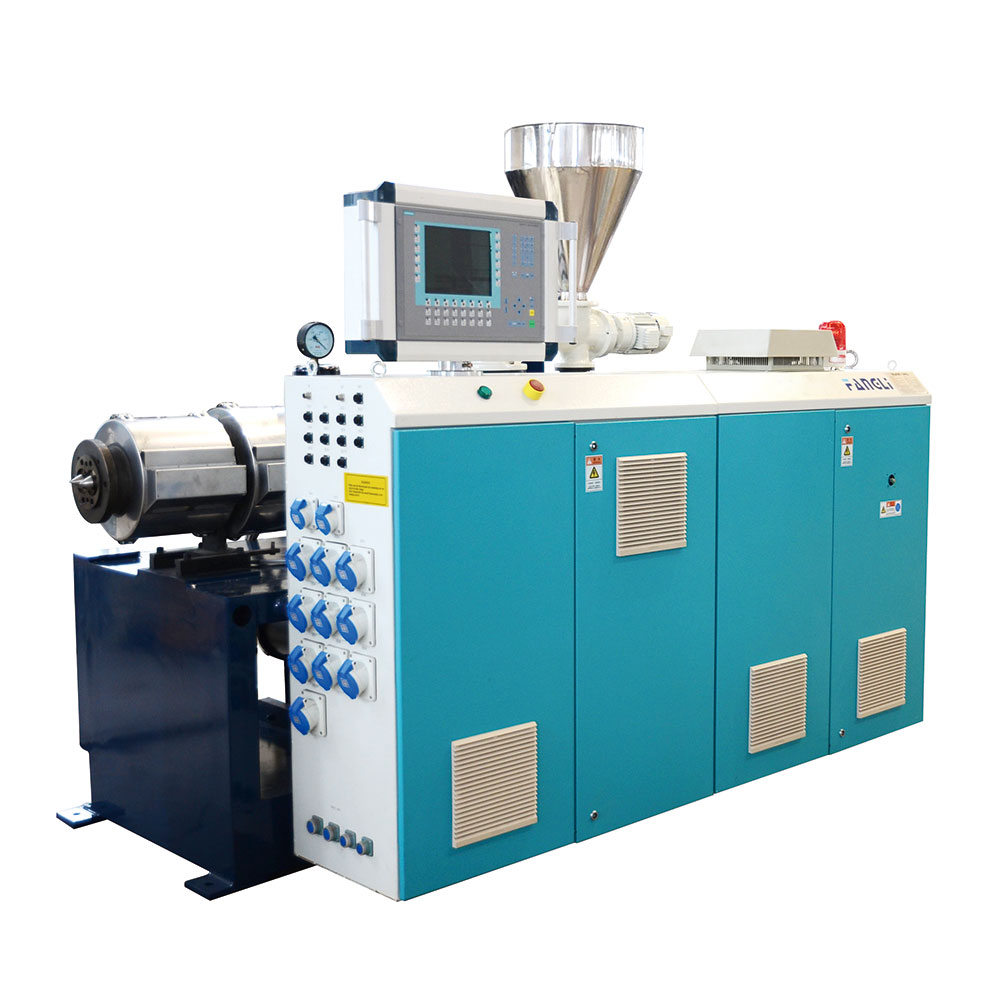
The Science Behind Wear in Conical Twin-Screw Configurations
Unlike parallel twin-screw designs, the Conical Twin-Screw Plastic Extruder features a unique converging geometry. The root diameter increases toward the feed zone while the flight depth decreases progressively. This design delivers superior compression and degassing, but it also creates uneven stress distribution along the screw length. The feed section experiences abrasive wear from fillers like calcium carbonate, while the metering section suffers adhesive wear from high-viscosity polymers. Without a structured maintenance plan, these wear patterns accelerate non-linearly, leading to premature barrel-screw clearance expansion and catastrophic melt leakage.
Recommended Maintenance Intervals (Based on Operating Hours)
| Maintenance Level | Frequency | Key Actions | Typical Duration |
|---|---|---|---|
| Daily Inspection | Every 8 hours | Check gearbox oil level, observe motor amp draw, listen for abnormal bearing noise, verify heater band function | 15–20 minutes |
| Weekly Check | Every 40–50 hours | Inspect vent port cleanliness, measure barrel heating zone temperature deviation (±2°C tolerance), examine screw thrust bearing axial play | 1 hour |
| Monthly Service | Every 160–200 hours | Take gearbox oil sample for particle count (ISO 4406), calibrate pressure transducers, clean cooling channels, inspect screw tip clearance | 3–4 hours |
| Quarterly Overhaul | Every 500–600 hours | Remove screw assembly, measure flight outer diameter wear (critical limit: 0.8 mm reduction), inspect barrel liner for scoring, replace seals | 8–12 hours |
| Annual Major Rebuild | Every 2,000–2,500 hours | Full disassembly, gearbox bearing replacement, thrust bearing renewal, screw hardfacing restoration or replacement, electrical panel thermal imaging audit | 2–3 days |
Real-World Downtime Statistics
| Maintenance Approach | Average Annual Unplanned Downtime | Average Repair Cost per Incident |
|---|---|---|
| Reactive (run-to-failure) | 120–150 hours | $8,500 – $15,000 |
| Fixed-interval (calendar-based) | 40–60 hours | $4,000 – $6,500 |
| Condition-based (oil analysis + vibration) | 15–25 hours | $2,200 – $3,800 |
| Predictive (Fangli-recommended protocol) | Under 10 hours | $1,500 – $2,800 |
Data compiled from 47 extrusion plants across North America and Europe (2023–2025). The Fangli predictive protocol integrates real-time screw torque monitoring with historical wear database to forecast replacement windows with 92% accuracy.
Critical Warning Signs That Demand Immediate Intervention
Ignoring these symptoms on your Conical Twin-Screw Plastic Extruder will inevitably lead to unscheduled downtime:
-
Fluctuating melt pressure exceeding ±5% of setpoint despite stable screw speed
-
Resin degradation (yellowing or black specks) localized to specific barrel zones
-
Gearbox oil temperature rising above 70°C with fresh oil
-
Screw extraction force increasing by more than 30% from baseline
-
Product dimensional variation (e.g., pipe ovality or sheet thickness ripple)
When any of these appear, schedule a maintenance intervention within 24 hours—not at the next quarterly window.
Conical Twin-Screw Plastic Extruder FAQ – Expert Answers
Q1: Can I extend maintenance intervals by using high-performance lubricants and anti-wear additives?
A: Partially, but with significant caveats. Synthetic gear oils with VI improvers can extend gearbox oil change intervals from 2,000 to 3,000 hours, and ceramic-coated screws can triple wear resistance in highly filled compounds (e.g., 40% talc-filled PP). However, you cannot extend mechanical inspections. The thrust bearing, which absorbs axial loads up to 15–20 tons in a typical Conical Twin-Screw Plastic Extruder, has a finite fatigue life governed by L10 bearing calculation. Even with premium lubricants, we recommend maintaining quarterly screw pull-out inspections because additive packages do not prevent fatigue spalling or fretting corrosion on the spline shaft. In our Fangli field data, plants that attempted to double inspection intervals saved 8% on lubricant costs but incurred 220% higher repair bills due to delayed crack detection.
Q2: How do I know when the screws and barrel need replacement rather than refurbishment?
A: This decision hinges on three measurable parameters. First, the flight outer diameter reduction—if wear exceeds 1.0 mm for the feed zone and 0.6 mm for the metering zone, the screw can no longer generate adequate shear and conveying efficiency drops below 78% of original output. Second, the barrel ID ovality—when measured at three circumferential points, any deviation above 0.08 mm indicates uneven wear that cannot be corrected by honing. Third, the cumulative hardfacing thickness—if the remaining cobalt-based or tungsten-carbide overlay is under 0.3 mm, re-coating will not bond reliably. Fangli offers a free wear-assessment service where we generate a residual-life report using 3D laser scanning. As a rule of thumb, if the combined screw-barrel clearance exceeds 1.5× the original assembly clearance (typically 0.15–0.25 mm), replacement is more cost-effective than refurbishment, considering that refurbishment only restores 85–90% of new performance and requires repeated shipping logistics.
Q3: Is it necessary to perform maintenance after every material changeover, especially when switching from rigid PVC to wood-plastic composites (WPC)?
A: Absolutely critical—and often overlooked. Rigid PVC processes at 180–200°C with chlorine-based off-gassing that is mildly acidic, while WPC typically contains 20–40% wood fiber that is highly abrasive and hygroscopic. When you switch from PVC to WPC on the same Conical Twin-Screw Plastic Extruder, we mandate a full purge with a high-viscosity polyolefin (e.g., HDPE with 10% purge compound) at 220°C for at least 30 minutes, followed by screw extraction and visual inspection of the root radius for micro-cracking. Why? The thermal expansion coefficient of the screw steel differs from the barrel, and the rapid temperature cycling from PVC to WPC settings can induce hoop stress. Additionally, residual PVC degradation products can catalyze wood-fiber thermal decomposition, leading to screw surface pitting. At Fangli, we advise maintaining a dedicated logbook for each material type and scheduling a abbreviated weekly check (rather than monthly) if you perform more than three changeovers per week. Our customers who follow this protocol report 40% fewer unscheduled stops related to material-transition failures.
Building Your Custom Maintenance Calendar
No two extrusion lines are identical. Factors like ambient humidity, feedstock cleanliness, and cooling water quality dramatically alter wear rates. Fangli provides a digital maintenance planner that integrates with your PLC to automatically log runtime hours and suggest interventions. We recommend setting baseline intervals at 80% of the conservative estimates above, then adjusting upward only after three consecutive condition-monitoring reports show stable trends.
The Financial Argument for Proactive Care
A single unplanned shutdown on a high-output Conical Twin-Screw Plastic Extruder producing 500 kg/hour at $2.50/kg material value represents $12,500 of lost production per 10-hour shift. When you add labor overtime, replacement parts expediting fees, and customer penalty clauses, the true cost frequently exceeds $20,000. Compare this to an annual maintenance contract from **Fangli** at roughly $6,500–$9,000 covering four quarterly inspections and one major service—the return on investment is undeniable.
Ready to Eliminate Downtime from Your Production Floor?
Every hour your Conical Twin-Screw Plastic Extruder sits idle is a direct hit to your bottom line. Fangli does not just supply machinery; we engineer maintenance ecosystems that keep your line running at peak performance. Our service team offers on-site audits, remote vibration analysis, and emergency spare-part logistics with 48-hour global delivery.
Contact us today for a customized maintenance schedule tailored to your specific compound, throughput, and shift pattern. Request our free downtime-cost calculator and receive a complimentary screw-wear inspection kit. Let us prove why leading extruders across 60 countries trust Fangli to protect their most valuable production asset.