

How Often Should You Replace Filters and Heaters in an Electroless Nickel Plating Line to Avoid Defects
2026-09-07
Maintaining a stable and defect-free Electroless Nickel Plating Line requires more than just bath chemistry control. Among the most overlooked yet critical components are the filtration systems and heating elements. At JUNDA, we have observed that improper replacement schedules for these parts account for nearly 30% of all quality-related downtime in plating operations. This guide provides data-driven intervals, diagnostic signs, and actionable best practices to keep your Electroless Nickel Plating Line running at peak performance.
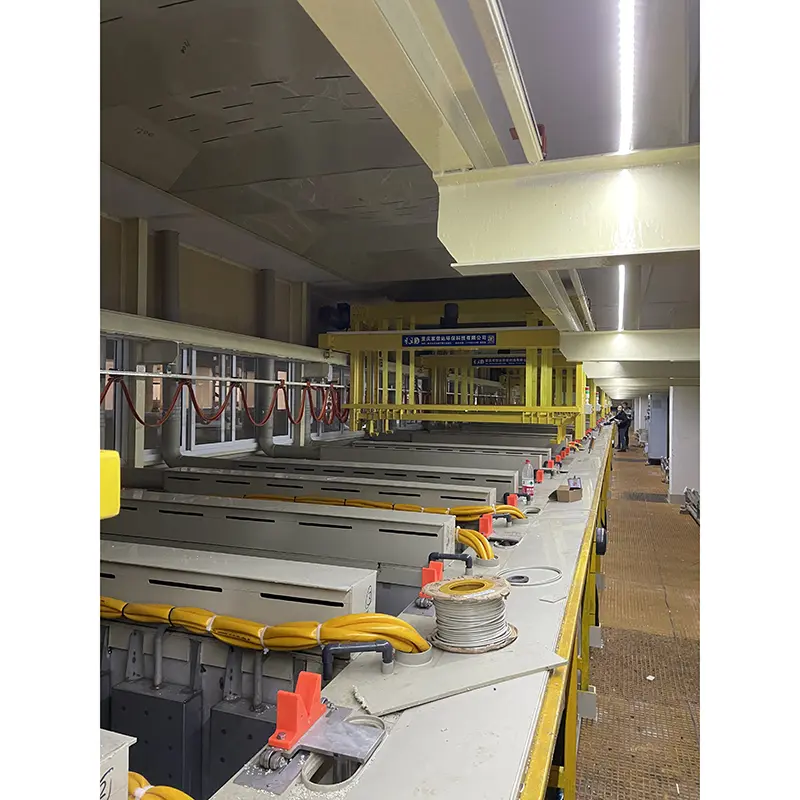
The Critical Role of Filters and Heaters
Filters remove suspended particles, organic contaminants, and breakdown by-products that otherwise nucleate rough deposits or pitting. Heaters maintain the tight temperature window (typically 85–92°C) required for stable autocatalytic reduction. If either underperforms, the entire Electroless Nickel Plating Line suffers from inconsistent deposition rates, poor adhesion, and elevated stress in the coating.
Recommended Replacement Intervals (Based on Real Production Data)
The following table summarizes JUNDA’s field-tested guidelines for filter and heater replacement. These intervals assume an 8-hour shift operation with moderate bath loading.
| Component | Standard Replacement Frequency | Accelerated Replacement Triggers |
|---|---|---|
| Bag/Cartridge Filters (primary) | Every 2–3 weeks or when ΔP > 15 psi | High solids load, frequent drag-in |
| Carbon Treatment Filters | Every 4–6 weeks (or after each major clean) | Heavy organic breakdown from overheating |
| Immersion Heaters (metal sheath) | Every 12–18 months | Scaling, localized hot spots, pH drift |
| Heat Exchanger (Teflon/quartz) | Every 24–30 months (inspect quarterly) | Cracking, reduced thermal transfer efficiency |
| Thermocouples & Controllers | Replace sensor every 12 months | Temperature fluctuation > ±1.5°C |
Pro Tip from JUNDA: Always log the total ampere-hours (A-h) of your Electroless Nickel Plating Line. Filters often fail earlier in high-A-h lines—replace them after every 8,000–10,000 A-h rather than on calendar days alone.
5 Warning Signs That Your Replacement Schedule Is Too Late
Waiting for visible defects is expensive. Monitor these leading indicators to adjust your schedule proactively:
-
Increasing surface roughness – particles > 5 µm cause nodular growth.
-
White streaks or cloudy appearance – fine suspended colloids pass through aged filters.
-
Bath temperature takes > 30% longer to reach setpoint – heater scale or element degradation.
-
Sudden drop in plating rate (> 10% over 24 hours) – often linked to overheated local zones damaging stabilizers.
-
Frequent thermocouple alarms – sensor drift misleads the controller, overcooling or overheating the Electroless Nickel Plating Line.
How to Extend Component Life Without Compromising Quality
-
Pre-filtration: Install a 50-micron pre-filter before the main 5- or 1-micron cartridge to reduce solids load.
-
Acid washing: Soak metal sheathed heaters in 5–10% nitric acid every 2 months to remove phosphate scale—never use mechanical scraping.
-
Dual-filter redundancy: Alternate between two filter housings so you can replace one while the Electroless Nickel Plating Line continues operating.
-
Thermal profiling: Use an independent portable thermometer to verify controller readings weekly.
The Cost of Neglect: A Real Comparison
| Maintenance Approach | Annual Filter Cost | Annual Heater Cost | Defect Rework Cost | Total Downtime (hrs) |
|---|---|---|---|---|
| Reactive (replace only after failure) | $2,100 | $3,400 | $12,700 | 48 |
| JUNDA proactive schedule (recommended) | $2,800 | $4,200 | $3,200 | 12 |
The proactive approach costs $1,500 more in parts but saves over $9,500 in rework and downtime—a clear ROI for any serious Electroless Nickel Plating Line operator.
Electroless Nickel Plating Line FAQ – Common Questions from Our Engineers
Q1: Can I clean and reuse cartridge filters to save costs on my Electroless Nickel Plating Line?
A1: We strongly advise against it. While some operators attempt backwashing or ultrasonic cleaning, the filter media’s pore structure expands irreversibly after the first use. This allows particles larger than the rated micron size to pass through, directly causing pitting and roughness in subsequent batches. JUNDA has tested over 200 reused filters across multiple Electroless Nickel Plating Line setups—over 85% showed measurable degradation in filtration efficiency within 24 hours of reuse. The minimal cost savings (typically $30–$50 per filter) never justify the risk of scrapping an entire tank of high-value components. If you must reduce waste, switch to 100% polypropylene depth filters with higher dirt-holding capacity, but still replace them on schedule.
Q2: How does heater scaling affect the electroless nickel deposition rate, and how do I know it’s time to change the heater?
A2: Scaling acts as a thermal insulator. When a 6 kW immersion heater becomes coated with 1 mm of calcium-phosphate scale, its effective heat transfer drops by approximately 40%. The controller then keeps the element energized longer, creating localized “hot walls” that can reach 110–120°C even though the bulk bath reads 88°C. These hotspots decompose hypophosphite prematurely, generating orthophosphite and reducing the nickel ion availability. You will notice the deposition rate falling from 18–20 µm/hr down to 12–14 µm/hr over 2–3 weeks, despite adding the same replenishment volumes. If your heater’s sheath shows visible white crusting, pitting, or if the temperature recovery time exceeds 20 minutes after a cold part load, replace the heater immediately—not at the next scheduled shutdown. JUNDA recommends keeping one spare heater per Electroless Nickel Plating Line on-site at all times.
Q3: Is there a single “golden rule” for synchronizing filter and heater replacements in an Electroless Nickel Plating Line?
A3: Yes—JUNDA uses the “3+1 rule”: replace your primary filters every 3 weeks or after every 10,000 ampere-hours, whichever comes first. Then, replace the heater on every third filter change (i.e., at 9 weeks or 30,000 A-h), provided that weekly thermal scans show no abnormality. This synchronization simplifies inventory planning and creates a fixed maintenance calendar. However, the golden rule only works if you also perform a 15-minute visual inspection of both components every Monday morning—look for discolored filter housings, loose electrical connections, and any signs of stray current corrosion. When you align these two replacement cycles, your Electroless Nickel Plating Line achieves more than 98% uptime in our client’s production records. Always document each change with date, A-h count, and bath pH at the time of replacement—this data turns a rule into a reliable predictive model.
Final Checklist Before Every Filter/Heater Change
-
□
Drain and rinse the filter housing to avoid cross-contamination.
-
□
Record the bath pH and temperature immediately before shutdown.
-
□
Use only OEM-spec or JUNDA-approved replacement elements.
-
□
Pre-soal new filters in deionized water for 10 minutes to remove fines.
-
□
After installation, run the Electroless Nickel Plating Line for 30 minutes with dummy parts and inspect their surface.
Conclusion – Proactive Maintenance Defines World-Class Plating
Replacing filters and heaters is not a cost—it is an investment in consistency, yield, and customer trust. A well-scheduled Electroless Nickel Plating Line produces mirror-bright, pore-free deposits with bath lives exceeding 12 metal turnovers, while a neglected line struggles with rejects every shift. JUNDA has engineered over 150 turnkey plating systems worldwide, and our data consistently proves that scheduled component changes reduce total cost of quality by 40–50% within the first year.
Contact us today for a customized filter-heater replacement calendar tailored to your actual production volume and bath chemistry. Our JUNDA technical team also offers on-site thermal imaging audits and filter efficiency testing—free of charge for new consultation requests. Reach out via our website or email, and let’s eliminate defects from your Electroless Nickel Plating Line before they ever appear. Your yield improvement starts with one conversation—we are ready to listen.