

How Often Should You Replace the Air End Bearings in a Low-Pressure Oil-Free Screw Air Compressor
2026-09-07
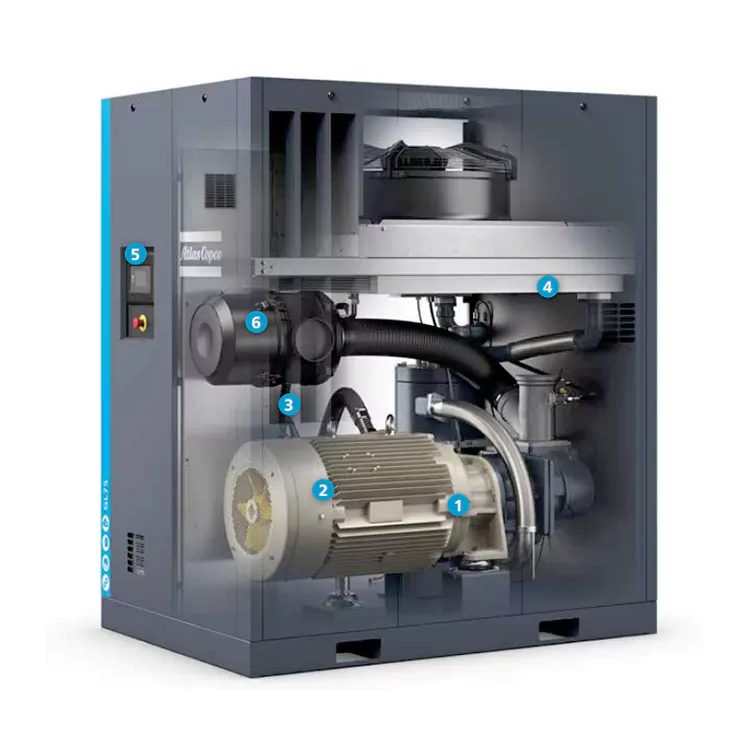
For facility managers and maintenance engineers, the air end bearings represent the single most critical wear component in a Low-Pressure Oil-Free Screw Air Compressor. Unlike lubricated rotary screws, where oil serves as both coolant and bearing lubricant, an oil-free design relies entirely on precision engineering and surface coatings to keep rolling-element bearings operational. At Dechuan, we frequently receive service inquiries from plants running 24/7 production lines, and the most common question always circles back to bearing replacement intervals. The short answer is every 40,000 to 50,000 operating hours under ideal conditions, but real-world duty cycles, ambient conditions, and load profiles can shift that window dramatically.
Why Bearing Life Differs in Oil-Free vs. Lubricated Designs
In a standard lubricated compressor, oil continuously flushes away micro-particles and absorbs frictional heat. In a Low-Pressure Oil-Free Screw Air Compressor, the bearings are sealed and grease-packed for life in many modern units, yet they still experience:
-
High radial loads from differential pressure across the rotors
-
Thermal expansion cycles during start/stop events
-
Vibration fatigue from unbalance or coupling misalignment
Dechuan engineers recommend viewing bearing replacement not as a fixed calendar event, but as a condition-based decision supported by vibration analysis, temperature trends, and operating hours.
Recommended Replacement Intervals by Application Type
| Application Environment | Recommended Bearing Change (Hours) | Primary Risk Factor |
|---|---|---|
| Clean, climate-controlled factory (≤25°C, <60% RH) | 48,000 – 52,000 | Normal fatigue |
| High-ambient workshop (30–40°C, moderate dust) | 38,000 – 42,000 | Grease degradation |
| High-humidity / coastal location (>80% RH) | 30,000 – 35,000 | Moisture ingress & micro-corrosion |
| Heavy cyclic loading (frequent starts >6/hr) | 25,000 – 30,000 | Impact stress on cage materials |
| Critical process (pharma/food, zero tolerance for downtime) | Planned at 36,000 | Preventive risk management |
Data compiled from Dechuan field service records across 200+ industrial sites over five years.
Three Critical Signs That Bearings Are Nearing End-of-Life
Even with scheduled planning, bearings can fail prematurely. Monitor these three indicators weekly:
-
High-frequency vibration spike (2× to 5× running speed harmonics) – detectable via portable accelerometer.
-
Front-end temperature rise – if the drive-end housing exceeds 85°C consistently, grease has oxidized.
-
Abnormal tonal noise – a high-pitched whine or intermittent rattle during unloaded running.
Dechuan offers a free remote diagnostic checklist for customers who log these parameters, helping you shift from reactive to predictive maintenance.
Step-by-Step Bearing Replacement Protocol
| Step | Action | Typical Duration |
|---|---|---|
| 1 | Isolate and de-energize the Low-Pressure Oil-Free Screw Air Compressor | 15 min |
| 2 | Remove air-end coupling and inlet/outlet flanges | 45 min |
| 3 | Extract rotor assembly using factory-specified puller tools | 90 min |
| 4 | Clean housing bores and inspect rotor journal surfaces | 60 min |
| 5 | Install new premium-grade bearings (SKF/FAG equivalent) with matched clearance | 120 min |
| 6 | Re-assemble with new O-rings and apply break-in grease charge | 90 min |
| 7 | Run-in test at 50% load for 2 hours, then re-torque fasteners | 150 min |
Total downtime: 8–10 hours for a skilled two-person team. Dechuan can supply complete bearing kits with pre-measured shims to cut reassembly time by 30%.
FAQ – Common Questions About Bearing Replacement
Q: Can I run my Low-Pressure Oil-Free Screw Air Compressor beyond 50,000 hours if vibration levels remain low?
A: Technically yes, but it is a high-risk strategy. Even with stable vibration, grease thickens over time due to base-oil evaporation, and the cage material (usually phenolic or steel-reinforced) suffers from cyclic creep. Dechuan has seen units reaching 62,000 hours without failure, but we also documented three catastrophic rotor-seizure cases between 55,000–58,000 hours. The repair cost for a seized rotor set is 4–6× higher than a proactive bearing change. We strongly advise replacing at 50,000 hours for non-critical plants, and at 40,000 hours for 24/7 continuous operations.
Q: Does the discharge pressure affect bearing replacement frequency in a Low-Pressure Oil-Free Screw Air Compressor?
A: Absolutely. Bearing life follows an inverse power-law relationship with radial load, which increases proportionally with discharge pressure. For a unit routinely operating at 4.5 bar (typical low-pressure range), bearings last roughly 50,000 hours. If you consistently push to 6.0 bar (still within low-pressure definition but near the upper margin), the dynamic equivalent load rises by ~18%, reducing calculated L10 life to about 38,000 hours. Dechuan recommends de-rating the interval by 1,000 hours for every 0.3 bar above your rated nameplate pressure. Always cross-check with your actual pressure-log data rather than relying on setpoint values.
Q: Is it necessary to replace both drive-end and non-drive-end bearings simultaneously?
A: Yes, and this is non-negotiable. The two bearing sets share the same grease fill, same operating temperature history, and same start/stop cycles. Replacing only one side creates an imbalance in radial clearance and thermal expansion characteristics, which often leads to premature failure of the newer bearing within 8,000–10,000 hours due to misalignment-induced edge loading. Dechuan supplies matched bearing pairs with certified clearance tolerances (C3 or C4 internally graded) to ensure equal load distribution. Moreover, we include new snap rings and wave washers in every kit to maintain correct axial preload – a detail many aftermarket suppliers overlook.
Financial Impact of Delayed Replacement
| Delay Beyond Recommended | Average Unplanned Downtime | Repair Cost (Parts + Labor) | Production Loss (8-hr shift) |
|---|---|---|---|
| 0 – 3,000 hrs (planned) | 10 hrs (scheduled) | $2,800 – $3,500 | Minimal (planned outage) |
| 5,000 – 8,000 hrs overdue | 2.5 days (emergency) | $5,200 – $6,800 | $4,000 – $12,000 |
| >10,000 hrs overdue | 5+ days (rotor rebuild) | $9,000 – $14,000 | $15,000+ |
Every Dechuan Low-Pressure Oil-Free Screw Air Compressor ships with a bearing log sheet and thermal imaging baseline – use these documents to track degradation trends from day one.
Final Recommendation
Set your first bearing replacement at 40,000 hours for new installations, then adjust the second interval based on actual wear-metal analysis from oil-grease sampling (even in "oil-free" designs, grease can be extracted for ferrography). If your plant operates in a dusty or high-temperature environment, bring that forward to 35,000 hours. Always use original or approved equivalent bearings – generic imports often lack the specialized heat-treatment for 100°C+ continuous operation.
Contact Us
Bearing replacement is not a task to guess or postpone. Dechuan provides turnkey field-service kits, on-site technical support, and remote vibration monitoring for all our Low-Pressure Oil-Free Screw Air Compressor models. Whether you need a replacement schedule template, a customized bearing kit, or a full overhaul quotation, our engineering team responds within 4 business hours. Contact Dechuan today – request a free bearing life assessment using your actual PLC data, and let us help you eliminate unplanned downtime before it hits your bottom line. Reach us via our website live chat or email [email protected] – we are ready to keep your production running reliably, shift after shift.