

How Often Should You Use an Industrial Scissors Sharpening Machine to Maintain Optimal Shearing Performance
2026-08-11
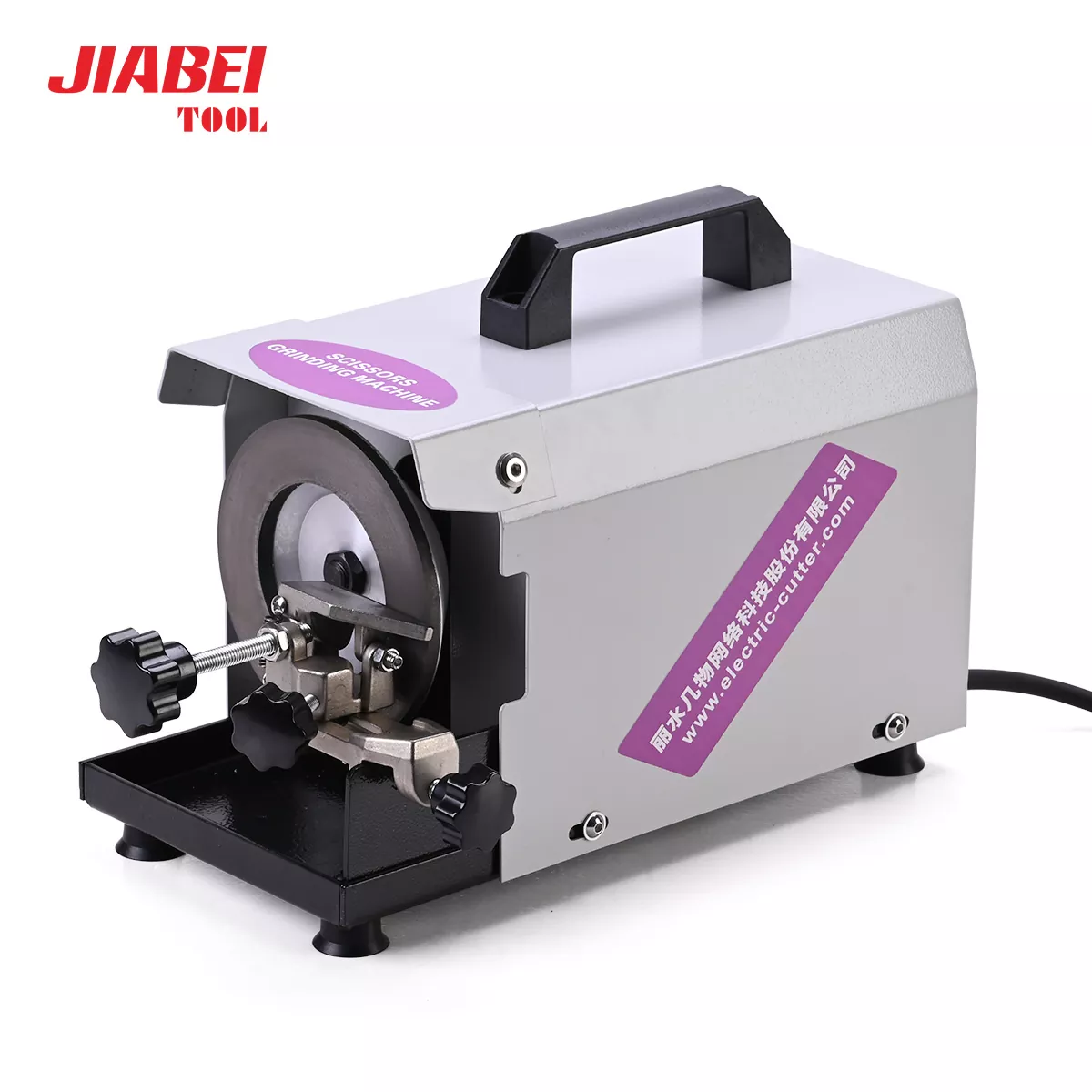
For textile mills, leather workshops, and heavy-duty cutting operations, a dull pair of industrial shears is more than an inconvenience—it is a direct threat to production efficiency, material yield, and worker safety. The Industrial Scissors Sharpening Machine from JIABEI TOOL addresses this challenge with precision engineering, but even the best equipment requires a disciplined maintenance schedule. The real question is not if you should sharpen, but when and how often—and the answer depends on several measurable variables that every production manager must understand.
The Science Behind Sharpening Frequency
Sharpening frequency is not a one-size-fits-all number. It is governed by three core factors: cutting volume, material abrasiveness, and blade metallurgy. Below is a practical guideline based on industry benchmarks and feedback from JIABEI TOOL users worldwide.
| Operational Parameter | Recommended Sharpening Interval | Indicators That Schedule Needs Adjustment |
|---|---|---|
| Light use (< 2 hours/day) | Every 4–6 weeks | Visible nicks, pulling instead of cutting |
| Moderate use (2–6 hours/day) | Every 2–3 weeks | Increased hand fatigue, rough cut edges |
| Heavy use (> 6 hours/day) | Weekly or after every 40–50 cutting hours | Jagged cuts, excessive dust/fraying |
| Abrasive materials (carbon fiber, Kevlar, coarse leather) | Every 3–5 production shifts | Burn marks on blades, overheating during cuts |
Why Over-Sharpening Harms More Than Helps
A common misconception is that more frequent sharpening extends blade life. In reality, each pass through an Industrial Scissors Sharpening Machine removes a microscopic layer of steel. Over-sharpening reduces the blade’s temper and changes its geometric profile, leading to premature failure. JIABEI TOOL engineers recommend a minimum material removal approach—only grind enough to restore a clean, burr-free edge. For most high-carbon stainless steels used in industrial scissors, 0.05–0.10 mm removal per session is the safe operating window.
Predictive Maintenance: The JIABEI TOOL Advantage
Instead of relying on calendar dates, forward-thinking shops adopt performance-based triggers. With JIABEI TOOL’s precision sharpening systems, operators can track:
-
Cutting force increase (measured via spring tension or pneumatic resistance)
-
Edge roughness (visual inspection under 10x magnification)
-
Material feed speed (slower feed = duller blades)
When any of these metrics deviate by more than 15% from baseline, it is time to schedule a sharpening session. This approach reduces unnecessary machine wear and maximizes the lifespan of both the scissors and the Industrial Scissors Sharpening Machine itself.
Step-by-Step Sharpening Protocol for Peak Performance
To achieve consistent results, follow this JIABEI TOOL-approved workflow:
-
Clean the blades – Remove adhesive residues and metal dust.
-
Set the correct angle – Match the original factory bevel (typically 35°–45° for industrial shears).
-
Perform a light pass – Use a fine-grit wheel (180–220 grit) for initial contact.
-
Inspect under light – Check for a continuous, shiny edge without dark spots.
-
Deburr and hone – Use a ceramic or leather strop to remove the wire edge.
-
Lubricate and test – Apply anti-rust oil and cut through test material (e.g., 10-layer cotton or 5mm leather).
Common Pitfalls That Ruin Blade Geometry
Even with a high-grade Industrial Scissors Sharpening Machine, errors occur. The most frequent mistakes include:
-
Inconsistent pressure – Uneven grinding creates a wavy edge.
-
Wrong wheel speed – Excessive RPM burns the steel, reducing hardness.
-
Skipping coolant – Heat accumulation destroys the blade temper in seconds.
JIABEI TOOL machines are equipped with variable speed controls and built-in coolant systems to eliminate these risks, but operator training remains equally critical.
📌 Industrial Scissors Sharpening Machine FAQ
Q: How can I tell if my industrial scissors need sharpening before they completely fail to cut?
A: Early warning signs are subtle but detectable. Listen for a change in sound—sharp blades produce a clean, crisp "snip," while dull blades create a crushing or grinding noise. Visually, examine the cut edge: if it shows white stress lines or fuzzy fibers on textiles, the edge is compromised. Also, monitor your operator’s cycle time; if cutting a standard stack takes 20% longer than usual, the blades are overdue. JIABEI TOOL recommends using a simple paper test (cutting a single sheet of 80gsm paper)—if the scissors fold or tear instead of slicing cleanly, schedule a sharpening immediately.
Q: Does sharpening frequency differ between straight scissors and curved scissors in industrial applications?
A: Yes, significantly. Straight-blade scissors experience uniform edge wear, so a fixed interval works well. Curved scissors, however, wear unevenly—the contact point shifts along the blade arc, creating localized dull spots. For curved shears, JIABEI TOOL advises a spot-check strategy: inspect the heel, middle, and tip separately. Often, you may need to sharpen the tip more frequently (every 1–2 weeks) while the heel remains sharp for a month. Using a Industrial Scissors Sharpening Machine with adjustable grinding head angles—a standard feature on JIABEI TOOL models—allows you to address each section individually without over-grinding the entire blade.
Q: Can I use the same sharpening wheel for different steel grades, or do I need to change wheels for each material?
A: This is a critical quality factor. Using one wheel for all steels compromises edge integrity. Soft steels (e.g., 420J2) require a coarse, open-structured wheel (grit 120–150) to prevent glazing. Harder powders (e.g., M390 or VG-10) perform best with a dense, fine-grit diamond or CBN wheel (grit 220–400). JIABEI TOOL offers interchangeable wheel kits with color-coded guides. For shops handling multiple steel types, we recommend dedicating at least two wheels: one for soft/stainless grades and one for high-hardness tool steels. Mixing them not only reduces wheel life but also creates inconsistent micro-bevels, leading to premature edge rolling.
Final Recommendation from JIABEI TOOL
No algorithm can replace the judgment of a skilled operator, but data-driven schedules remove guesswork. Start with the weekly-heavy / biweekly-moderate framework, then log each sharpening session—including material type, total cut length, and grinding time. After 10 sessions, you will see a clear pattern unique to your production environment.
Ready to Optimize Your Sharpening Workflow?
Achieving optimal shearing performance is not a one-time setup—it is an ongoing partnership between your operators and your equipment. JIABEI TOOL provides not only premium Industrial Scissors Sharpening Machine systems but also free scheduling templates, remote diagnostic support, and wheel selection consultations.
Contact us today for a personalized sharpening audit. Our engineers will analyze your current blade consumption, recommend a custom frequency plan, and demonstrate how JIABEI TOOL can reduce your blade replacement costs by up to 40% within the first quarter. Reach out via our website live chat or email [[email protected]]—we respond within 4 business hours, worldwide.