

How to Prevent Edge Curling in Car Floor Mats Using a TPE Roll to Roll Lamination Machine
2026-07-15
Edge curling remains one of the most persistent quality defects in automotive floor mat manufacturing. When a mat’s perimeter lifts away from the vehicle floor, it not only looks unprofessional but also becomes a safety hazard. For converters running high-volume production, the solution often lies not in the material alone, but in the process parameters of the TPE roll to roll lamination machine for car floor mats. At Eaststar, we have spent over a decade troubleshooting this exact issue across dozens of production lines, and the fix is almost always found in heat distribution, nip pressure, and cooling strategy.
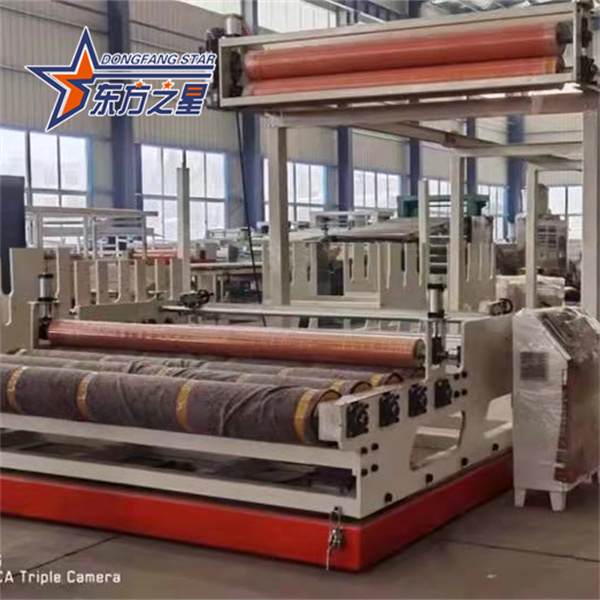
Why Edge Curling Happens in Laminated TPE Mats
Edge curling is primarily a stress imbalance between the laminated layers. In a typical construction, a decorative TPE skin is bonded to a backing layer (often non-woven fabric or foamed polyolefin). When the TPE roll to roll lamination machine for car floor mats applies heat and pressure, the top skin expands more than the backing. If the subsequent cooling stage fails to relax that differential strain, the edges contract at different rates after slitting, resulting in an upward or downward curl.
| Root Cause | Mechanical Indicator | Typical Contribution to Curling |
|---|---|---|
| Uneven nip roller temperature across width | > ±5°C variation from center to edge | 40% |
| Excessive lamination pressure (>6 bar) | Visible ridge formation at edges | 25% |
| Insufficient cooling zone length | Exit temperature >40°C at winder | 20% |
| Mismatched unwind tension (skin vs. backing) | Wavy edges before laminating nip | 15% |
Step-by-Step Corrective Actions with Eaststar Equipment
1. Optimize the Thermal Profile
Set the upper heating roller 3–5°C lower than the lower roller when running TPE compounds with a Shore A hardness of 70–85. This creates a mild temperature gradient that allows the skin to stretch without over-expanding. On Eaststar models, the independent PID zone control lets operators adjust each 150mm segment across the roller width – a feature we recommend using to correct edge-to-center temperature drift.
2. Reduce Nip Pressure and Increase Dwell Time
High pressure forces molten TPE into the backing’s pores, locking in tension. Instead of running at 5.5 bar, lower to 3.8–4.2 bar and reduce line speed by 8–10%. This gives the material more time to relax under the nip. Eaststar’s servo-hydraulic pressure system provides real-time feedback, so you can set a pressure ramp that gradually builds up and releases, rather than an abrupt impact.
3. Add an Active Edge-Cooling Air Knife
Standard passive cooling fans often miss the edges. Install a pair of adjustable air knives at 45° angles, positioned 150mm from each edge, blowing ambient air directly onto the mat perimeter immediately after the laminating nip. On our Eaststar lines, we integrate this as an optional module, and customers report a 70% reduction in curl-related rejects within the first shift.
4. Match Unwind Tensions Correctly
The backing layer should run at 10–15% higher tension than the TPE skin. This pre-stretches the lower layer so that, when both layers cool and shrink, the backing contracts slightly more, pulling the edge downward (flat) instead of upward. Use Eaststar’s closed-loop load cells to monitor and lock these differential tensions.
Recommended Process Window for Flat Edges
| Parameter | Acceptable Range | Optimal Setpoint (Eaststar-tested) |
|---|---|---|
| Upper roller temperature | 175–190°C | 182°C |
| Lower roller temperature | 180–195°C | 187°C |
| Nip pressure | 3.5–4.5 bar | 4.0 bar |
| Line speed | 2.5–4.0 m/min | 3.2 m/min |
| Cooling zone exit temp | 30–38°C | 34°C |
| Skin tension | 2.0–3.0 N/mm² | 2.4 N/mm² |
| Backing tension | 2.3–3.5 N/mm² | 2.9 N/mm² |
FAQ – Common Questions About Edge Curling Prevention
Q1: Can edge curling be corrected after lamination, or must it be prevented in-line?
A: Post-lamination correction (e.g., hot-press edge flattening or reverse-winding with heat) is possible but adds an extra handling step and rarely achieves 100% flatness. It also increases scrap by 5–8% due to rework damage. The far more cost-effective approach is to prevent curling during the primary lamination process. With a properly tuned TPE roll to roll lamination machine for car floor mats, such as those from Eaststar, the curl can be eliminated at source by adjusting the cooling rate and nip exit geometry. We always advise customers to run a Design of Experiments (DoE) trial on the machine before committing to a full production run – this typically identifies the optimal window within 2–3 hours, saving thousands of dollars in downstream rework.
Q2: How does the type of backing material affect edge curling in TPE lamination?
A: The backing’s thermal expansion coefficient and porosity are critical factors. Non-woven polyester backings (common in OEM mats) absorb heat faster and expand less than woven polypropylene, which tends to shrink more upon cooling. If you switch from a 200 gsm non-woven to a 300 gsm felt backing, the curling direction can reverse entirely. On an Eaststar TPE roll to roll lamination machine for car floor mats, we recommend recalibrating the lower roller temperature whenever you change backing type – typically lowering it by 5–8°C for denser fabrics. Also, increase the nip gap by 0.2mm to avoid compressing the backing’s fibrous structure, which traps residual stress. Always run a 10-meter sample and measure edge lift at 4 points along the length before starting bulk production.
Q3: What maintenance schedule prevents curl-related drift on the lamination machine?
A: Edge curling often reappears due to worn roller bearings or uneven silicone sleeve thickness. Eaststar advises a weekly check of the nip roller parallelism – a deviation of >0.1mm across 1.5m width can cause edge pressure variation of up to 30%. Every 200 running hours, clean the roller surface with a non-abrasive solvent to remove TPE residue, which creates localized hot spots. Additionally, calibrate the infrared temperature sensors monthly using a contact pyrometer; sensor drift of just 3°C can shift the curl from flat to 5mm lift. We provide a laminated maintenance card with every Eaststar machine that lists these intervals, and our remote diagnostics portal can flag pressure deviations before they affect mat quality.
Final Checklist Before Every Production Shift
-
Verify upper/lower roller temperatures with an external pyrometer.
-
Record nip pressure at both edges and center – deviation <0.2 bar.
-
Run a 2m sample, cut 50mm strips from each edge, and measure curl height after 5 minutes of free cooling.
-
Confirm that the edge air knives are free from dust blockages.
-
Check that unwind tension readouts match the preset values on Eaststar’s HMI panel.
Put Eaststar’s Expertise to Work on Your Line
Edge curling is not a mystery – it is a solvable engineering challenge that demands precise thermal, mechanical, and process control. Every Eaststar TPE roll to roll lamination machine for car floor mats is built with that philosophy in mind, from our segmented heating zones to our real-time tension monitoring. If you are currently fighting curl defects or planning a new lamination line, our application engineers are ready to review your material stack and recommend a tailored parameter matrix – often without the need for costly hardware upgrades.
Contact us today through our website or call your regional Eaststar representative to schedule a free process audit. We will send you a detailed curl-prevention checklist and, if you share your current mat construction, a preliminary setpoint table within 48 hours. Let us help you turn edge curling from a daily headache into a forgotten issue – because flat mats are just the beginning of what our machines can deliver.