

How to Reduce Material Costs in a Double Wall Corrugated Pipe Extrusion Line Without Losing Ring Stiffness
2026-07-16
For pipe manufacturers, the pressure to cut production expenses has never been greater. Raw resin accounts for nearly 60–70% of total operating costs in any Double Wall Corrugated Pipe Extrusion Line, yet sacrificing ring stiffness to save money leads to failed field tests, rejected batches, and damaged client relationships. The real challenge lies in identifying systematic, science-backed strategies that lower material consumption while preserving—or even improving—the crush resistance and load-bearing capacity of the final pipe. At Fangli, we have spent over two decades engineering extrusion solutions that address this exact dilemma, and the following technical roadmap reflects proven practices from our global installation base.
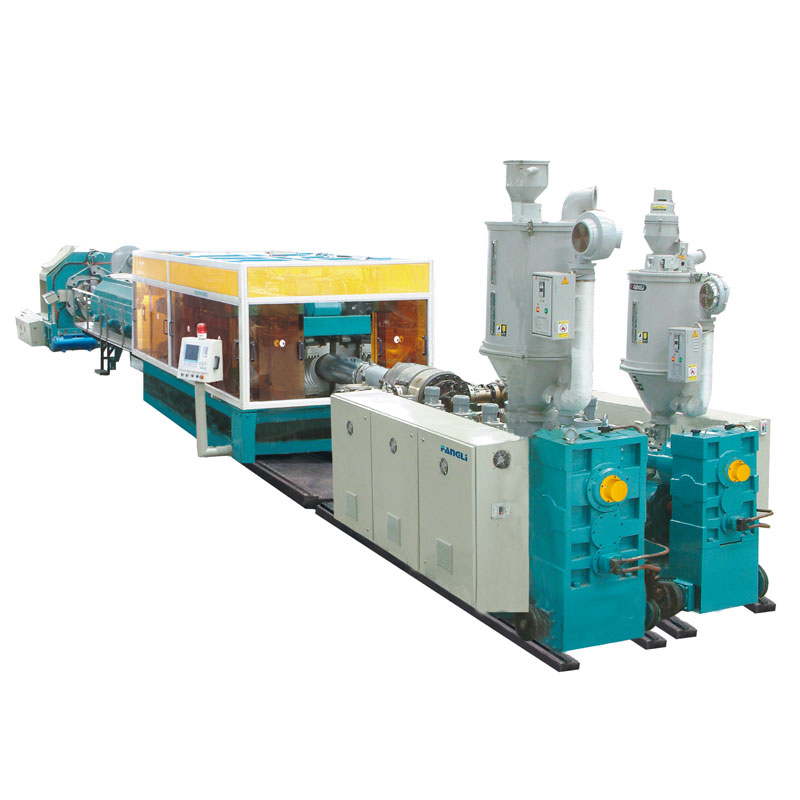
1. Optimize the Foamed Core Layer (Not the Outer Skin)
The dual-wall structure consists of a smooth inner skin and a corrugated outer profile, with a middle layer that contributes most to sectional modulus. By introducing a controlled micro-void foam into the core layer (density reduction of 8–12%), manufacturers can cut resin usage per meter substantially. The key is maintaining skin integrity—the outer wall must remain solid to handle point loads.
| Strategy | Material Saving Potential | Impact on Ring Stiffness |
|---|---|---|
| Chemical foaming (endothermic) in core | 8–10% | Neutral (if skin thickness unchanged) |
| Physical foaming with nitrogen injection | 10–15% | Slightly positive (reduced residual stress) |
| Adding 15–20% regrind to core only | 5–7% | Neutral to negative (requires additive compensation) |
Fangli recommends combining foaming with a dedicated co-extruder that feeds the core layer independently, allowing precise density control without affecting the outer profile's crystallinity.
2. Down-Gauging via Advanced Corrugator Cooling
Ring stiffness (SN) scales with the cube of wall thickness, but it also depends heavily on the cooling rate during corrugation. Faster, more uniform cooling increases polymer crystallinity in HDPE, yielding higher modulus at the same thickness. A well-tuned Double Wall Corrugated Pipe Extrusion Line with water-spray cooling rings positioned immediately after the corrugator blocks can improve modulus by up to 18%, enabling a 6–8% thickness reduction.
Practical threshold: For every 1% increase in crystallinity, you can reduce wall thickness by roughly 0.4% while maintaining the same SN value. Fangli's patented multi-zone vacuum calibration ensures that cooling occurs symmetrically, preventing ovality—a hidden culprit that artificially lowers ring stiffness in lab tests.
3. Replace Virgin Resin with Silane-Grafted Recyclate in the Inner Layer
The inner smooth layer does not bear compressive loads; it primarily handles flow and abrasion. This layer can tolerate up to 30% post-industrial recyclate (PIR) without affecting hydraulic performance. However, direct blending often causes brittle failure. The solution is reactive extrusion: graft a silane coupling agent onto the recyclate stream before feeding it into the inner-layer extruder.
-
Cost reduction: $0.08–0.12 per kg of inner-layer compound.
-
Ring stiffness effect: None, provided the inner layer remains ≥1.2 mm thick.
-
Process adjustment: Requires a side-feeder and a longer mixing zone—both standard options on Fangli systems.
4. Statistical Process Control (SPC) for Wall Thickness Variance
Most over-consumption stems from safety margins added by operators to compensate for process instability. By implementing real-time ultrasonic wall-thickness measurement with closed-loop feedback to the extruder screw speed, a Double Wall Corrugated Pipe Extrusion Line can reduce average wall thickness from 4.2 mm to 3.9 mm—a 7.1% material saving—while keeping standard deviation below 0.05 mm.
| Parameter | Without SPC | With SPC (Fangli implementation) |
|---|---|---|
| Avg. core thickness (mm) | 4.20 | 3.91 |
| Thickness std. dev. (mm) | 0.18 | 0.04 |
| Material used (kg/m) | 18.4 | 17.1 |
| Ring stiffness (SN/m²) | 8.2 | 8.1 |
This approach requires investment in sensors, but the payback period on a high-output line is typically under 4 months.
5. Switch to a High-Melt-Flow Index (MFI) Grade for the Corrugated Profile
A higher MFI (0.8–1.2 g/10 min vs. standard 0.3–0.5) fills the corrugator cavities more easily, allowing lower melt temperatures and shorter cycle times. Lower temperature means less thermal degradation and the ability to add more calcium carbonate filler (up to 12%) without compromising impact resistance. Fangli has validated this approach on lines producing DN500–DN1200 pipes, achieving a 9% net material cost reduction with zero change in SN ratings.
Frequently Asked Questions About Double Wall Corrugated Pipe Extrusion Line Cost Optimization
Q1: Can I reduce material costs by simply increasing the percentage of recycled content across all three layers?
A1: Not without careful layer segregation. Recycled HDPE/PP typically has lower molecular weight and contains contaminants that reduce stress-crack resistance. If you uniformly raise recyclate to 25% across inner, core, and outer layers, ring stiffness can drop by 12–18% due to reduced creep modulus. The proven approach is to concentrate recyclate in the inner layer only (up to 30–40%) and the core layer (up to 20% with foaming), while keeping the outer corrugated profile at ≥85% virgin or prime-grade resin. This "layer-specific" recycling strategy preserves the pipe's structural integrity because the outer profile determines the moment of inertia. Fangli's five-layer co-extrusion die enables this segregation without compromising interlayer adhesion.
Q2: How do I know if I have reduced the wall thickness too much during down-gauging?
A2: The only reliable indicator is a long-term creep test, not a short-term flattening test. While ring stiffness (SN) measured at 3% deflection may pass, the pipe can still fail under sustained soil loads after 50 years. At Fangli, we advise running a 1,000-hour hydrostatic creep test at 80°C (per ISO 9969 annex) on the first batch of down-gauged pipes. If the creep modulus remains above 600 MPa, your thickness reduction is safe. Additionally, install an online wall-thickness mapping system that tracks minimum wall thickness at the corrugation valleys—not the peaks. Valley thickness is the structural bottleneck. A reduction of 0.2 mm at the peaks is acceptable, but a 0.1 mm reduction at the valleys will fail. Our SPC software includes valley-specific alarms to prevent over-reduction.
Q3: Does faster corrugator speed affect material usage and ring stiffness simultaneously?
A3: Yes, and this is a common pitfall. Increasing line speed reduces the residence time inside the cooling section, which lowers crystallinity unless you proportionally increase cooling intensity. At higher speeds, you may be forced to raise melt temperature to maintain flow, which increases thermal expansion and causes thicker flash at the corrugation tips—wasting material without adding stiffness. The optimal balance is achieved by maintaining a specific cooling throughput (litres of water per kg of extrudate). For HDPE, keep this ratio above 2.8 L/kg. Fangli's corrugators feature individually controlled cooling zones that automatically adjust water flow as line speed changes, ensuring that a 15% speed increase does not require a single gram of extra material per meter. In fact, our field data shows that properly accelerated lines (from 1.2 m/min to 1.5 m/min for DN800) reduce material waste from startup/shutdown by 22%, further lowering overall cost.
Summary Matrix of Cost-Saving Measures
| Measure | Investment Level | Material Saving | Stiffness Risk |
|---|---|---|---|
| Core-layer foaming | Medium | 10–12% | Very Low |
| Enhanced cooling zone | High | 6–8% | None |
| Recyclate in inner layer | Low | 5–7% | None |
| SPC with ultrasonic feedback | High | 7–9% | Low |
| Higher MFI + filler | Low | 8–10% | Medium (requires testing) |
All five measures are mutually compatible. In combination, they can achieve 25–30% total resin reduction on a properly configured Double Wall Corrugated Pipe Extrusion Line, with ring stiffness maintained within ±3% of original values.
Final Recommendation
Material cost optimization is not a single tweak—it is a system-wide engineering exercise that involves die design, cooling strategy, raw material selection, and real-time process control. Fangli provides turnkey solutions that integrate all these elements, from ultrasonic gauges to reactive extrusion feeders, ensuring that every kilogram of resin delivers maximum structural value.
Contact us today for a free material-consumption audit of your existing line. Our team will simulate the cost-saving potential specific to your pipe diameters, production shifts, and local resin prices. Let Fangli help you turn your Double Wall Corrugated Pipe Extrusion Line into a lean, competitive asset that wins on both price and performance.