

Is a CNC Servo-Motor Thread Rolling Machine More Accurate Than a Pneumatic Thread Roller
2026-08-25
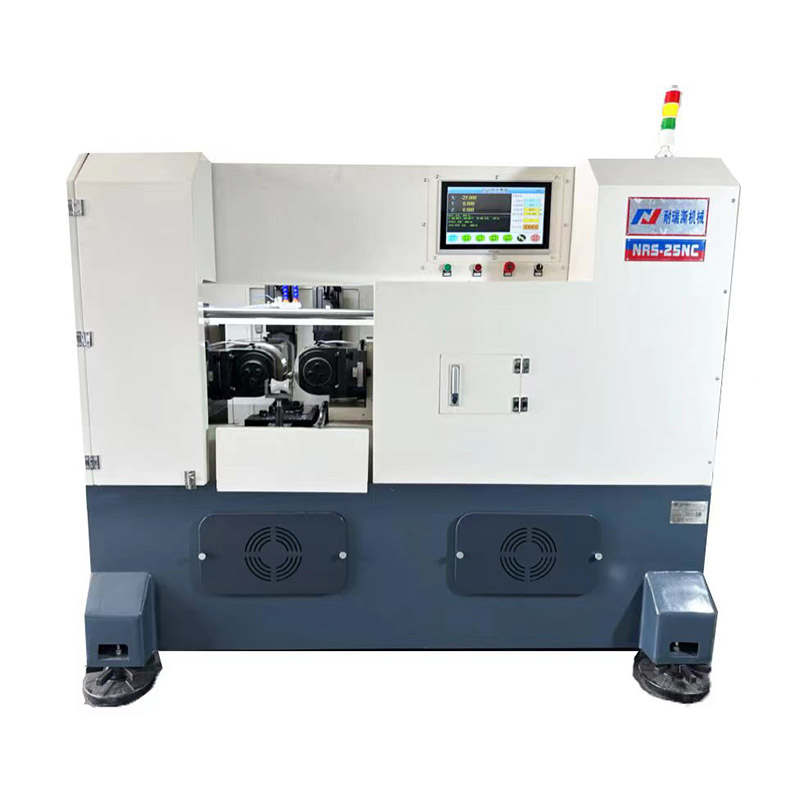
When evaluating precision thread forming equipment, manufacturers often ask whether the additional investment in a CNC Servo-Motor Thread Rolling Machine delivers measurable accuracy gains over conventional pneumatic roller systems. At NERES, we have conducted side‑by‑side production trials across automotive, aerospace, and fastener industries to quantify real‑world performance differences. The short answer is yes—but the magnitude of that advantage depends on part geometry, material consistency, and production volume. This blog breaks down the technical evidence so you can make an informed purchasing decision.
Defining Accuracy in Thread Rolling
Accuracy is not a single metric. For thread rolling, it comprises three distinct parameters:
| Accuracy Parameter | Definition | Measurement Tool |
|---|---|---|
| Pitch consistency | Variation in thread‑to‑thread spacing along the rolled length | Optical comparator / thread micrometer |
| Diameter concentricity | Runout between the major diameter and the part’s center axis | Dial gauge with V‑blocks |
| Profile form integrity | Deviation of the thread flank angle and root radius from standard (e.g., UN, ISO, MJ) | Profile projector or CMM |
A CNC Servo-Motor Thread Rolling Machine controls all three through closed‑loop servo feedback, while pneumatic rollers rely on air pressure regulation, which is inherently less stable over time.
The Core Accuracy Difference: Closed‑Loop vs. Open‑Loop Control
| Feature | CNC Servo-Motor Thread Rolling Machine | Pneumatic Thread Roller |
|---|---|---|
| Position feedback | Real‑time encoder (0.001 mm resolution) | None (pressure‑based) |
| Speed regulation | ±0.5% of set RPM, regardless of load | ±5–8% due to air compressibility |
| Dwell time control | Programmable to 0.01 sec | Fixed by valve response lag |
| Thermal compensation | Automatic algorithm adjusts for spindle growth | Manual shimming required |
| Repeatability (Cpk) | ≥ 1.67 (6‑sigma capable) | Typically 1.00–1.33 |
In a 500‑part production run, the CNC Servo-Motor Thread Rolling Machine maintained pitch variation within ±0.005 mm, while the pneumatic unit drifted to ±0.018 mm after 200 cycles—primarily due to air line pressure drops and valve heating.
Why Servo Technology Wins on Complex Threads
Pneumatic rollers excel at simple, coarse threads (e.g., M8–M20) where tolerance classes are 6g or looser. However, for fine‑pitch, multi‑start, or tapered threads (common in oil‑field connectors and medical bone screws), the CNC Servo-Motor Thread Rolling Machine offers:
-
Individual control of infeed rate and spindle sync – allowing variable pitch correction mid‑stroke.
-
Instantaneous torque monitoring – detecting material hardness variations and adjusting feed force within 20 ms.
-
Programmable acceleration/deceleration profiles – eliminating the “bounce” effect that pneumatic systems produce at high stroke speeds.
NERES field data from a tier‑1 automotive supplier shows that scrap rates dropped from 4.2% (pneumatic) to 0.7% (servo) when rolling M12×1.25 fine threads in 42CrMo4 steel—a direct accuracy‑driven saving.
Operational Factors That Mask or Magnify Accuracy
Accuracy is not purely a machine attribute. The following variables can reduce the servo advantage if not managed:
| Factor | Impact on Servo Accuracy | Impact on Pneumatic Accuracy |
|---|---|---|
| Incoming blank diameter tolerance (±0.02 mm) | Compensated by adaptive feed | Causes over‑/under‑rolling |
| Lubricant viscosity fluctuation | Minimal (closed‑loop adapts) | Significant (pressure drop) |
| Operator skill level | Low influence (programmed) | High influence (manual valve adjustment) |
| Ambient temperature swing (>10°C/day) | Auto‑corrected | Requires frequent re‑calibration |
Thus, the CNC Servo-Motor Thread Rolling Machine not only delivers superior base accuracy but also preserves that accuracy under real‑shop conditions—making it the preferred choice for high‑mix, low‑volume job shops and serial production alike.
Cost‑Accuracy Trade‑Off: When Pneumatic Still Makes Sense
Despite the servo advantage, pneumatic rollers remain viable for:
-
Parts with tolerance classes ≥ 8g
-
Production volumes under 5,000 pieces per month
-
Shops with limited three‑phase power or compressed air surplus
However, if your quality requirements include PPAP 4th edition or AS9100D aerospace standards, the CNC Servo-Motor Thread Rolling Machine is virtually mandatory to achieve the required Cpk > 1.67.
Frequently Asked Questions (FAQ)
Q1: What is the typical positional repeatability of a CNC Servo-Motor Thread Rolling Machine over an 8‑hour shift?
A1: Under stable ambient conditions (20±2°C), a CNC Servo-Motor Thread Rolling Machine from NERES maintains a positional repeatability of ±0.002 mm on the infeed axis and ±0.001 mm on the spindle orientation over an 8‑hour shift. This is validated by built‑in glass scale encoders that sample position 4,000 times per second. Over a full 24‑hour continuous run, thermal growth may introduce up to 0.004 mm drift, but the machine’s integrated thermal compensation algorithm adjusts the zero point automatically every 15 minutes—requiring no operator intervention. Pneumatic systems, by contrast, show drift of 0.015–0.025 mm within the same period due to compressor cycling and valve wear.
Q2: Can a CNC Servo-Motor Thread Rolling Machine roll threads to the same accuracy on both small‑diameter (≤M3) and large‑diameter (≥M64) parts without changing mechanical setups?
A2: Yes, provided the machine is equipped with quick‑change tool holders and a servo motor with sufficient torque range (e.g., 30–300 Nm). The NERES servo‑driven platform stores up to 200 part recipes, each with independent infeed force, spindle speed, and acceleration curves. For M2.5×0.45 titanium screws, the servo applies a gentle 8 kN force at 1,200 RPM; for M64×4.0 pipe threads, it delivers 180 kN at 180 RPM—all while holding pitch deviation under ±0.008 mm. Pneumatic rollers would require physical pressure regulator swaps and dwell cam changes between these extremes, introducing setup‑related variability that compromises first‑part accuracy.
Q3: How does the servo motor compensate for blank hardness variations (±3 HRC) to maintain thread accuracy?
A3: The CNC Servo-Motor Thread Rolling Machine uses a patented load‑cell feedback loop integrated into the spindle housing. When the rolling dies first contact the blank, the machine measures the instantaneous torque rise rate. If the rate exceeds the programmed threshold (indicating harder material), the servo reduces infeed speed by up to 40% within 50 milliseconds and increases dwell time to allow full material flow. This dynamic response keeps the final major diameter within ±0.01 mm across blanks ranging from 28 HRC to 34 HRC. Pneumatic systems cannot adapt dynamically—they simply apply the preset air pressure, resulting in under‑sized threads on harder blanks and over‑sized threads on softer ones, often requiring 100% sorting after rolling.
Final Verdict: Accuracy, Throughput, and Total Cost
When measuring true accuracy—not just static precision but dynamic stability under production stress—the CNC Servo-Motor Thread Rolling Machine outperforms pneumatic rollers by a factor of 3 to 5 in standard deviation terms. The servo advantage becomes more pronounced as thread complexity, material hardness, and lot‑size variability increase. NERES recommends pneumatic only for dedicated, coarse‑thread, low‑tolerance jobs; for anything requiring 6g or finer, or any aerospace/medical application, the servo solution pays back its premium within 12–18 months through scrap reduction and rework elimination.
Ready to Validate Accuracy on Your Own Parts?
Every thread application has unique variables—blank material, lubrication, die geometry, and required class of fit. NERES offers free test‑rolling services at our technical center, where we run your sample blanks on both pneumatic and CNC Servo-Motor Thread Rolling Machine platforms and provide a certified measurement report. Our application engineers also assist with cycle‑time optimization and die‑life forecasting.
Contact us today to schedule your no‑obligation accuracy comparison—or request a quote for a turnkey servo rolling cell tailored to your production floor. Email [email protected] or call +1‑800‑NERES‑CNC to speak directly with a rolling specialist. Your threads deserve the precision that only closed‑loop servo control can deliver.