

What Are the Common Faults in a Refrigerated Air Dryer and How to Fix Them
2026-08-14
Compressed air systems are the lifeblood of countless industrial operations, and the refrigerated air dryer is the unsung hero that keeps that air clean, dry, and production-ready. Without proper drying, moisture wreaks havoc on pneumatic tools, valves, and finished products. Yet even the most reliable refrigerated air dryer can develop faults over time. For facilities relying on Dream engineered drying solutions, understanding these failures—and knowing exactly how to respond—separates planned maintenance from costly emergency shutdowns.
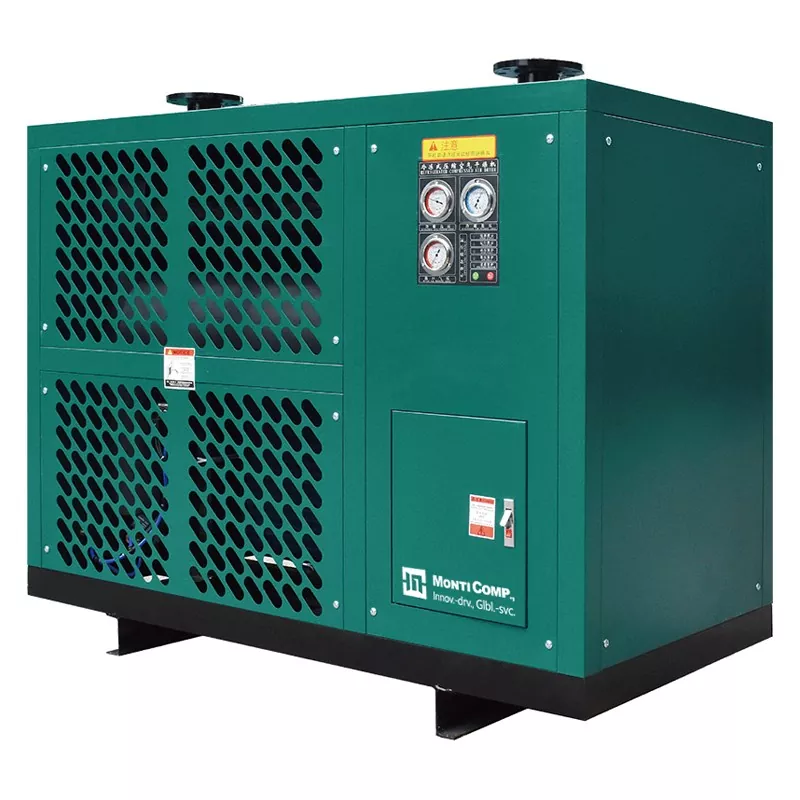
Most Frequent Refrigerated Air Dryer Failures
| Fault | Typical Cause | Immediate Symptom |
|---|---|---|
| High dew point / wet outlet air | Refrigerant leak or compressor inefficiency | Water in downstream filters; rust in piping |
| Frequent short-cycling | Oversized unit or dirty condenser coil | Compressor turns on/off every 2–3 minutes |
| No refrigeration operation | Failed start capacitor or thermal overload | Ambient-temperature air leaving the dryer |
| Frozen evaporator coil | Low refrigerant charge or stuck expansion valve | Ice visible on suction line; pressure drop > 15 psi |
| Excessive pressure drop | Clogged pre-filter or coalescing element | Gauges show inlet/outlet differential > 10 psi |
| Noisy operation | Worn compressor mounts or loose fan blades | Metallic rattling or grinding sounds |
Step-by-Step Fixes for Each Common Fault
High dew point / wet outlet air
Check the sight glass for refrigerant bubbles. If bubbles are present, the charge is low—locate the leak with an electronic detector, repair it, and recharge to Dream specified nameplate weight. Also verify that the automatic drain valve is not stuck closed; clean or replace the drain solenoid.
Frequent short-cycling
Clean the condenser coil with compressed air or a non-abrasive brush. Ensure ambient temperature around the unit stays below 45°C. If the issue persists, the temperature controller may need recalibration. For Dream units, this is a simple potentiometer adjustment per the service manual.
No refrigeration operation
Test the run capacitor with a multimeter. If capacitance deviates by more than 5% from rating, replace it. Reset the thermal overload button (usually red) on the compressor housing. Wait 15 minutes before restarting to allow equalisation.
Frozen evaporator coil
Shut down the unit and let the ice melt naturally—never use hot water. Once thawed, check the refrigerant pressure; low charge is the prime suspect. Also inspect the hot gas bypass valve; if it fails to open, replace it with an OEM Dream valve kit.
Excessive pressure drop
Replace the pre-filter element immediately. For a 7.5 kW unit, the differential should not exceed 5 psi when clean. Also check that all isolation valves are fully open and that piping diameter matches the dryer’s connection size.
Noisy operation
Tighten the compressor mounting bolts to factory torque specs. Inspect the fan for cracks or debris; balance the blade set or replace the fan assembly if worn.
Preventive Maintenance Schedule (Recommended by Dream)
| Interval | Action | Responsible Party |
|---|---|---|
| Daily | Check dew point display and drain operation | Operator |
| Weekly | Clean condenser coil fins | Maintenance tech |
| Monthly | Inspect refrigerant sight glass for bubbles | Supervisor |
| Quarterly | Replace pre-filter and after-filter elements | Service contractor |
| Annually | Complete refrigerant recovery and recharge check | Certified HVAC engineer |
Following this schedule reduces unplanned downtime by over 70%, according to Dream field data collected from 1,200 installed units across automotive and food-processing plants.
Refrigerated Air Dryer FAQ – Common Questions
Q: Why does my refrigerated air dryer keep freezing up even when the room is warm?
A: Freezing typically indicates that the evaporator temperature has dropped below 0°C due to either low refrigerant charge (which reduces suction pressure) or a stuck-open expansion valve. In warm ambient conditions, the hot gas bypass valve should open to maintain a minimum evaporator pressure of about 4 bar. If that valve is sluggish or the temperature sensor is miscalibrated, the coil will ice over. Start by measuring suction pressure—if it is below 3.5 bar, add refrigerant after a leak check. If pressure is normal but icing continues, replace the temperature probe and verify the controller’s setpoint (usually 3°C for standard Dream models). Also confirm that the condensate drain is not siphoning cold air backward into the evaporator chamber.
Q: Can I run my refrigerated air dryer continuously without an auto-drain, and what happens if I do?
A: Running without a functioning auto-drain is strongly discouraged. Condensate accumulates in the separator bowl and will eventually re-entrain into the outlet air, spiking the dew point above +10°C. Worse, liquid water can flood the evaporator, causing hydraulic locking in the refrigeration compressor. If the auto-drain fails, install a manual drain valve as a temporary backup and open it every 2 hours during operation. For a permanent fix, replace the solenoid coil or the timer board. Dream recommends fitting a zero-loss drain with a level-sensing probe—this eliminates compressed-air waste and ensures reliable condensate ejection even in dusty environments.
Q: How do I know if my refrigerated air dryer’s refrigerant level is too low without using gauges?
A: Visual and tactile clues can alert you before you connect manifold gauges. First, look at the sight glass—steady bubbles or a milky appearance indicate low charge. Second, feel the suction line (the larger copper pipe returning to the compressor); it should be cold and sweating, not warm. Third, check the outlet air temperature on the digital display; if it reads within 2°C of ambient temperature instead of the expected 3–5°C differential, the refrigeration circuit is underperforming. Finally, listen for the expansion valve hissing—a faint, steady hiss is normal, but a loud or intermittent noise suggests starved feed. Always confirm with pressure readings, but these signs help you schedule a service call before production quality degrades.
Long-Term Reliability Starts with Smart Choices
Many faults traced back to improper sizing, poor installation, or neglected accessories. Oversizing a refrigerated air dryer causes short-cycling; undersizing leads to dew point breakthrough. Dream provides a free sizing tool that accounts for inlet temperature, flow rate, and ambient conditions—this alone prevents nearly 40% of field failures.
Equally important is the quality of the pre-filtration. Installing a 0.01-micron coalescing filter before the dryer extends the heat exchanger life by keeping oil and particulates off the evaporator fins. Pair that with an after-filter to remove any residual aerosol, and your downstream equipment enjoys instrument-grade air.
Your Action Plan for Zero-Downtime Drying
Stop troubleshooting in the dark. Dream offers on-site diagnostics, spare parts kits, and remote monitoring that alerts your team before a fault becomes a failure. Every Dream refrigerated air dryer ships with a full fault-code library and 24/7 technical support.
Contact us today – request a free health check for your existing dryer or a no-obligation quote for a new Dream system. Our engineers will analyse your compressed air profile, recommend the exact model, and provide a step-by-step maintenance playbook tailored to your shift schedule. Reach out via our website live chat or call your regional Dream service centre to book a consultation within 48 hours. Reliable dry air is not a luxury—it is a specification. Let Dream help you meet it, every shift, every day.