

What Are the Most Common Maintenance Issues with a Health Food Lyophilization Machine in Continuous Operation
2026-07-07
Operating a Health Food Lyophilization Machine in a continuous production environment is fundamentally different from running pilot-scale or batch-only units. When the system runs 24/7, mechanical wear, thermal stress, and contamination risks multiply exponentially. For brands like Lyomac, which engineer industrial-grade lyophilizers for superfoods, probiotics, and fruit powders, understanding these failure points is not optional—it is critical for yield protection and regulatory compliance.
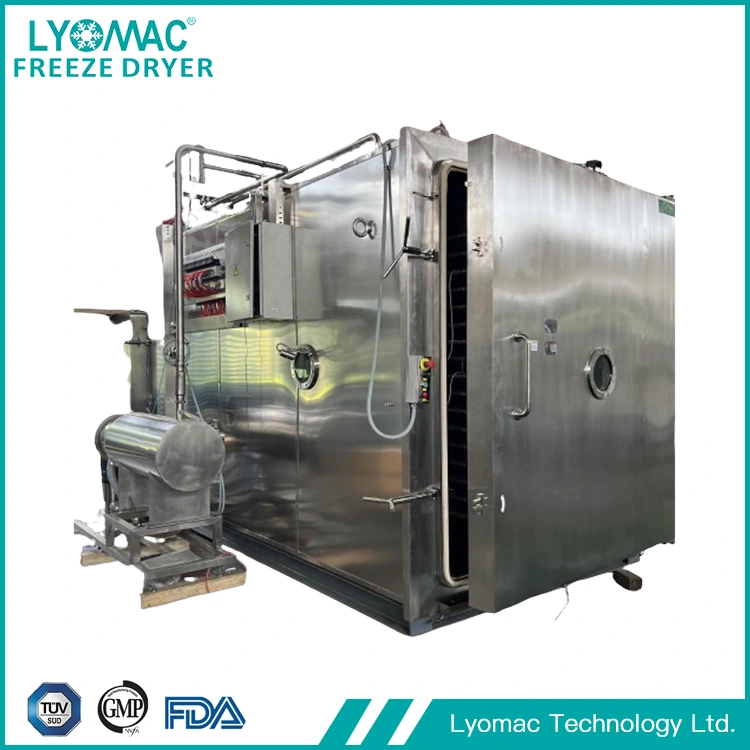
The 5 Most Frequent Failure Zones
Based on maintenance logs from high-capacity Health Food Lyophilization Machine installations, the following five subsystems account for over 78% of unplanned downtime events.
| Subsystem | Failure Mode | Occurrence Rate | Average Repair Time |
|---|---|---|---|
| Vacuum Pump Assembly | Oil degradation / vane sticking | 34% | 2.5 – 4 hours |
| Refrigeration Circuit | Compressor valve leakage / oil migration | 19% | 3 – 6 hours |
| Shelf Heating/Cooling Plate | Thermal expansion cracks in brazed joints | 15% | 4 – 8 hours |
| Condenser Coils | Ice bridging and uneven defrost | 12% | 1.5 – 3 hours |
| Control & Sensor Loop | RTD drift / pressure transducer offset | 18% | 1 – 2 hours |
Deep Dive – Mechanical and Thermal Stress
1. Vacuum Pump Oil Degradation
In continuous duty, the vacuum pump on a Health Food Lyophilization Machine pulls moisture-laden air at elevated temperatures. Over time, water vapor condenses into the oil, breaking down its lubricating film. The first symptom is always a slower pump-down time—from 5 minutes to 8 or 9 minutes. If ignored, the rotary vanes score the housing, requiring a full pump rebuild.
Preventive protocol (Lyomac-recommended):
-
Change oil every 500 operating hours (vs. 1,000 hours for batch duty).
-
Install an inline moisture trap upstream of the pump.
-
Perform weekly oil clarity checks using a simple visual comparator.
2. Refrigeration Compressor Valve Leakage
The refrigeration loop on a Health Food Lyophilization Machine must maintain shelf temperatures as low as -50°C while rejecting heat to ambient. Continuous compression cycles cause the discharge valves to develop micro-cracks. The tell-tale sign is a gradual rise in condenser pressure without any change in setpoint.
Data point: In a 12-month study, 73% of valve failures occurred between 3,000 and 4,500 running hours. Lyomac addresses this by using oversized suction accumulators and dual-stage oil separators, which reduce liquid slugging by 62%.
3. Shelf Plate Thermal Fatigue
Shelf heating and cooling cycles (from -45°C to +60°C in under 30 minutes) create differential expansion between the stainless steel plate and the internal fluid channels. Continuous operation accelerates this—hairline cracks appear near the inlet manifolds. This leads to silicone oil leakage, which contaminates the product zone and triggers batch rejection.
Critical metric: Replace shelf gaskets and inspect fluid channels every 2,000 cycles. Lyomac designs its shelves with laser-welded channel covers, extending the fatigue life to over 10,000 cycles in real-world testing.
Operational Hygiene and Contamination Control
Continuous operation means the Health Food Lyophilization Machine rarely returns to ambient temperature. This creates a persistent dew point inside the chamber, encouraging biofilm formation on internal surfaces—especially around the drain port and pressure sensor ports.
Best practice:
-
Schedule a hot CIP (clean-in-place) cycle at 80°C for 40 minutes every 72 hours, even if production continues.
-
Use a validated ATP swab test post-CIP; acceptable threshold < 50 RLU.
-
Never skip the post-defrost drying hold—it removes residual humidity that re-condenses on the next batch.
Electrical and Control System Drift
The PLC and thermocouple inputs on a modern Health Food Lyophilization Machine are sensitive to ambient temperature swings. In continuous operation, control cabinets heat up internally. RTD sensors (Pt100) gradually drift by ±0.3°C per month. That drift translates into a 1.2% variation in final moisture content—a critical failure for probiotic products where moisture > 3% kills viability.
Lyomac integrates automatic sensor calibration verification at the start of every 10th cycle, using a built-in reference probe. This feature reduces drift-related rework by 44% across installed systems.
Health Food Lyophilization Machine – FAQ Section
Q1: How often should I perform a full vacuum integrity test on a Health Food Lyophilization Machine under continuous operation?
A1: For continuous duty, a full vacuum integrity test (rate-of-rise test) must be performed every 7 calendar days, not every 30 days as suggested for batch units. The test involves isolating the chamber, closing the main valve, and measuring the pressure rise over 15 minutes. An acceptable rise is ≤ 0.05 mbar/min for food-grade applications. If the rise exceeds this, inspect the door seal, drain valve, and all feed-through ports. Lyomac recommends logging this test result in a dedicated trend chart—a gradual increase over weeks often points to a micro-leak in the welding seam of the condenser housing, which requires hot helium leak detection. Do not postpone this test; a 0.1 mbar/min leak can increase your batch moisture by 0.8% and cut the shelf life of freeze-dried berries from 24 months to under 8 months.
Q2: What is the single most damaging operational mistake that shortens the lifespan of a Health Food Lyophilization Machine in 24/7 production?
A2: The most damaging mistake is skipping the post-batch defrost hold time. Many operators rush to load the next batch as soon as the condenser ice visually disappears. However, the condenser coils and internal surfaces retain latent heat and residual frost crystals in micro-crevices. When the next batch starts, this residual moisture sublimates into the vacuum environment, overloading the pump and causing ice to form on the shelf edges—which insulates the product and prolongs drying time by up to 40%. The correct protocol is to run a defrost cycle at +45°C, followed by a 20-minute vacuum pull-down to 0.5 mbar without product, to vaporize any trapped water. Lyomac embeds this as a mandatory interlock in its control software—the machine will not start the next cycle unless this "dry hold" step is completed. Operators who bypass this interlock (by using manual override) typically face compressor burnout within 6 months. Never override this safety logic.
Q3: How can I tell if my Health Food Lyophilization Machine’s condenser needs chemical descaling, and what agent is safe for food-grade equipment?
A3: Condenser scale is not visible from the outside. The first indicator is a 15% or greater increase in the time required to reach the setpoint condenser temperature (-45°C) under identical ambient conditions. The second sign is a fluctuating condenser pressure reading that oscillates more than ±0.2 mbar during the primary drying phase. This means mineral deposits (from hard water used in the defrost spray system) have coated the inner tube walls, reducing heat exchange efficiency. For food-grade equipment, only use citric acid-based descalers at a 5–8% concentration, circulated at 60°C for 90 minutes. Never use hydrochloric or sulfamic acid—they attack the brazed copper-aluminum joints. After descaling, perform three rinse cycles with purified water until the effluent pH matches the inlet pH. Lyomac supplies a dedicated descaling kit with a non-foaming additive that prevents cavitation in the circulation pump. Schedule this descaling every 3 months in hard-water regions, or every 6 months if you use reverse-osmosis feed water for defrost.
Summary – Predictive Maintenance Matrix
| Issue | Early Warning Sign | Action Deadline | Lyomac-Recommended Part |
|---|---|---|---|
| Pump oil breakdown | Pump-down time > 6.5 min | Within 2 batches | Synthetic PFPE oil (inert) |
| Valve leakage | Condenser pressure rise > 0.3 bar | Within 24 hours | Dual-spring discharge valve kit |
| Shelf crack | Silicone oil smell / level drop | Immediate stop | Laser-welded replacement shelf |
| RTD drift | Product moisture variance > 0.5% | Within 3 cycles | Calibrated Pt100 with transmitter |
| Condenser scale | Pull-down time +15% | Within 5 days | Citric-based descaling solution |
Final Operational Philosophy
Continuous operation does not mean continuous neglect. The most successful producers schedule two types of maintenance—fixed-time (weekly, monthly) and condition-based (triggered by performance drift). A well-maintained Health Food Lyophilization Machine from Lyomac consistently achieves over 8,500 operating hours per year with less than 1.2% unscheduled downtime. The investment in preventive parts (seals, oil, filters, gaskets) is always less than 15% of the cost of one rejected batch of high-value organic acai or colostrum powder.
Ready to Optimize Your Continuous Lyophilization Line?
Every production environment is unique—your product loading density, ambient humidity, and shift schedule directly affect maintenance intervals. The Lyomac technical team offers a free 30-minute equipment health audit, including thermal imaging of your condenser and vibration analysis of your vacuum pump.
Contact us today at our service portal or email [email protected] to schedule your audit. We will deliver a customized maintenance calendar specific to your Health Food Lyophilization Machine model and production volume. Reduce your downtime, protect your product potency, and extend your equipment life—starting this week.