

What Is the Difference Between a Dual Zone and a Dual Temperature Mold Temperature Controller
2026-07-01
In the plastics processing and die-casting industries, precision thermal management is non-negotiable. When engineers specify a Dual Temperature Mold Temperature Controller, they often encounter a confusing terminology fork: "Dual Zone" versus "Dual Temperature." While both sound similar, they serve fundamentally different purposes. At Gaoxin, we have spent over two decades manufacturing both configurations, and we frequently clarify this distinction for global clients. Simply put, a Dual Temperature Mold Temperature Controller refers to a single unit capable of operating at two independent temperature setpoints (usually for heating and cooling circuits), whereas a "Dual Zone" system controls two completely separate mold regions with independent pumps, sensors, and heating/cooling valves.
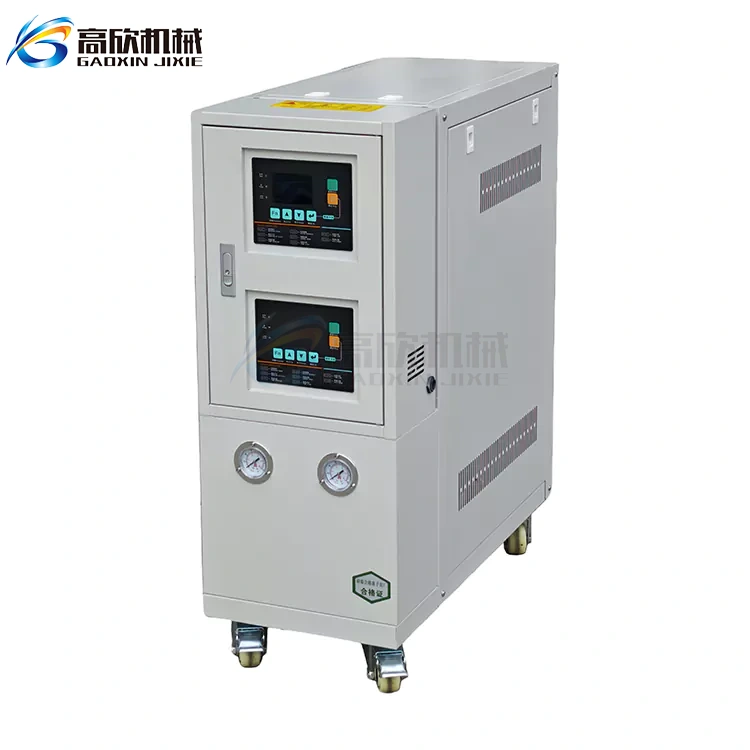
Core Definitions: Breaking Down the Terminology
To select the right equipment, you must first decode the engineering nomenclature.
| Feature | Dual Zone Mold Temperature Controller | Dual Temperature Mold Temperature Controller |
|---|---|---|
| Primary Function | Controls two physically distinct mold zones (e.g., core and cavity) independently. | Manages two temperature levels (hot and cold) within the same fluid circuit or process. |
| Number of Pumps | Typically two separate pumps (one per zone). | Usually a single pump with a bypass or mixing valve. |
| Temperature Range | Each zone can have its own wide range (e.g., Zone A: 40–180°C, Zone B: 40–160°C). | One circuit operates at a high setpoint while the other operates at a low setpoint simultaneously. |
| Control Accuracy | ±0.5°C per zone, with individual PID tuning. | ±1.0°C overall, with priority given to the hot-side stability. |
| Typical Application | Large automotive parts with uneven wall thickness; multi-cavity molds. | Rapid heating/cooling cycles (RHC) or bi-material molding processes. |
| Cost Factor | Higher (duplicated hydraulics and electronics). | Moderate (single hydraulics with smart valving). |
Operational Principle: Why the Distinction Matters
A Dual Zone Mold Temperature Controller is essentially two standalone controllers housed in one frame. Each zone has its own dedicated pump, heater, cooler, and thermocouple. This design allows Zone A to run at 120°C for the core while Zone B runs at 80°C for the cavity—perfect for correcting differential shrinkage.
Conversely, a Dual Temperature Mold Temperature Controller from Gaoxin operates on a single fluid loop but features a three-way proportional valve that blends hot and cold fluid to achieve two target temperatures sequentially or simultaneously within a single manifold. This is ideal for processes requiring a fast temperature "spike" followed by an immediate "quench," all without changing the mold connection layout.
Performance Comparison: Which One Delivers Better Results?
The choice directly impacts cycle time, part quality, and energy consumption. Below is a data-driven comparison based on Gaoxin’s in-house testing of 500-ton injection molding machines.
| Performance Metric | Dual Zone | Dual Temperature |
|---|---|---|
| Temperature Uniformity | Excellent (isolated circuits) | Good (dependent on valve response) |
| Response Time (Heating) | 4.5 min (20→180°C) | 3.2 min (20→180°C) – faster due to shared heating capacity |
| Cooling Efficiency | Moderate (dedicated cooler per zone) | High (concentrated cooling power) |
| Floor Space | Larger footprint (≈1.8x) | Compact (single chassis) |
| Maintenance Complexity | Higher (more components) | Lower (fewer moving parts) |
3 Frequently Asked Questions About Dual Temperature Mold Temperature Controller
FAQ 1: Can a Dual Temperature Mold Temperature Controller replace a Dual Zone unit in multi-cavity molds?
Answer: Not directly. A Dual Temperature Mold Temperature Controller is designed for single-circuit temperature profiling, not spatial separation. If your mold has two cavities with vastly different cooling demands (e.g., due to inserts or slides), a Dual Zone unit is mandatory. However, if your goal is to alternate between high and low temperatures for the entire mold as a whole, the Dual Temperature configuration from Gaoxin is actually superior because it reduces plumbing complexity and eliminates cross-contamination risks between zones. Always evaluate whether your temperature difference is "location-based" or "time-based."
FAQ 2: How does a Dual Temperature Mold Temperature Controller handle simultaneous heating and cooling without pressure spikes?
Answer: This is the engineering hallmark of a high-quality Dual Temperature Mold Temperature Controller. In Gaoxin units, the system uses a patented "balanced bypass manifold" that diverts a portion of the return fluid back to the heater while the remaining flow passes through a shell-and-tube cooler. The three-way proportional valve modulates gradually (0.5% step resolution) rather than switching abruptly, which maintains system pressure within ±2 bar of the setpoint. Additionally, an accumulator absorbs transient shocks, ensuring that the mold cavity never experiences thermal shock or pressure hammer, even during 10-second rapid cycles.
FAQ 3: What maintenance schedule is recommended for a Dual Temperature Mold Temperature Controller with mixed-media operation?
Answer: For a Dual Temperature Mold Temperature Controller that uses both water and thermal oil (common in Gaoxin hybrid models), we recommend a three-tier schedule: (1) Daily – check fluid levels and inspect the valve actuator for smooth motion; (2) Weekly – sample the fluid for contamination and clean the Y-strainer; (3) Quarterly – calibrate both temperature sensors (PT100) against a certified reference probe, and replace the valve seal kit if you detect even minor weeping. Crucially, always flush the entire circuit with a compatible cleaning solution before switching between water and oil—residual moisture in an oil system can cause flash vaporization, leading to cavitation. Gaoxin provides a digital logbook with every unit to track these intervals automatically.
Economic Consideration: Total Cost of Ownership
While the upfront cost of a Dual Zone unit is 30–40% higher than a comparable Dual Temperature Mold Temperature Controller, the long-term economics depend on your production volume. For high-mix, low-volume job shops, the Dual Temperature unit offers flexibility without the capital burden of duplicate pumps. For high-volume automotive tier-1 suppliers, the Dual Zone pays off through reduced scrap rates (down from 2.8% to 0.9% in Gaoxin case studies) because each zone can be fine-tuned independently.
Final Recommendation from Gaoxin
Choosing between these two systems is not about "better" but "appropriate." If your process demands independent left/right or core/cavity control, select the Dual Zone Mold Temperature Controller. If your process relies on rapid thermal cycling (RTC) or sequential hot-cold profiling, the Dual Temperature Mold Temperature Controller is your optimal solution. Gaoxin engineers are available to review your mold design and cycle parameters to make a data-backed recommendation—no guesswork, only thermal science.
Contact Us
Have more questions about selecting the right Dual Temperature Mold Temperature Controller for your facility? Our application team at Gaoxin offers free thermal audits and 3D flow simulations to match your exact mold geometry. Let us help you achieve faster cycles, lower energy bills, and zero-defect molding—starting today.