

What Is the Difference Between a Stretch-Reducing Mill and a Conventional Multi Stand Reducing Rolling Mill
2026-07-20
In the world of seamless tube and pipe production, two technologies often come up in engineering discussions: the stretch-reducing mill (SRM) and the conventional Multi Stand Reducing Rolling Mill. While both are used to reduce the outer diameter of tubular products, their working principles, control strategies, and final product characteristics differ significantly. At GRM, we have engineered both systems for decades, and we frequently guide customers through this exact choice. Understanding these differences is not just academic—it directly affects yield, tolerance, surface quality, and production cost.
Core Definition and Primary Function
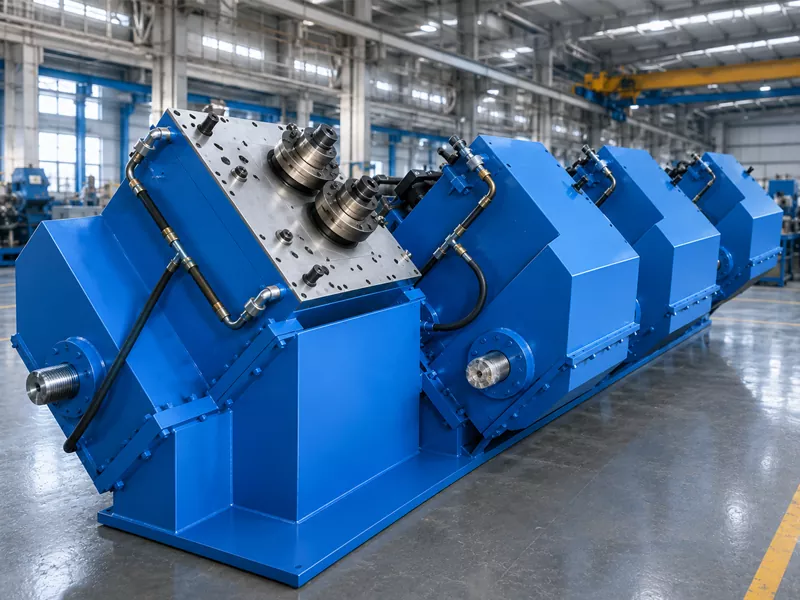
A conventional Multi Stand Reducing Rolling Mill operates as a sequential set of roll stands (typically 3 to 24 stands) that progressively reduce the diameter of a tube with minimal wall thickening. Each stand contributes a small, fixed reduction, and the overall process is relatively "free" in terms of inter-stand tension control—meaning the tube moves largely under its own driven speed without active stretching.
In contrast, a stretch-reducing mill (SRM) is a specific subset of the Multi Stand Reducing Rolling Mill family, but with a critical distinction: it applies controlled overdrive between stands. This means the downstream stands are driven at progressively higher speeds than the upstream ones, intentionally creating axial tension that "stretches" the tube while reducing its diameter. This tension actively controls wall thickness, allowing the mill to produce thinner walls than a conventional reducing mill could achieve with the same initial shell.
Key Differences at a Glance
| Aspect | Conventional Multi Stand Reducing Rolling Mill | Stretch-Reducing Mill (SRM) |
|---|---|---|
| Tension Control | Minimal or no inter-stand tension | Active, controlled overdrive tension |
| Wall Thickness Control | Limited; wall thickens as diameter reduces | Precisely controlled; can reduce wall thickness |
| Roll Speed Pattern | Linear or uniform speed progression | Parabolic or customized speed profile |
| Typical Reduction per Stand | 5–8% | 3–6% (due to tension limits) |
| Product Range | Heavy-wall pipes, structural tubes | Light-wall tubes, API casing, automotive components |
| Motor Drive System | Individual or group drives with fixed ratios | Individual AC drives with fast dynamic response |
| Setup Complexity | Simpler roll pass design | Complex pass design + speed scheduling |
Operational Principle: Why Tension Changes Everything
In a conventional Multi Stand Reducing Rolling Mill, the tube is compressed radially between rolls, and the metal flows primarily in the circumferential and longitudinal directions. Without significant axial tension, the wall tends to increase as the diameter shrinks—a phenomenon known as "wall thickening." This is acceptable for applications requiring heavy walls, but it becomes a limitation when lightweight, high-strength tubes are needed.
The stretch-reducing mill solves this by introducing a speed differential. As the tube moves from stand to stand, each subsequent stand pulls the material faster than the previous one pushes it. This tensile stress counteracts the natural thickening tendency, effectively "ironing" the wall to a target thickness. The result: a lighter tube with uniform wall thickness, even at high reduction ratios (up to 80% or more in diameter).
However, this comes at a cost. The SRM requires sophisticated process models, real-time speed adjustments, and precise roll gap settings. GRM integrates advanced automation packages that monitor torque and motor current to maintain the optimal tension profile across all stands.
Product Quality and Defect Considerations
| Quality Parameter | Conventional Mill | Stretch-Reducing Mill |
|---|---|---|
| Wall Eccentricity | Moderate (depends on incoming shell) | Significantly improved (tension centers the tube) |
| Surface Finish | Good, but may show ripples | Excellent, with smoother external surface |
| Internal Stress | Low residual stress | Higher residual stress (requires stress relief) |
| Dimensional Tolerance | ±5–8% of nominal wall | ±3–5% of nominal wall |
| End Crop Loss | Minimal | Higher (due to tension transients at ends) |
The trade-off is clear: SRM offers superior precision and lighter products, but it demands more engineering input and generates more end-crop waste. For many GRM clients, the decision boils down to their product mix—if they produce mostly standard structural tubes, a conventional Multi Stand Reducing Rolling Mill is cost-effective. If they target automotive, boiler, or premium casing grades, the SRM is indispensable.
Frequently Asked Questions About Multi Stand Reducing Rolling Mill
Q1: Can a conventional Multi Stand Reducing Rolling Mill be upgraded to perform stretch-reducing functions?
A1: Yes, but not by simply changing roll speeds. A true stretch-reducing capability requires replacing the drive system with individual AC motors (or high-response DC drives) capable of independent speed control, plus installing a real-time tension monitoring system (load cells or torque sensors). The roll pass design must also be recalculated because the reduction sequence changes under tension. GRM offers retrofit packages that include new drive cabinets, automation software, and pass design consultancy. However, the mechanical structure—housing, bearings, and gearing—must be evaluated for higher torque fluctuations. In many cases, a full upgrade is about 60–70% of the cost of a new SRM, making it viable only if the existing mill has a robust frame and sufficient motor capacity.
Q2: Which type of Multi Stand Reducing Rolling Mill delivers better dimensional stability for thin-wall tubes under 3 mm?
A2: The stretch-reducing mill is unequivocally superior for thin-wall tubes. With a conventional Multi Stand Reducing Rolling Mill, wall thickness below 3 mm becomes highly unstable because the natural wall thickening cannot be counteracted without tension. The SRM’s active tension profile keeps the wall within ±0.15 mm even for 2 mm walls, provided that the incoming shell is concentric. Additionally, the SRM reduces "ovalization" (out-of-roundness) because the axial tension stabilizes the tube cross-section. GRM has supplied SRM lines that consistently produce 1.8 mm wall tubes for automotive driveshafts with a Cpk (process capability) above 1.67. For such applications, the conventional mill is simply not an option.
Q3: How do operating costs compare between a conventional Multi Stand Reducing Rolling Mill and an SRM over a 10-year lifecycle?
A3: While the initial capital cost of an SRM is 30–40% higher than a conventional mill of the same stand count, the lifecycle cost analysis often favors the SRM for high-volume, high-value products. Here is a breakdown from GRM’s project database:
| Cost Factor | Conventional Mill | Stretch-Reducing Mill |
|---|---|---|
| Energy Consumption (kWh/ton) | 75–85 | 90–105 (higher due to tension drives) |
| Roll Consumption (kg/ton) | 0.8–1.2 | 1.0–1.5 (faster wear under tension) |
| Scrap/Rework Rate | 4–6% | 2–3% (better tolerance reduces rejects) |
| Maintenance (annual) | Moderate (gear boxes, bearings) | Higher (drives, cooling systems, sensors) |
| Total Cost per Ton (10-yr avg) | Baseline + 0% | Baseline + 8–12% |
However, the SRM enables selling thinner-wall products at a premium price (typically 15–25% higher per ton), so the net profit margin often outweighs the extra operating expense. For producers focused on commodity pipes, the conventional mill remains more economical. GRM always performs a tailored ROI analysis before recommending either solution.
Which One Should You Choose?
The decision is not about which technology is "better"—it is about which fits your product portfolio, target markets, and budget. If your orders are predominantly thick-wall (e.g., 6 mm and above) with standard tolerances, a conventional Multi Stand Reducing Rolling Mill offers lower investment, simpler operation, and easier maintenance. If your future lies in lightweight, high-precision tubes for energy, automotive, or mechanical engineering, the stretch-reducing mill is your pathway to competitiveness.
At GRM, we design, manufacture, and commission both types, and we offer hybrid solutions that allow you to switch between modes for different product batches—giving you the best of both worlds. Our engineers use advanced finite-element models to predict wall behavior before the first billet is rolled, ensuring your mill meets yield and quality targets from day one.
Contact Us
Choosing the right Multi Stand Reducing Rolling Mill is a strategic decision that impacts your production economics for decades. Whether you are planning a greenfield project, upgrading an existing line, or simply seeking a second opinion on your process parameters, the GRM team is ready to assist. We provide on-site audits, feasibility studies, and customized proposals with clear payback calculations. Let GRM help you roll smarter, not harder.