

What is the impact of screw compression ratio on the impact strength of thermoformed PP seedling tray sheets
2026-04-24
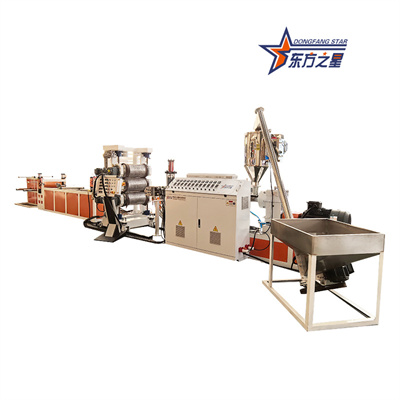
When optimizing a PP Seedling Tray Sheet Extruder Machine, few parameters influence final product quality as profoundly as the screw compression ratio. At Eaststar, extensive field data confirms that this ratio directly governs the impact strength of thermoformed trays by controlling polymer melt homogeneity and molecular orientation.
The Science Behind Compression Ratio
The compression ratio is the volumetric change in the screw channel from feed zone to metering zone. Typical ratios for polypropylene range from 2.5:1 to 4.0:1. A lower ratio yields gentle but incomplete mixing, while a higher ratio intensifies shear and melting.
| Compression Ratio | Shear Level | Melt Homogeneity | Impact Strength (kJ/m²) | Common Defects |
|---|---|---|---|---|
| 2.5:1 – 2.8:1 | Low | Poor | 4.2 – 5.0 | Unmelted particles |
| 2.9:1 – 3.2:1 | Optimal | Excellent | 6.5 – 7.8 | Minimal |
| 3.3:1 – 4.0:1 | High | Good (but degraded) | 5.0 – 5.9 | Burn spots, brittleness |
Impact on Thermoformed Trays
Impact strength measures how much energy a tray can absorb before cracking. A PP Seedling Tray Sheet Extruder Machine operating at a 2.9:1 to 3.2:1 compression ratio produces sheets with uniform spherulite morphology. This ensures seedling trays withstand drops and root ball pressure. Ratios above 3.3:1 cause excessive frictional heat, degrading PP chains and lowering impact strength by 20–30%. Ratios below 2.8:1 leave unmelted granules, acting as crack initiation points.
Eaststar recommends matching the compression ratio to your recycled content percentage. For 30% recycled PP, a 2.8:1 ratio balances shear and degradation.
PP Seedling Tray Sheet Extruder Machine FAQ
Question 1: How does screw compression ratio affect dimensional stability of thermoformed seedling trays?
Answer: Compression ratio determines melt pressure uniformity at the die exit. An optimal ratio (2.9:1 to 3.2:1) creates stable melt flow, resulting in sheet thickness variation below ±3%. Lower ratios cause pressure surging, producing uneven tray wall thickness. Higher ratios induce melt fracture, leading to wavy surfaces that distort during thermoforming. Eaststar machines integrate precision screw geometries to maintain thickness tolerance within 0.02 mm across 1200 mm width.
Question 2: Can I use the same screw compression ratio for different PP grades like homopolymer and copolymer?
Answer: No. Homopolymer PP requires a lower ratio (2.6:1 to 2.9:1) due to its narrower processing window and higher crystallinity. Copolymer PP, containing ethylene segments, is more shear-tolerant and performs best at 3.0:1 to 3.3:1. Using a homopolymer ratio for copolymer leads to incomplete plastication; using a copolymer ratio for homopolymer causes chain scission and impact strength loss. Eaststar offers interchangeable screw assemblies tailored to specific PP formulations for PP Seedling Tray Sheet Extruder Machine systems.
Question 3: How often should the screw be inspected when running recycled PP on a seedling tray sheet line?
Answer: Every 800–1000 operating hours. Recycled PP contains contaminants like paper labels, adhesives, and degraded polymers that accelerate screw wear, especially at higher compression ratios. Wear increases the effective ratio over time—after 2000 hours, a 3.0:1 screw may behave like 2.7:1, reducing impact strength. Eaststar recommends a wear check protocol: measure screw flight tip clearance every 500 hours. If clearance exceeds 0.8 mm, recondition or replace the screw to maintain impact strength above 6.5 kJ/m².
Practical Guidelines for Operators
-
For virgin PP with 20% talc filler: set compression ratio at 3.1:1
-
For 100% post-industrial recycled PP: use 2.7:1 – 2.9:1
-
For high-speed production (over 300 kg/h): increase compression ratio by 0.1–0.2 to compensate for shorter residence time
-
Monitor melt temperature drop across the screw; a drop below 5°C suggests insufficient compression
Conclusion – Contact Eaststar
Selecting the right compression ratio transforms your PP Seedling Tray Sheet Extruder Machine from a source of inconsistent rejects into a high-efficiency production line. Eaststar engineers each screw based on your specific PP grade, output target, and recycled material percentage.
Contact us today for a free screw design consultation and let our team optimize your impact strength performance.