

What Is the Maintenance Schedule for a Two Plug Socket Automatic Assembly Machine
2026-06-22
For manufacturers relying on high-speed production lines, the Two Plug Socket Automatic Assembly Machine is the backbone of consistent output and precision. Without a structured maintenance plan, even the most advanced equipment can suffer from unexpected downtime, quality defects, and shortened service life. Desheng, a trusted name in automation solutions, has developed a proven maintenance framework that helps factories maximize the ROI of their Two Plug Socket Automatic Assembly Machine. This blog outlines a professional, daily-to-yearly maintenance schedule, answers the most frequently asked questions, and provides actionable checklists to keep your assembly line running at peak performance.
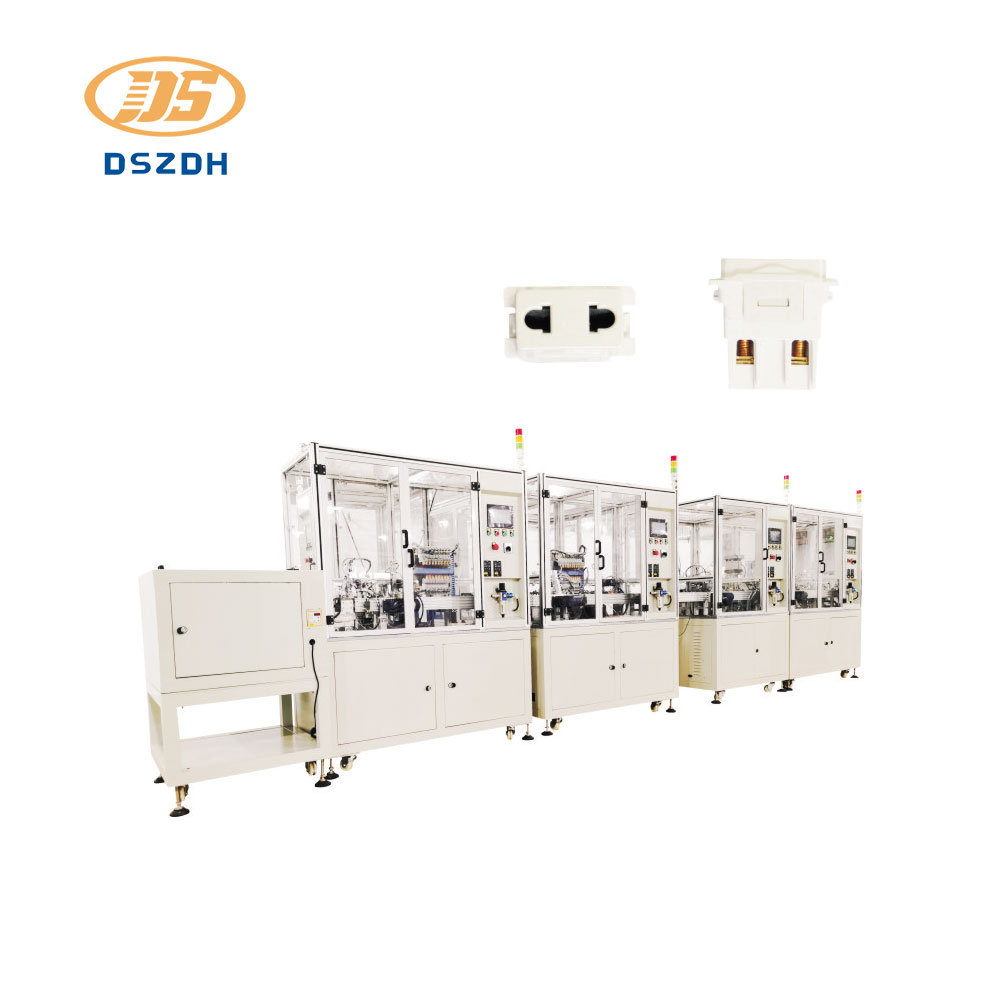
Why a Structured Maintenance Schedule Matters
A Two Plug Socket Automatic Assembly Machine integrates pneumatic actuators, servo motors, vision inspection cameras, and conveyor indexing systems. Each component degrades at a different rate. A reactive "fix-when-broken" approach leads to:
-
Unplanned stoppages (average 4–6 hours per incident)
-
Scrap rate increases from <0.5% to over 5%
-
Premature wear on cam followers and guide rails
-
Safety risks for operators
Desheng recommends a tiered maintenance strategy based on operating hours, not calendar days, because actual usage varies significantly between shifts.
The Complete Maintenance Schedule (By Frequency)
| Frequency | Tasks | Responsible Role | Estimated Time |
|---|---|---|---|
| Daily (Every 8 hrs) | Clean debris from indexing table; inspect terminal insertion pins for wear; check air pressure (5.5–6.5 bar); verify emergency stop functionality | Line Operator | 15 min |
| Weekly (Every 40 hrs) | Lubricate linear guides and cam followers (ISO VG-68 oil); tighten all electrical terminal connections; run a 50-cycle test with dummy sockets to check torque consistency | Maintenance Technician | 45 min |
| Monthly (Every 160 hrs) | Replace filter elements in air preparation unit; calibrate vision system reference points; measure servo motor belt tension (frequency 120–140 Hz); inspect all proximity sensors for metal debris | Senior Technician | 2.5 hrs |
| Quarterly (Every 500 hrs) | Perform backlash check on indexing cam; replace wear strips on socket carriers; update PLC firmware (if applicable); verify all torque drivers with a certified gauge | Maintenance Engineer | 4 hrs |
| Yearly (Every 2,000 hrs) | Full gearbox oil change (EP-220); replace all pneumatic hoses (age limit); servo drive capacitor health test; complete geometrical alignment using laser interferometer | External Specialist + Desheng Support | 8 hrs |
Critical Signs That Your Machine Needs Unscheduled Attention
Even with a perfect schedule, operators must watch for:
-
Unusual clicking noises during the crimping station
-
Rejected sockets exceeding 2% over two consecutive hours
-
Temperature rise on servo drivers above 65°C
-
Intermittent communication errors between HMI and PLC
If any of these occur, pause production and run the quick-diagnosis mode built into every Desheng Two Plug Socket Automatic Assembly Machine.
Pro Tips from Desheng’s Field Engineers
-
Use genuine spare parts – aftermarket sensors often have different switching frequencies, causing misalignment.
-
Keep a digital logbook – record each maintenance action with photos. Desheng provides a free template spreadsheet for all customers.
-
Train at least two operators on daily checks – redundancy ensures coverage during shift changes.
-
Never over-lubricate – excess grease attracts dust, which accelerates cam wear.
FAQ – Frequently Asked Questions About the Two Plug Socket Automatic Assembly Machine
Q1: How do I know if my Two Plug Socket Automatic Assembly Machine needs calibration, not just cleaning?
A1: Cleaning removes surface contaminants, but calibration affects dimensional accuracy. Run a standard reference socket (provided by Desheng) through the machine every morning. If the measured insertion force deviates by more than ±0.5 N from the baseline, or if the vision system reports a position error >0.1 mm on three consecutive cycles, calibration is required. Calibration involves adjusting the camera mounting brackets, updating the pixel-to-millimeter conversion factor, and resetting the servo homing offsets. This process takes about 20 minutes and should be performed weekly under normal conditions. If your production runs high-temperature materials (e.g., PBT+GF), calibration drift can happen faster – in that case, perform it every 3 days.
Q2: What is the most common cause of sudden failure in a Two Plug Socket Automatic Assembly Machine, and how can I prevent it?
A2: The most common sudden failure is jamming of the terminal feed mechanism, usually caused by bent coil terminals or foreign objects (e.g., broken wire strands) entering the feed track. This jams the escapement cylinder, which then overheats the solenoid valve. To prevent this, install a dual-stage magnetic filter on the terminal reel holder – Desheng offers this as a low-cost add-on. Additionally, run a "dry cycle" without terminals every 200 cycles to blow out debris using compressed air. Also, check the terminal straightness gauge daily; if more than 2 out of 20 terminals show a bend >0.3 mm, replace the entire coil reel immediately. This simple habit reduces unplanned jams by over 80%, according to Desheng’s service records.
Q3: Can I extend the yearly overhaul interval if my Two Plug Socket Automatic Assembly Machine runs only one shift per day?
A3: Yes, but with conditions. The yearly overhaul is based on 2,000 operating hours, not calendar months. If your machine runs one 8-hour shift (5 days/week), that totals roughly 2,080 hours per year – so the interval aligns naturally. However, if you run fewer hours (e.g., 6 hours/day), you can extend to 14–15 months provided that you still perform quarterly checks without skipping. The gearbox oil, however, has a shelf-life limit of 18 months regardless of hours, because condensation forms inside the housing. Therefore, Desheng recommends a maximum of 16 months between full overhauls, even with light usage. Always take an oil sample before extending – if it shows copper particles >50 ppm, change it immediately.
Summary Checklist – Daily Startup Routine
-
Visual inspection of all guard doors and interlocks
-
Air pressure reading (record in log)
-
Run 5 sample sockets – measure rejection rate
-
Listen for abnormal bearing noise near the main cam box
-
Confirm that the Desheng HMI shows no active alarms
Conclusion
A disciplined maintenance schedule transforms your Two Plug Socket Automatic Assembly Machine from a potential bottleneck into a reliable profit center. Daily cleaning, weekly lubrication, monthly calibrations, quarterly component checks, and yearly overhauls – when executed consistently – reduce total cost of ownership by up to 35% over five years. Desheng has supported over 200 factories worldwide with customized maintenance kits, remote diagnostic tools, and on-site training programs.
Contact Us
Every production environment is unique. Whether you need a tailored maintenance calendar, spare parts quotation, or a live demo of our latest Two Plug Socket Automatic Assembly Machine models, the Desheng engineering team is ready to assist. Contact us today via our website’s live chat or request a callback – we will send you a free maintenance logbook template and a 15-point health check scorecard for your existing machine. Let us help you keep your assembly line running smarter, longer, and safer.