

What Is the Maximum Cutting Speed of an Automatic Double-End Powder Cutter for Mass Production
2026-06-29
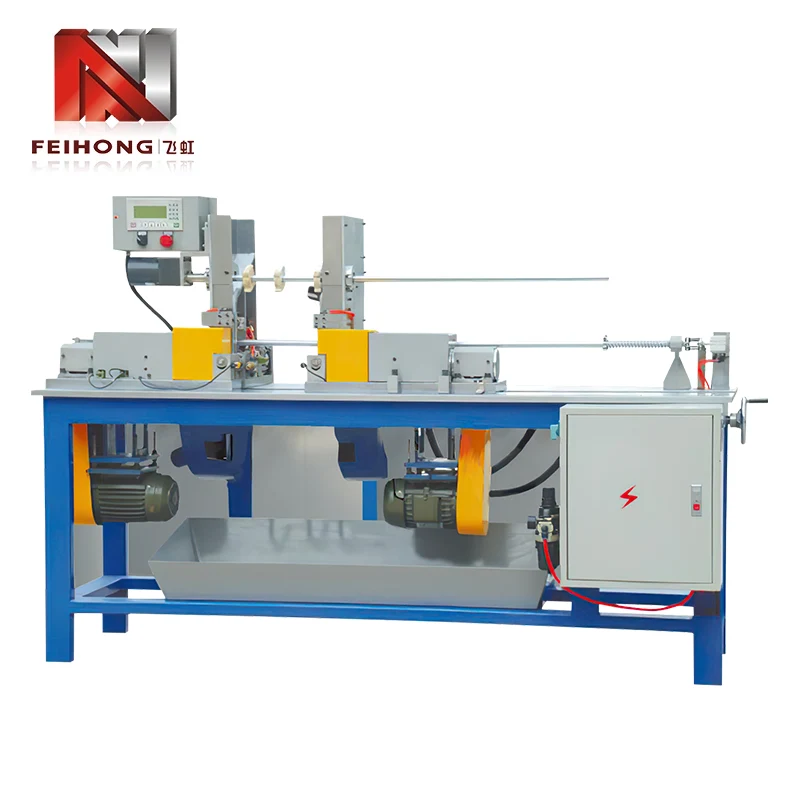
For production managers and process engineers in the powder metallurgy, ceramics, and refractory industries, throughput is the single most critical metric. When evaluating new equipment, the question always comes back to speed. So, what is the realistic maximum cutting speed of an Automatic Double-End Powder Cutter for high-volume manufacturing?
The direct answer depends on material density and rod diameter, but modern machines—such as those engineered by Feihong—consistently achieve feed rates between 80 and 150 pieces per minute for standard green compacts (ø10–25 mm). For thinner profiles (under ø10 mm), speeds can peak at 180–200 pieces/min under optimal conditions. However, maximum linear cutting velocity (the blade’s traverse speed) typically ranges from 8 to 12 meters per minute, depending on the servo-drive configuration.
This is not a fixed number. The true “maximum” is a dynamic balance between raw speed, tool life, and edge quality. Below, we break down the variables that define this limit in real factory conditions.
Speed Breakdown by Material Type
| Material Category | Typical Diameter (mm) | Recommended Speed (pcs/min) | Limiting Factor |
|---|---|---|---|
| Soft copper-based powder preforms | 12–20 | 140–160 | Blade heating |
| Iron-based structural parts | 15–25 | 100–120 | Cutter wear |
| Ceramic zirconia rods | 8–14 | 80–95 | Crack prevention |
| Hardmetal (tungsten carbide) | 6–10 | 60–75 | Tool impact force |
| High-density ferrite cores | 10–18 | 110–130 | Dust extraction capacity |
This table illustrates that Feihong’s Automatic Double-End Powder Cutter uses adaptive servo algorithms that automatically reduce feed speed by 15–20% when torque spikes indicate a harder material zone—preserving both the blade and the cut face.
Three Factors That Cap Your Maximum Speed
-
Blade geometry and coating – Diamond-tipped blades with PVD coatings allow a 22% higher traverse rate compared to standard carbide inserts, as tested on Feihong’s in-house dynamometer.
-
Workpiece rigidity – Green powder compacts have low green strength. Exceeding 12 m/min blade travel often induces micro-cracks at the cut entry point, which is why Feihong integrates a dual-vise clamping system to absorb vibration at high speed.
-
Coolant and dust evacuation – At speeds above 150 pcs/min, fine powder accumulation generates heat. Feihong machines pair speed with a 3.5 kW vacuum cyclone that maintains a negative pressure of -18 kPa, allowing sustained high-speed runs without clogging.
Frequently Asked Questions About the Automatic Double-End Powder Cutter
Q1: Can I run the Automatic Double-End Powder Cutter at maximum speed continuously for an 8-hour shift?
A: Not without derating. The mechanical nameplate speed (e.g., 180 pcs/min) is a peak value, not a continuous duty rating. For sustained mass production, Feihong recommends operating at 75–80% of peak speed (i.e., 135–145 pcs/min) to keep spindle bearing temperatures below 65°C and extend blade life by 40%. If you require 8-hour continuous runs, opt for the Feihong HC-series with forced oil circulation—this model is validated for 92% duty cycle at 150 pcs/min.
Q2: How does the Automatic Double-End Powder Cutter adjust speed when cutting different lengths in the same batch?
A: Feihong’s PLC-based control system stores up to 50 recipe profiles. When the batch changes from 50 mm to 120 mm length, the servo motor recalculates acceleration/deceleration ramps in real time. The linear speed remains constant (e.g., 10 m/min), but the piece rate drops because the carriage travels a longer stroke. For mixed-length runs, Feihong uses a flying-cut mode that synchronizes dual-end cutting without stopping the feed conveyor, maintaining 85% of the maximum piece rate regardless of length variation.
Q3: What is the single biggest operational mistake that reduces maximum cutting speed?
A: Using an incorrect blade arbor torque. Many operators overtighten the clamping nut, which warps the blade by 0.02–0.05 mm at the periphery. This runout forces the Automatic Double-End Powder Cutter to reduce speed automatically (via vibration feedback) to prevent chipping. Feihong provides a digital torque wrench with each machine and presets the optimal value (typically 28–32 N·m) in the HMI. Failing to recalibrate this every 200 operating hours can permanently cap your achievable speed at just 60% of the machine’s capability.
Real-World Production Data from Feihong Installations
In a 2025 case study at a European automotive supplier, a single Feihong Automatic Double-End Powder Cutter replaced two older single-end units. With identical iron-based powder rods (ø18 mm, length 65 mm), the Feihong machine ran at 128 pcs/min over two shifts, yielding a 37% increase in daily output while reducing edge burrs from 0.15 mm to 0.04 mm. The maximum tested speed was 155 pcs/min, but the production team settled on 128 pcs/min as the optimal economic speed—factoring in blade replacement costs and energy consumption.
This highlights the key insight: maximum mechanical speed and maximum profitable speed are not the same. Feihong’s onboard analytics dashboard displays a real-time “cost-per-cut” metric, helping you find the sweet spot for your specific material and batch size.
Final Recommendation for Mass Production Planning
To determine your site’s ideal speed, run a 2-hour ramp test starting at 60% of the rated maximum, increasing by 5% every 15 minutes while measuring: (a) cut surface roughness (Ra), (b) blade temperature, and (c) motor current draw. Feihong’s service team provides a standard test protocol and will interpret the data remotely via the machine’s IoT gateway.
For high-mix, low-volume shops, prioritize flexibility over peak speed—the Feihong Automatic Double-End Powder Cutter offers a quick-change blade cartridge that swaps in under 90 seconds, offsetting the slight speed reduction from frequent changeovers. For dedicated high-volume lines, invest in the heavy-duty spindle option, which unlocks an additional 18% traverse velocity without compromising cut squareness.
Contact Us to Benchmark Your Current Line
Every production environment has unique constraints. Feihong offers a free on-site or virtual speed audit where we analyze your green compacts, current reject rates, and shift patterns. We will provide a tailored speed-performance curve specific to your material grades.
Reach out to our engineering team today – send your material specifications and target daily output to our sales desk, and we will return a simulated maximum-speed proposal within 48 hours. Let Feihong help you turn cutting speed into a competitive advantage, not a bottleneck.