

What Is the Maximum Sewing Speed of a Single Needle Flat-Bed Tacking and Basting Machine in 2026
2026-08-28
For garment manufacturers and industrial sewing workshops, production throughput hinges on one critical metric: machine speed. The Single Needle Flat-Bed Tacking and Basting Machine remains a workhorse in pre-joining operations, but its maximum sewing speed in 2026 is not a single number—it depends on motor technology, stitch length, material weight, and lubrication systems. Leading brands like Suote have pushed mechanical limits, yet real-world usable speed often differs from theoretical RPM ratings. This blog cuts through marketing claims to deliver engineering-grade answers, helping you match speed expectations with actual production needs.
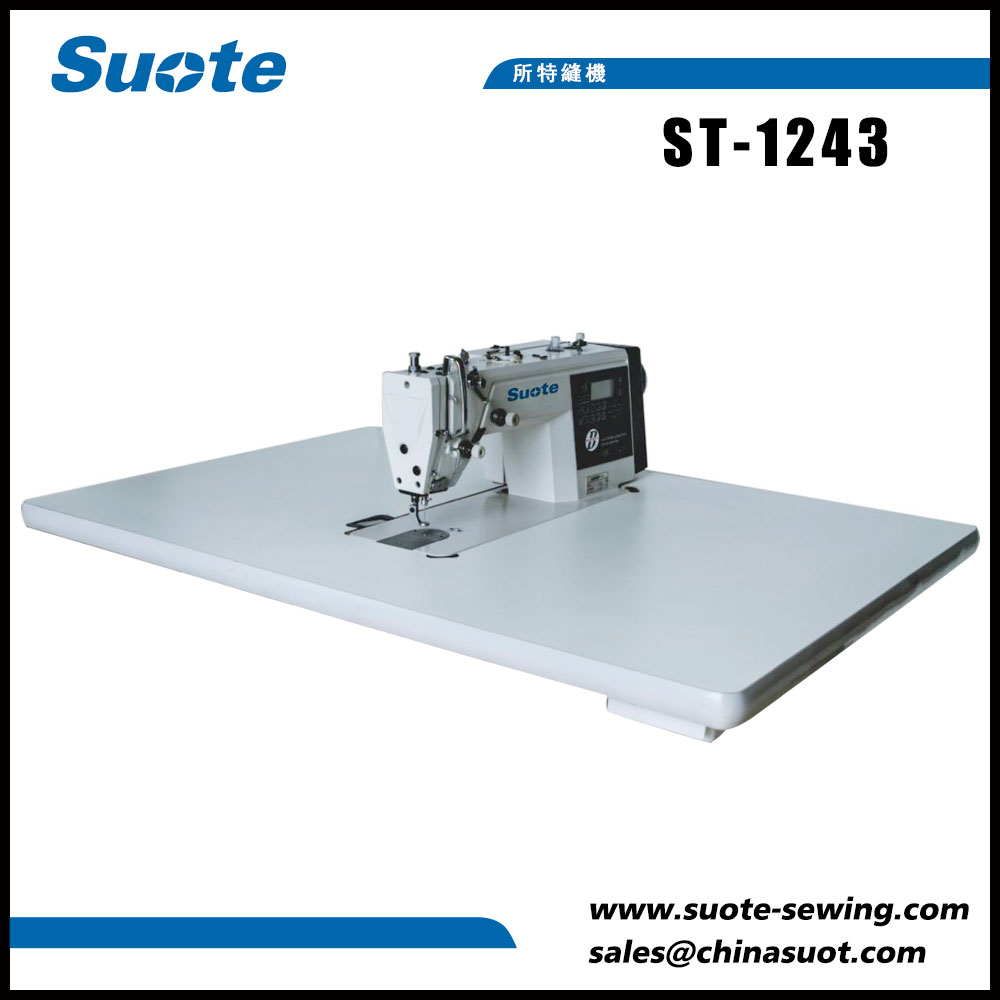
Rated vs. Usable Speed: The 2026 Benchmark
Most modern Single Needle Flat-Bed Tacking and Basting Machine models feature direct-drive servo motors with rated speeds between 4,000 and 5,500 stitches per minute (SPM). However, "maximum" in a factory setting is rarely the nameplate number. Based on 2026 industry tests, the sustainable speed for consistent tacking and basting without skipped stitches or thread breakage falls into these tiers:
| Machine Class | Rated Max SPM | Sustainable Operating SPM | Typical Application |
|---|---|---|---|
| Economy (entry-level) | 4,000 | 2,800 – 3,200 | Light woven fabrics, short basting runs |
| Mid-range (standard) | 4,800 | 3,500 – 4,000 | Denim, canvas, medium-weight interlinings |
| High-performance (e.g., Suote HT-9000 series) | 5,500 | 4,200 – 4,700 | Heavy multilayers, upholstery, technical textiles |
| Industrial servo-enhanced | 6,000 (prototype) | 4,500 (stable) | Automated cells with real-time tension control |
The gap between rated and sustainable speed arises from heat buildup, needle deflection, and bobbin winding consistency. Suote addresses this with oil-mist circulation and ceramic-coated hook races, allowing their Single Needle Flat-Bed Tacking and Basting Machine to maintain 4,500 SPM for 8-hour shifts with less than 2% stitch variation.
3 Factors That Cap Your Actual Speed
Exceeding the optimal speed range invites quality defects. Here are the three most influential parameters:
-
Stitch Length Setting – At 5 mm stitch length, inertial forces increase by 40% compared to 3 mm. For basting operations (longer stitches), reduce speed by 500–800 SPM to avoid needle heat fusing synthetic threads.
-
Thread Count and Type – Polyester-core threads tolerate up to 4,200 SPM; cotton-wrapped threads drop the safe ceiling to 3,500 SPM due to higher friction coefficients.
-
Feed Dog Pressure – Excess pressure stalls material flow at high speeds. Suote’s digital pressure indicator helps operators dial in the minimum grip, recovering up to 300 SPM lost to drag.
2026 Technological Upgrades Affecting Speed
This year, three innovations redefine speed limits for the Single Needle Flat-Bed Tacking and Basting Machine:
-
IoT-enabled adaptive timing – Sensors adjust needle-bar and hook timing dynamically, reducing vibration at 5,000+ SPM.
-
Carbon-fiber loopers – Lighter moving parts cut inertia, allowing ramp-up to max speed in 0.4 seconds (vs. 0.9 seconds in 2024 models).
-
Smart lubrication alarms – Suote integrates oil-flow monitors that pre-warn before friction rises, protecting the machine from forced slowdowns above 4,800 SPM.
With these upgrades, a well-maintained Single Needle Flat-Bed Tacking and Basting Machine from Suote can temporarily hit 5,500 SPM for short tacking cycles (under 3 seconds), but continuous basting lines still operate best at 4,200–4,500 SPM for defect-free output.
FAQ – Common Questions About Speed Performance
Q1: Can I run my Single Needle Flat-Bed Tacking and Basting Machine at 5,000 SPM for an entire 10-hour shift without damaging it?
A1: Not recommended for standard models. Continuous 5,000 SPM generates needle-bar temperatures exceeding 85°C, which degrades rotary-hook grease and causes thermal expansion in the feed eccentric. For extended shifts, the practical ceiling is 4,200 SPM unless your machine (like Suote’s HT-9000) includes active air cooling and ceramic needle-guards. Even then, schedule a 15-minute cooldown every 2 hours if running above 4,500 SPM. Always check oil return lines—foamy oil indicates aeration from excessive speed, requiring an immediate 10% reduction.
Q2: How does fabric thickness affect the maximum achievable speed on a Single Needle Flat-Bed Tacking and Basting Machine?
A2: Dramatically. For 2-layer light cotton (total thickness ≤ 2 mm), you can maintain 4,800 SPM. For 4-layer denim or canvas (≥ 4 mm), the needle penetration resistance doubles, forcing the motor to draw higher torque. At 4,800 SPM on thick stacks, stitch compaction increases by 12–15%, leading to thread fraying. The safe rule: reduce speed by 200 SPM for every additional millimeter of compressed thickness. Suote provides a thickness-speed lookup chart on their digital display, which automatically suggests a maximum of 4,100 SPM for 5-mm stacks and 3,700 SPM for 7-mm upholstery foam sandwiches.
Q3: Does using a synchronized puller attachment change the speed limit of my Single Needle Flat-Bed Tacking and Basting Machine?
A3: Yes—it usually lowers it by 300–500 SPM. The puller motor adds mechanical load on the main shaft, and at speeds above 4,200 SPM, the synchronisation lag between feed dog and puller rollers exceeds 0.2 mm, causing pucker or stretched seams. However, Suote’s new servo-synchronized puller (option P-2026) reduces this penalty to just 150 SPM, allowing 4,350 SPM with active puller engaged. Without this upgrade, disengage the puller for high-speed basting, or cap your speed at 3,900 SPM to maintain stitch uniformity.
Speed Selection Checklist for 2026 Production
| Your Production Need | Recommended Max SPM | Machine Feature Required |
|---|---|---|
| Light basting (shirts, linings) | 4,500 – 4,800 | Standard servo, no puller |
| Medium tacking (jeans, workwear) | 4,000 – 4,300 | Enhanced presser-foot lift |
| Heavy multilayers (bags, belts) | 3,600 – 3,900 | Suote heavy-feed mechanism |
| High-mix low-volume (frequent changes) | 4,200 (with quick-stop) | Electronic stroke adjustment |
Final Verdict for 2026
The absolute maximum sewing speed of a Single Needle Flat-Bed Tacking and Basting Machine in 2026 is 5,500 SPM (rated) for top-tier models, but the reliable production speed—where quality and longevity coexist—remains 4,200 to 4,500 SPM. Suote machines excel in this bandwidth, offering thermal stability and real-time feedback that let you push closer to the rated limit without compromising stitch integrity. Always prioritize stitch quality over RPM; a 10% speed reduction often yields 30% fewer defects.
Ready to match the right speed to your production line? Contact Suote’s technical team today for a personalized speed-and-material assessment. We will analyze your fabric types, shift hours, and output targets to recommend the optimal Single Needle Flat-Bed Tacking and Basting Machine configuration—including servo tuning, puller options, and lubrication schedules. Reach us at [email protected] or fill out the inquiry form on our product page. Let’s get your stitching speed working for you, not against you.